Place · week 45
Het Schip: the Amsterdam workers' palace that should never really have existed
In the Spaarndammerbuurt stands a building that looks as if an architect gave his imagination completely free rein. Undulating walls, strange towers, exuberant brickwork and windows that never seem to be the same. But Het Schip is much more than an architectural work of art. Behind the red bricks lies a revolutionary idea: why should only the rich be allowed to live beautifully? More than a hundred years ago, that idea gave rise to one of Amsterdam's most remarkable buildings.
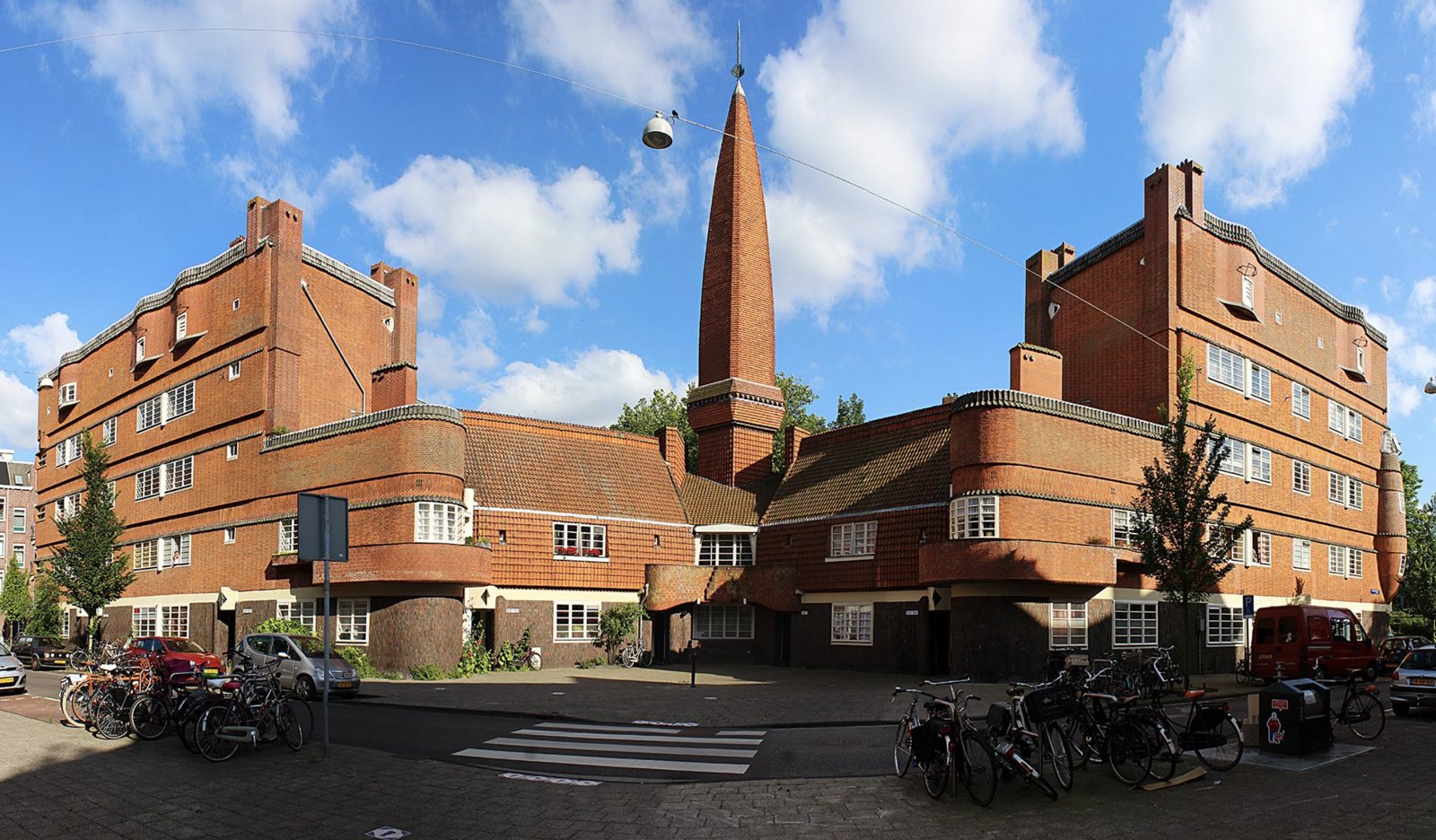
A ship in the middle of the city
Walk from the Spaarndammerplantsoen towards the Zaanstraat and you will see a building that barely resembles an ordinary Amsterdam housing block. The walls undulate. Corners are rounded. Bricks form patterns you would not normally expect on social rented housing. On one side a curious tower rises up. On the other, the façades seem to move through the street like the bow of a ship.
The building has something of an ocean liner that has run aground between the houses. Hence its name: Het Schip, the Ship. It was designed by Michel de Klerk, one of the leading architects of the Amsterdamse School, the Amsterdam School of expressionist architecture, and completed around 1920. But behind that remarkable appearance lies a story that goes far beyond architecture. It is a story about poverty, idealism, political struggle and a young architect who believed that ordinary workers, too, had a right to beauty.
Amsterdam was once a city full of slums
To understand how special Het Schip was, we have to go back to the Amsterdam of around 1900. The city was growing at a tremendous pace. Workers moved to Amsterdam to work in factories, docks and workshops. But there was hardly any decent housing available for all those people. Many families lived in small, damp rooms. Sometimes an entire family lived in a single room, where they cooked, ate and slept.
Sanitary facilities were poor. Running water could not be taken for granted everywhere, and fresh air and daylight were often lacking. Infectious diseases could therefore spread easily. The homes were not only uncomfortable. They were often unhealthy. At the end of the nineteenth century there was a growing awareness that something had to change. The authorities could no longer leave workers' housing solely to private slum landlords.
In 1901 the Woningwet, the Housing Act, was passed. A revolutionary step. The law made it possible to tackle bad housing and to give financial support to housing associations building better homes. But that still left one question unanswered. Just how beautiful were these new workers' homes actually allowed to be?
A young architect with big ideas
Michel de Klerk was born in Amsterdam in 1884. He grew up in a large Jewish family in the Jodenbuurt, the old Jewish quarter. His father was a diamond cutter. So De Klerk knew the poverty of the working-class districts not only from the outside. He saw at close quarters how people lived in cramped and poor housing. From an early age it was clear that he was an exceptionally good draughtsman.
He was given the chance to develop as an architect and worked, among other places, for Eduard Cuypers, in an architectural practice where several future representatives of the Amsterdam School got to know one another. De Klerk was not an architect who thought only in practical terms. He believed a building should evoke feeling. In his view, a house could be more than four walls and a roof.
It had to have character. Beauty. An identity of its own. And he did not believe that beauty was reserved for wealthy clients. It was precisely workers, who often put in long days in harsh conditions, who deserved a beautiful place to come home to. In the Amsterdam of the time, that was by no means a self-evident idea.
The housing association that wanted something special
The housing association Eigen Haard had been founded in 1909 to make better housing possible for people on modest incomes. In the Spaarndammerbuurt the association was given the opportunity to build new workers' homes. Michel de Klerk had already designed two remarkable housing blocks in the area. But with his third major project he went much further.
The site lay between the Zaanstraat, the Oostzaanstraat, the Hembrugstraat and the Spaarndammerplantsoen. An awkwardly shaped plot of land. Where a traditional architect might have designed a simple housing block, De Klerk saw possibilities. He designed a complex in which almost everything was connected. The façades, roofs, towers, doors, windows and even the smallest decorations. Nothing seemed accidental.
There were 102 homes, a post office and communal facilities. An existing school was incorporated into the whole. The result was a building intended not only to give people a roof over their heads. It also had to radiate pride. As if the residents were not living in an ordinary worker's house, but in a palace.
Palaces for workers
When the homes were completed around 1920, they were a huge improvement for many working-class families. They offered more comfort, light and space than many of Amsterdam's old workers' houses. There were amenities such as running water, gas and electric light. The building documents even specified precisely how the doorbells were to be made. The homes were not enormous flats, but were designed for the everyday life of ordinary families.
And that was exactly where the innovation lay. De Klerk devoted as much attention to these relatively modest homes as other architects did to villas and grand townhouses. He designed unusual window shapes, decorative façades and richly detailed entrances. Even elements that were not strictly necessary received attention. The idea was that architecture could give people dignity. A worker could be proud of his home.
And his children could grow up in surroundings that showed that beauty did not belong only to the well-off.
But the building became far too expensive
All those special details naturally came at a price. The bricks had to be laid in unusual patterns. Some shapes required special materials and techniques. The many ornaments and irregular façade elements made construction more complicated. The project became more expensive than usual. And that led to political debate. Why should a housing association spend so much money on decoration?
Surely that money could also be spent on more homes? The debate reached Amsterdam's city council. There the costs of Het Schip were discussed at length. The socialist alderman Floor Wibaut defended De Klerk. He acknowledged that the architect built expensively, but felt that the exceptional artistic quality justified the costs. According to tradition, he even called De Klerk the Rembrandt among architects.
It was a remarkable comparison. A young architect designing workers' housing was compared with one of the greatest artists in Dutch history. But the debate was really about a much bigger question. Should public housing be purely cheap and functional? Or could the city also invest in beauty for people with little money? Het Schip was the building in which those two views quite literally met.
The tower that serves no purpose at all
One of the most striking parts of Het Schip is the remarkable tower on the Hembrugstraat. It rises high above the homes and looks almost like a church tower. But anyone who thinks it contains a clock, a staircase, a lookout or a hidden room will be disappointed. The tower has no practical function. It is above all an architectural statement.
A decorative structure that gives the whole complex a distinctive silhouette. And that is exactly why it was so controversial. Critics thought it absurd to spend money on a tower that served no purpose. But for De Klerk that was the wrong way of thinking. Beauty did not always have to be practical. A remarkable tower could give residents something that could not be expressed in square metres or money.
Pride in their surroundings. The tower became one of the best-known symbols of the Amsterdam School. And it very nearly failed to withstand the ravages of time. During restoration surveys, parts of the supporting structure turned out to be seriously affected by corrosion. There was a danger that the tower would eventually lose its stability. Fortunately, it could be saved.
The tower that was once criticised for having no function turned out, a century later, to be one of the best-loved parts of the building.
A post office as a work of art
Perhaps even more remarkable than the tower is the former post office on the corner of the Spaarndammerplantsoen. In the early twentieth century a post office was an important amenity. People could send letters there, receive post and use financial services. In Het Schip it also had a social purpose: workers could collect their wages there, instead of being paid in the pub.
But De Klerk did not design an ordinary post office. He turned it into a complete work of art. The floor was given an unusual shape. The ceiling was vaulted. There were special counters, furniture and a telephone booth. And the colours were anything but standard. Purple-blue and lavender-blue hues defined the interior. The space seemed to belong more to an extraordinary theatre than to an office where people came to deal with their post.
De Klerk designed almost everything as a single whole. Not just the building itself, but also the interior and furnishings. The post office remained in use until 1999. After that it became part of Museum Het Schip. Today it is one of the most remarkable surviving post office interiors from 1920s Netherlands. The original colours have been restored after careful research.
And visitors can still see how De Klerk transformed even an everyday public space into something exceptional.
Windows you could hardly lean out of
Het Schip also contains details that seem surprising today. Take the placement of some of the windows. They sit strikingly high. That was not only an architectural choice. The client also had ideas about how residents ought to behave. In Amsterdam's old working-class neighbourhoods it was common for people to lean out of their windows, chat with the neighbours and keep a close eye on street life.
The designers of the new workers' housing wanted to create a different kind of living environment. A quieter family life. More privacy. And less emphasis on life in the street. The high windows suited that ideal. This shows that the new public housing was not only about better buildings. It was also underpinned by views on how people should live.
Architecture was meant to help shape the daily behaviour of residents. What seems a curious design detail today therefore tells us something about the social ideas of a hundred years ago.
The architect who barely outlived his masterpiece
Michel de Klerk was still young when Het Schip was completed. But his life would be tragically short. He died on 24 November 1923, aged just 39. He left behind a wife and children. And an impressive body of buildings, drawings and designs. Het Schip had become his most famous work. A building with which he had shown that social housing could also be architecturally exceptional.
His ideas would continue to influence Dutch architects for a long time. The Amsterdam School developed into a recognisable movement, with buildings in which imagination, craftsmanship and expressive forms took centre stage. De Klerk did not live to see the further development of that movement. But his building survived. And eventually it became an internationally renowned example of what social housing could be.
A century later: living in a monument
What is special about Het Schip is that it has not become solely a museum. To a large extent the complex is still a residential building. People live there. Bicycles are parked there. Groceries are carried in. Children grow up there. And behind the remarkable façades, ordinary Amsterdam life still goes on. That is exactly what the building was once intended for.
It was not designed as a palace for a king or as the headquarters of a wealthy company. It was designed as a place to live. For ordinary people. The housing corporation Eigen Haard still owns the complex. Over the years the homes have been renovated and adapted to modern requirements. Of the original 102 homes, 82 remain today.
Each time, a balance had to be struck between modern living comfort and preserving the remarkable architecture. In recent years the complex has been thoroughly restored. In 2015 the Getty Foundation supported this with a grant from its Keeping It Modern programme. Brickwork was repaired, special ornaments were reconstructed and fragile elements were given renewed attention. In this way the building has been preserved for future generations.
From workers' homes to a world-famous museum
In 2001 Museum Het Schip opened its doors. It began as a temporary initiative marking a hundred years of the Housing Act. But the museum proved so successful that it was given a permanent home. It tells the story of the Amsterdam School, the history of public housing and the architecture of Michel de Klerk. Visitors can do more than admire the exterior.
There is also a historic worker's home furnished as it was in the 1920s. There you can see how a family lived at the time. What furniture they had. What the kitchen looked like. And how daily life was organised. The museum also shows how great the difference was between the old slums and the new workers' homes. Because what may seem ordinary today was an enormous step forward at the time.
A home of your own with better sanitation, daylight and space. For many working-class families, that changed their daily existence. In this way the museum makes it clear that architecture is not only about buildings. It is also about the people who live in them.
Het Schip keeps dreaming about the future
Het Schip still stands as one of the most striking buildings in Amsterdam. More than a hundred years after Michel de Klerk designed his remarkable housing complex, the building is still used to reflect on housing, the city and the future. Museum Het Schip is now 25 years old. And on 6 November 2026 a new exhibition opens there: Bright New World. De kracht van verbeelding (The power of imagination). It runs until 1 August 2027.
It places visions of the future from the 1920s and 1930s, by figures including Berlage and Le Corbusier, alongside the work of contemporary makers such as MVRDV and Jonas Staal. The theme fits strikingly well with the history of the building. Because Het Schip, too, once began as a vision of the future. The idea that an ordinary worker could live in a beautiful home.
With amenities that could not be taken for granted in the past. In a building that was not only practical, but also inspired pride and wonder. What once seemed a utopian idea became reality in the Spaarndammerbuurt. And more than a hundred years later the building is still standing.
What Het Schip tells us today
Amsterdam once again has a major housing problem. There is a shortage of affordable homes. Young Amsterdammers struggle to find somewhere to live. Families are leaving the city because they can no longer afford the cost of housing. And new-build projects are the subject of constant debate about costs, quality and available space. That debate sometimes looks surprisingly similar to the debate of 1920.
How much may a home cost? Should it above all be quick and cheap? Or may we also invest in quality, character and beauty? Het Schip offers no simple answer to today's housing shortage. But it does show that a city can enjoy architecture for a hundred years when more has been invested in it than was strictly necessary.
The extra attention to design has turned an ordinary housing block into a monument. A building people travel to Amsterdam specially to see. Where architects from all over the world find inspiration. And where ordinary Amsterdammers still live. That is perhaps the most remarkable thing about Het Schip. It is at once an international architectural masterpiece and an ordinary residential building.
A museum and a home. A historic monument and a living part of the city.
The palace built for ordinary people
Anyone standing in front of Het Schip today is looking at a building that seems an impossible combination. A palace without a king. A ship that never sailed. A tower without a function. And a post office designed as if it were an art museum. But behind all those remarkable forms lies a simple idea. That the place where someone lives says something about how we see that person.
Michel de Klerk believed that workers did not have to settle for drab, unimaginative houses. He believed that they, too, had a right to beauty. That a family with little money could be proud of its front door. And that good public housing was more than a roof over your head. Het Schip proved that it was possible.
The original residents are long gone. The architect died more than a hundred years ago. But the building still stands. With its remarkable towers, undulating walls and hundreds of small details. And every day Amsterdammers walk past it. Perhaps without realising that they are looking at one of the finest social ideals in the history of their city.
Het Schip shows that remarkable architecture need not be only for remarkable people. Sometimes the most beautiful architecture comes about precisely when a city decides that ordinary people deserve something exceptional. And that makes Het Schip one of the most remarkable buildings in Amsterdam.
Sources
Stadsarchief Amsterdam (Het Schip, April 2019), Arcam (architecture guide), Museum Het Schip (including on the post office), Amsterdam op de kaart, Architectuur.org, NH Nieuws (Architect Michel de Klerk ontwierp honderd jaar geleden paleizen voor de arbeider [A hundred years ago architect Michel de Klerk designed palaces for the worker]), the Getty Foundation (Keeping It Modern, 2015) and the Amsterdams Dagblad on the exhibition Bright New World (October 2026). More information and opening hours: hetschip.nl.
Comments (0)
Log in to leave a comment.
More stories about Amsterdam
All stories →
The siege of Felix Meritis: the day Amsterdammers turned on each other over a war 1,500 kilometres away
Redactie Amsterdammers.love · 17 min read

Zoë van der Meer (16): the girl who no longer dared go to school, and wrote a book about it
Redactie Amsterdammers.love · 10 min read
Vlieger: the Amsterdam paper shop that has refused to be ordinary for 157 years
Redactie Amsterdammers.love · 15 min read