Event · week 45
The siege of Felix Meritis: the day Amsterdammers turned on each other over a war 1,500 kilometres away
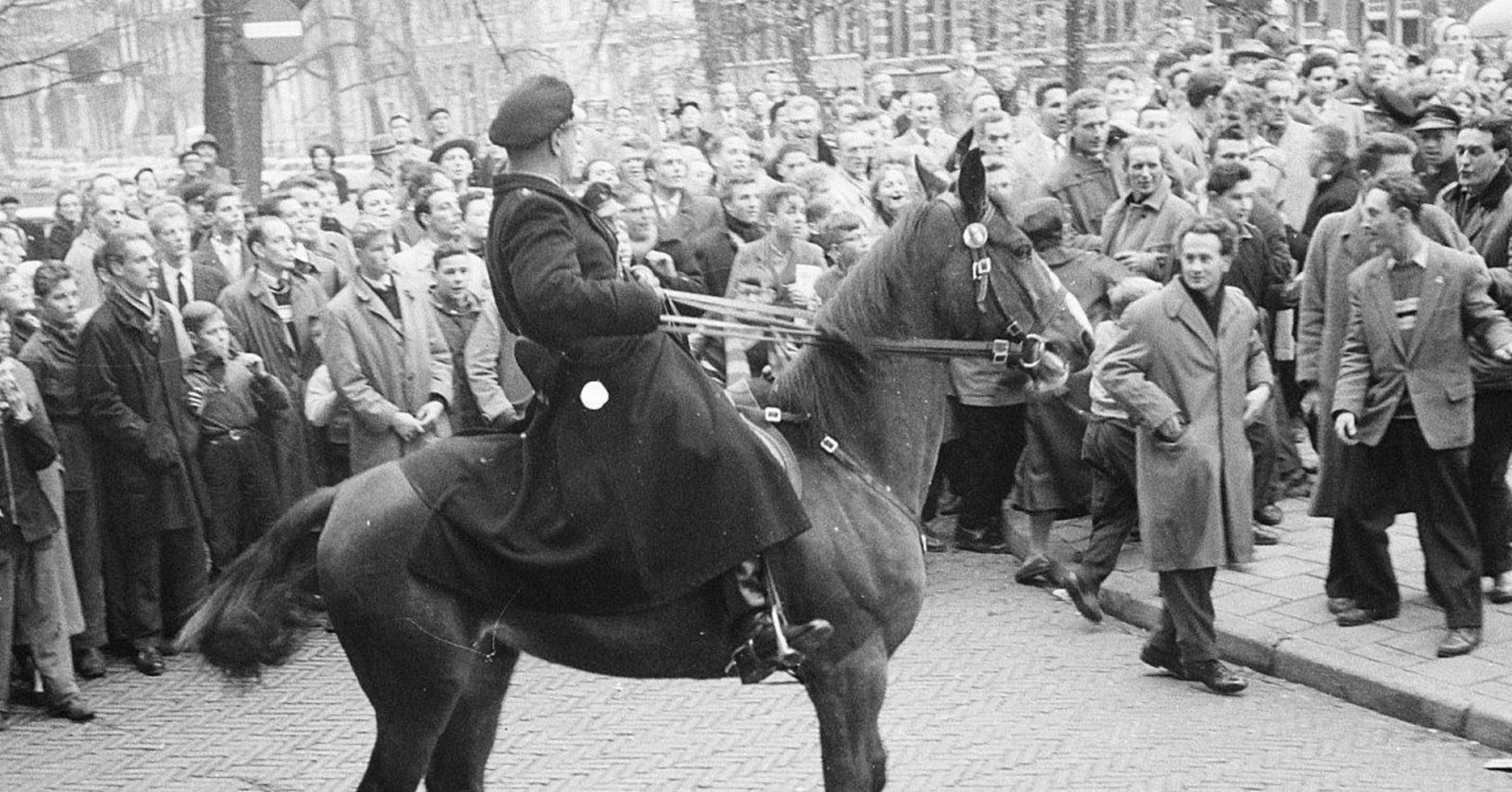
On Sunday 4 November 1956, a stately building on the Keizersgracht became a fortress under siege. Hundreds of furious Amsterdammers gathered outside the headquarters of the Communist Party of the Netherlands. Stones flew through the windows, attempts were made to set the building on fire, and inside, hundreds of communists prepared for a violent confrontation. The police lost control. The most remarkable part? The cause lay not in Amsterdam but in Hungary, where Soviet tanks crushed an uprising that same morning. Exactly seventy years later, this event tells a remarkable story about freedom, political conviction and the dangers of mass anger.
A Sunday morning that changed the Netherlands
It is Sunday 4 November 1956. The Netherlands is having a lie-in. For many families, Sunday is the only day off in the week. People go to church, visit relatives or stay at home listening to the radio. Television is still in its infancy. The news comes mainly from the radio. But this morning, something different from the usual Sunday programmes comes over the airwaves.
That morning, Dutch listeners are startled by a radio report from Budapest. Radio reporter Alfred van Sprang reports from the Duna Hotel that Soviet troops have invaded the Hungarian capital. Tanks are rolling through the streets. There is shooting. And the Hungarians, who had risen up against their communist government almost two weeks earlier, are fighting for their freedom.
For many Dutch people, the news brings back memories of the Second World War. The Netherlands has been liberated from the German occupation for only eleven years. And now, in another European country, something is happening again that many people regard as foreign military oppression. The outrage is enormous. In Amsterdam too. But on that early Sunday morning, no one can suspect that within hours the anger will erupt into one of the most remarkable political riots in the city's history.
What happened in Hungary?
To understand the events in Amsterdam, we need to go back to 23 October 1956. In the Hungarian capital, Budapest, students take to the streets. They demand political reform, more freedom and less influence from the Soviet Union. At that time Hungary is part of the Eastern Bloc. Although the country has its own government, it is tightly controlled by Moscow.
The demonstrations grow rapidly. Workers join in. Insurgents seize buildings and clash with the security forces. The reform-minded politician Imre Nagy becomes prime minister once again. For a moment it seems as though the Hungarians might regain their freedom. On 1 November, Nagy even announces that Hungary wants to leave the Warsaw Pact and become neutral.
For the Soviet Union, that is unacceptable. In the early hours of 4 November, Soviet troops pour into Hungary. The uprising is crushed by force. In the days that follow, thousands of Hungarians are killed. Around 200,000 people flee the country. To the outside world it is a shocking event. And in Amsterdam, that shock has a very particular effect.
Why the Keizersgracht?
At Keizersgracht 324 stands Felix Meritis. It is an imposing eighteenth-century building, originally built for a society devoted to the arts, science and social progress. But in 1956 the building has a very different function. It is the headquarters of the Communistische Partij Nederland, the CPN (the Communist Party of the Netherlands). The editorial offices and printing works of the communist newspaper De Waarheid ("The Truth") are also based there.
That newspaper has a remarkable history. During the Second World War, De Waarheid was published illegally, and communists played an important role in the Dutch resistance against the German occupier. But after the war the political climate changed. The Cold War divided Europe into two power blocs. On one side, the United States and its allies. On the other, the Soviet Union and the communist states of Eastern Europe.
The CPN remained closely tied to Moscow. When the Hungarian uprising broke out, the party largely adopted the position of the Soviet leadership. The communist party leadership portrayed the insurgents as reactionary forces intent on destroying socialism. That made many Dutch people furious. On the radio and in the newspapers they saw reports of Hungarian citizens fighting for their freedom.
But De Waarheid gave a completely different account. As a result, the building on the Keizersgracht became the symbol of everything the anger was directed against.
An unfortunate film screening
On that same Sunday morning, a strange scene is unfolding on the Nieuwendijk. At the Royal cinema, a special film screening is being held for readers of De Waarheid. That happens regularly. The communist newspaper often hires the cinema to show films from Eastern Europe. This morning's film has a striking title: The Tank Brigade Attacks.
The film comes from Czechoslovakia and glorifies the Soviet army's struggle against Nazi Germany. But that very morning, Soviet tanks are rolling through Budapest. The parallel is painful. The film had been scheduled long in advance, but now the title seems almost a provocation. During the screening, party official Henk Hoekstra appears backstage. He has bad news.
The gathering has to be cut short. The party leadership is expecting serious disturbances in Amsterdam. The film is stopped. The audience leaves the cinema. And party members are called on to come to Felix Meritis. There they are to help protect the building.
The first demonstrators gather
Towards midday, the first groups of people appear on the Keizersgracht. At first they are curious passers-by. Some stop to look. Others start shouting. But as the news reports from Hungary keep coming, the mood darkens. The crowd grows. Insults are hurled at the building. The people inside are branded traitors. And then a chant emerges that will be heard all day long.
De Waarheid kapot, Felix op slot! ("Smash De Waarheid, shut Felix down!")
More and more people take up the words. For the demonstrators, Felix Meritis stands for a party that is trying to justify the oppression in Hungary. For the communists inside, it is their own political home, built with contributions from members and sympathisers. Two groups of Dutch people face each other. And both are convinced they are on the right side of history.
The unexpected role of Simon Carmiggelt
One of the most remarkable incidents of that Sunday involves a well-known Amsterdam writer. Simon Carmiggelt. By 1956, Carmiggelt is already famous for his daily columns in Het Parool, which appear under the title Kronkel. He lives in Amsterdam and is known as a thoughtful, ironic observer of everyday life. Hardly the type you would expect to be a violent rioter.
But on 4 November, he too is deeply shaken by the news from Hungary. Together with his wife Tiny, he walks towards Felix Meritis. On the building hangs a display case containing a copy of De Waarheid. Carmiggelt reads how the paper describes the Hungarian insurgents. And suddenly he loses his self-control. He smashes the glass of the display case.
Whether he really punched the pane in or merely pushed it in, witnesses' recollections differ. But the glass breaks. Bystanders advise him to walk on. Carmiggelt refuses. He feels he is responsible for what he has done. When two police officers appear, he lets himself be taken away. Carmiggelt gets off relatively lightly. But in protest he writes no new Kronkels that week.
It is a remarkable moment. Even a writer famous for his gentle humour and humane observations is carried away by his anger on this day.
Inside, the defence is organised
While the crowd outside grows, the communists inside are preparing. Party officials call on members to come to Felix Meritis. Posts are set up. The entrances are guarded. And people search for objects with which to defend the building. Chair legs. Wooden sticks. Metal pipes. Anything usable is gathered. The defenders know the crowd outside is getting bigger and bigger.
Some communists are themselves deeply shocked by the violence in Hungary. Within the party there are serious doubts about Moscow's course. But that does not mean these members are prepared to leave their party building to an angry mob. For them, this is not just a political conflict. It is also about their personal safety.
And about the question of whether a group of people has the right to force their way into a building and silence others by violence. In the end, hundreds of communists gather in and around the building. Felix Meritis turns into a fortress under siege.
The stones start to fly
Over the course of the afternoon and evening, the situation gets completely out of hand. More and more people gather around the Keizersgracht. Stones are thrown at the building. Windows are smashed. The front door is attacked. According to historical accounts, demonstrators take a heavy grappling hook from a bridge. They use it to try to ram the doors open.
Inside, the communists try to hold their ground. Outside, the shouting is incessant. The police try to cordon off the street. But the officers fail to stop the violence. This is partly because the authorities initially underestimate the scale of the riots. There is also sympathy among officials and police officers for the anger over the events in Hungary.
That makes taking action against the demonstrators less straightforward. But the situation is becoming more and more dangerous. The protest against foreign oppression turns into violence against political opponents in the protesters' own city.
The attempts to set the building on fire
When evening falls, the mood on the Keizersgracht has grown even grimmer. Demonstrators throw burning rags and other flammable objects through broken windows. Attempts are made to set the building alight. For the people inside, this is a life-threatening development. Felix Meritis is a large historic building with several floors, corridors and halls.
There are many people inside. A serious fire could have disastrous consequences. The defenders try to fend off the attacks. Meanwhile, the feeling grows that they have been abandoned by the authorities. Party officials try to get help. But it takes time before the police are actually able to protect the building adequately.
It is one of the most disturbing aspects of the episode. The demonstrators are protesting against the crushing of a freedom movement. But at the same time, some of them are trying to force their way by violence into the headquarters of another political party. By now, the line between protest and political intimidation has been well and truly crossed.
Bottles of fizzy lemonade from the roof
Deep in the night, events reach an almost absurd climax. It is now Monday 5 November. At around three in the morning, defenders of Felix Meritis climb onto the roof. They have found a remarkable way to disperse the crowd below. Bottles of fizzy lemonade. The bottles are thrown down from the roof. But the demonstrators below do not know what is in them.
Some think hydrochloric acid is being thrown at them. Panic breaks out. People pull back. The action helps to ease the immediate pressure on the building. It is a strange detail in an otherwise very serious episode. A group of communists defending themselves with soft-drink bottles against an angry mob who think they are being attacked with a corrosive chemical.
But it also shows how improvised the defence was. The people inside had no professional security organisation. They had to protect themselves with whatever was available in the building.
The paper comes out as usual
After a night of violence, Felix Meritis is badly damaged. Windows have been smashed. There has been an attempt to force the door. The building has been attacked with stones and burning objects. But the demonstrators have not achieved their main goal. The communist newspaper De Waarheid comes out as usual the next morning. For the party leadership, that is an important victory.
The paper condemns the attacks on its buildings and speaks of organised vandalism. Its coverage of Hungary remains heavily influenced by the Soviet line. That once again provokes anger among many Dutch people. So the events are not over yet.
Monday 5 November: back on the streets
The next day, people all over the Netherlands come together to protest against the violence in Hungary. In Amsterdam too, large groups take to the streets, among them many students. They come from a range of political, social and religious backgrounds. Outrage at the Soviet invasion unites groups who often disagree on other issues. Speeches are made.
People speak of freedom, democracy and solidarity with the Hungarian people. But the call for measures against Dutch communists also grows louder. Some demonstrators even think the CPN should be banned. Emotions are still running high. And once again, the protests do not end peacefully everywhere. That evening, new riots break out. Violence is used again at Felix Meritis and other communist buildings.
By now the police are better prepared. They take a harder line against rioters. Confrontations break out in other Dutch cities too. So the unrest is not confined to Amsterdam. But it is the siege of Felix Meritis that becomes the best-known image of those days.
The role of the mayor
In 1956, the mayor of Amsterdam is Arnold d'Ailly. His response to the violence later becomes a subject of debate. When city councillor Wim Jansz repeatedly phones him that Sunday asking him to send police, D'Ailly replies that the population is incensed and that many officers are on leave. It later turns out that reserve staff were in fact standing by at police headquarters.
He is criticised because the police are said not to have acted forcefully enough against the attacks on communist buildings. Later historical studies describe how this initial reluctance made the situation worse. The problem was that political sympathy and the maintenance of public order threatened to become entangled. Many officials disapproved of the Soviet action.
But that did not mean people therefore had the right to attack political opponents. Precisely in a democracy, the government must also protect the safety of people whose ideas are strongly rejected. The events of November 1956 therefore became an important example of the dangers that arise when a government fails to keep sufficient distance from the emotions of an angry crowd.
The communists become increasingly isolated
The Hungarian uprising and the events in Amsterdam have major consequences for the CPN. Even before November 1956, there is discontent within the party about the policies of the Soviet Union. Earlier that year, Soviet leader Nikita Khrushchev condemned serious crimes committed by Stalin in a secret speech. This causes confusion among communists throughout Europe.
Some begin to doubt the political leadership in Moscow. Others continue to defend the Soviet Union. The invasion of Hungary deepens that division. In the Netherlands too, members leave the CPN. Members hand in their membership cards. The party loses hundreds of members, and thousands of readers cancel their subscriptions to De Waarheid. But perhaps the most important consequence is political isolation.
The CPN finds itself even further outside the Dutch political mainstream. For years to come, the party will struggle with the consequences of its stance on the Hungarian uprising.
Not just anger, but help too
Yet the story of November 1956 is not only a story about violence. At the same time, something else is happening in Amsterdam. While demonstrators are throwing stones on the Keizersgracht, other Amsterdammers are organising help for people fleeing Hungary. Collections are held. Families offer to take in refugees. Churches and civic organisations try to arrange shelter.
In the end, the Netherlands takes in around three thousand Hungarian refugees. How many of them ended up in Amsterdam is not known exactly. But the archives show that many residents of the city were willing to take people into their homes. One special example is the Vogel family. Andor Vogel, himself of Hungarian descent, lives with his family on the Michelangelostraat in Amsterdam-Zuid.
When Mrs Vardy and her son Peter flee Hungary, the family offers them a place to stay. They try to make the newcomers feel at home as quickly as possible. But it does not end there. A fourteen-year-old girl, Marianne, also comes to Amsterdam. She is Andor's niece and has lost her parents. The family decides to take her in as well.
Andor even gives up his study to make room for her. It is a small, personal story that has been preserved in the Stadsarchief Amsterdam (the Amsterdam City Archives). And it reveals a very different side of those November days. While one group of Amsterdammers vents its anger on the streets, another group of people is trying to actually help.
The two faces of Amsterdam
The events of 4 and 5 November 1956 reveal a striking contrast. On the one hand, an enormous commitment to the freedom of the Hungarians. On the other, the willingness of some demonstrators to use violence against people with different political convictions. Many Dutch people were rightly shocked by the violent suppression of the Hungarian uprising.
But that did not justify wrecking party buildings and threatening political opponents. During the riots, that distinction was sometimes lost entirely. At the same time, other Amsterdammers showed their concern by taking in refugees. Not with stones. But with a spare room. With food. With practical help. And with a willingness to adapt their own lives for a while for someone who had nowhere else to go.
They are two completely different responses to the same event. And both are part of Amsterdam's history.
The building that survived it all
Felix Meritis was ultimately not destroyed. The building survived. After the CPN era, it took on various new functions. Over the years it developed once again into a place for culture, debate and civic encounters. In recent years, the listed building has been thoroughly restored. Its remarkable halls and historic details were preserved and, where necessary, renewed.
Today the building once again has a public role. It hosts lectures, debates, performances, workshops and other cultural activities. In the spring of 2026, a new café also opened there: Felix Café. That gave the building an extra meeting place for visitors and Amsterdammers. It is a remarkable development. The same building that was attacked by an angry mob in 1956 because of the political ideas spread from it now presents itself, seventy years later, as a meeting place for a wide range of voices and perspectives.
4 November 2026: exactly seventy years later
Wednesday 4 November 2026 marks exactly seventy years since the siege of Felix Meritis began. Anyone walking past Keizersgracht 324 today sees a beautifully restored monument. Cyclists ride by. Visitors go inside for a cultural programme. And in the café, people are drinking coffee. Nothing about the calm façade immediately recalls the evening when an angry crowd stood shouting in front of the building.
There are no more stones lying in the street. The windows are intact. And the building is no longer guarded by men with chair legs and metal pipes. But the history has been preserved. Photographer Ed van der Elsken took striking pictures of the events. Press photographers from Anefo also captured the riots. Their photos show demonstrators and police officers facing each other on the Keizersgracht.
The Rijksmuseum holds several of Van der Elsken's photographs. The Stadsarchief Amsterdam has images and documents about the riots and about the reception of Hungarian refugees. As a result, seventy years on, the story can still be reconstructed. Not only from the perspective of the demonstrators. But also from that of the communists, the police, the journalists and the refugees.
How a distant war reached Amsterdam
What is remarkable about the siege of Felix Meritis is how quickly an international event can transform a city. In the early morning, the news from Budapest comes over the radio. A few hours later, people gather on the Keizersgracht. By the afternoon, an angry mob has formed. In the evening, stones fly through the windows.
And deep in the night, defenders throw bottles of soft drink from the roof to drive off their attackers. Within a single day, an international political crisis turns into a street battle in Amsterdam. That happened in 1956. Without the internet. Without social media. Without smartphones. Radio was enough to reach hundreds of thousands of people and stir deep emotions.
It shows that the speed with which news affects people is not something unique to our time. Seventy years ago, too, events on the other side of Europe could have a direct impact on daily life in Amsterdam.
The lesson of the Keizersgracht
The history of 4 November 1956 cannot simply be divided into good and bad Amsterdammers. The demonstrators were angry about a real tragedy. The Hungarian uprising was crushed by force and thousands of people lost their lives. But some demonstrators used that outrage as a pretext for intimidation and destruction. The communist party leadership defended an oppressive foreign intervention.
But the people in Felix Meritis had just as much right to protection from violence. And while those groups faced each other, other Amsterdammers decided to offer refugees a safe home. That is what makes the episode so remarkable. It tells us not only something about the Cold War. But also about how people react when their convictions, fears and emotions are running high.
About the power of solidarity. But also about the dangers of casting political opponents as enemies. And about a government's responsibility to protect everyone's safety, even when public opinion turns en masse against a particular group.
The Sunday the Cold War came to Amsterdam
On 4 November 1956, there were no Soviet tanks in Amsterdam. There was no foreign occupier. And no war between two countries was being fought on the Keizersgracht. Yet for many of those present, it felt as though the Cold War had suddenly reached their own street. The feelings that set Europe against itself converged in front of a single Amsterdam building.
In shouting. In anger. In broken glass. And in fear. Seventy years later, Felix Meritis is once again a place where people come together to exchange ideas. That is perhaps the most beautiful contrast in this history. A building that was once attacked because a contested political conviction was propagated there is now once again a home for encounter and discussion.
And on the other side of the city, Hungarian refugees found a place back then with Amsterdammers who opened their doors. The siege of Felix Meritis shows how quickly anger can turn people against one another. But the reception of Hungarian refugees in those same days also shows that concern for the freedom of others can take a very different form.
Sometimes with a stone through a window. But fortunately also with a door opened for someone. And that makes 4 November 1956 one of the most remarkable events in the history of Amsterdam.
Sources
Ons Amsterdam (4 november 1956: Amsterdammers bestormen Felix Meritis [4 November 1956: Amsterdammers storm Felix Meritis]), IsGeschiedenis (Hans Olink, Amsterdam en de Hongaarse opstand van 1956 [Amsterdam and the Hungarian uprising of 1956], with recollections from eyewitnesses such as Simon Carmiggelt), Stadsarchief Amsterdam (Hongaarse vluchtelingen in 1956 [Hungarian refugees in 1956]), Historiek (De CPN en de Hongaarse opstand [The CPN and the Hungarian uprising]), Rijksmuseum (photographs by Ed van der Elsken) and Felix Meritis. You can find Felix Meritis at Keizersgracht 324.
Comments (0)
Log in to leave a comment.
More stories about Amsterdam
All stories →
Vlieger: the Amsterdam paper shop that has refused to be ordinary for 157 years
Redactie Amsterdammers.love · 15 min read
Record Palace: the Amsterdam record shop where world stars simply browse the crates
Redactie Amsterdammers.love · 16 min read
Fred Oosting (76): sixty years on the Waterlooplein, from old mops to tourist souvenirs
Redactie Amsterdammers.love · 10 min read