Shop · week 45
Vlieger: the Amsterdam paper shop that has refused to be ordinary for 157 years
On the Amstel there is a shop where time has stood still a little. Behind the simple façade lie hundreds of stacks of paper, from wafer-thin Japanese paper to colourful card and unusual materials for artists. The shop is called Vlieger and has existed since 1869. It began with a boy who, at the age of thirteen, travelled round North Holland's schoolmasters with a box of cigars and some school supplies. Later his business grew into a publishing house that distributed millions of children's booklets. The company nearly went under. But in 2026 Vlieger is still here, as one of the most special independent shops in Amsterdam.
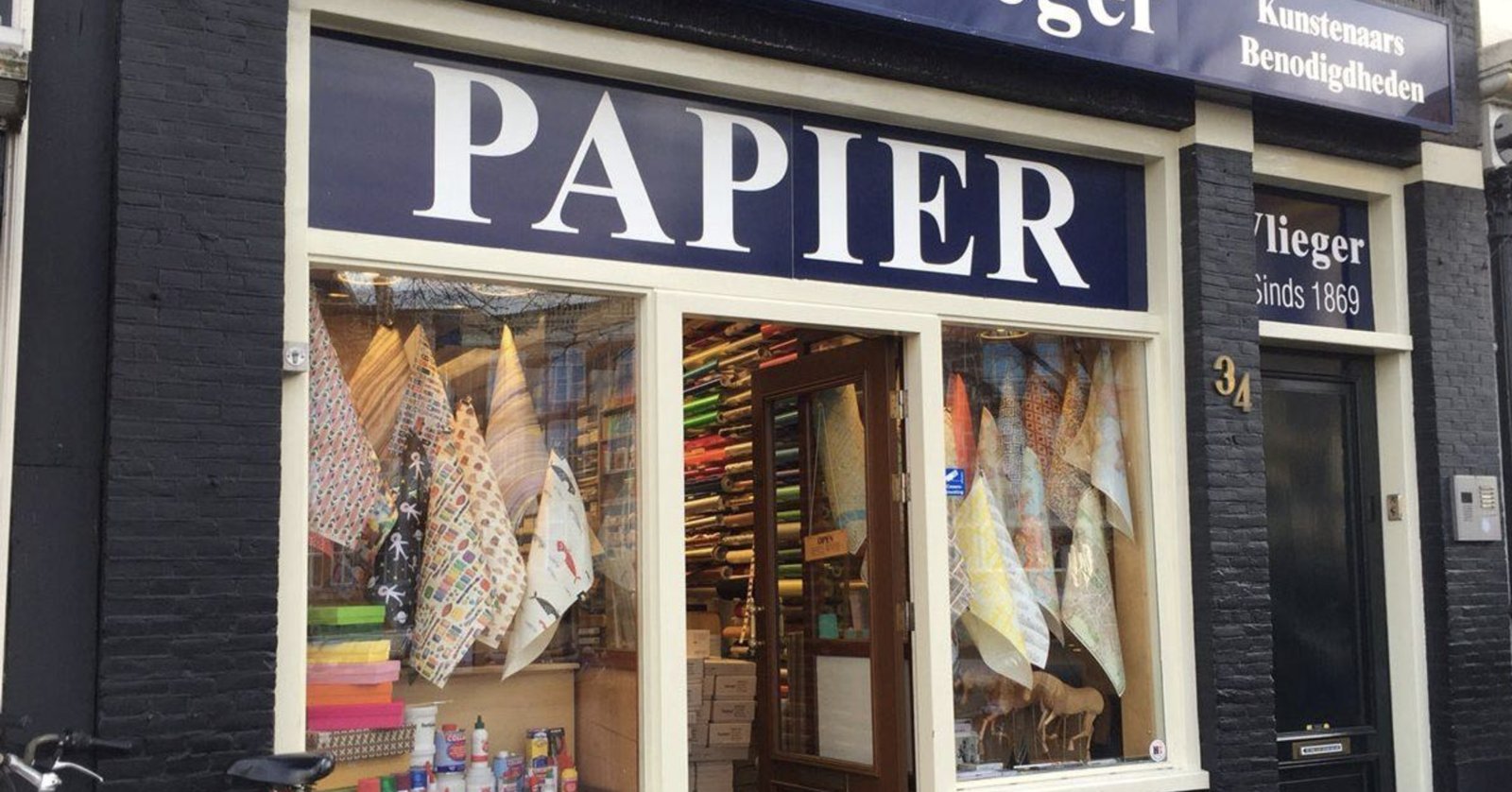
A shop full of paper
Walk along the Amstel, close to the Halvemaansteeg, and at number 34 you will see a strikingly simple shopfront. Dark blue with white letters. PAPIER. No trendy brand name, no screens with special offers and no complicated retail concept. Just paper. But step inside and you discover that this single word hardly does justice to everything there is to find.
Inside, the shop seems bigger than you would expect from the outside. Wooden compartments and shelves are filled with sheets of paper in hundreds of colours, types and textures. There is handmade paper, Japanese paper, watercolour paper, card and paper so thin it looks almost translucent. Elsewhere there are envelopes, notebooks, glue, tape and materials for bookbinding.
There are products almost everyone recognises. But also materials you didn't even know existed. Vlieger is a shop you walk into for a sheet of paper and easily end up browsing for much longer. For artists, designers, students and paper lovers it has been a trusted address for generations. And behind the name lies a history that goes back to a time when Amsterdam had no electric trams, telephones or modern department stores.
The farmer's son who came to Amsterdam
The story does not begin in Amsterdam, but in Landsmeer. That is where Jan Vlieger was born on 10 November 1844. He was the youngest of six children. His father Abel was a cattle farmer. But the small farm did not bring in enough to support the whole family. Around 1855 the family moved to Amsterdam. Jan was about eleven years old.
His parents started a dairy shop on the Prinsengracht, on the corner of the Oude Looiersstraat. The milk was brought from Landsmeer to Amsterdam by barge. For young Jan there was little time for a long schooling. After six years of primary school he started work. First as an apprentice at a printing works.
There he fell out with his boss. He left and found other work in the printing trade. Eventually he ended up with bookseller Herman Koster, who had a shop on the Haringpakkerij, close to the Nieuwendijk. That turned out to be the beginning of a lifelong bond with paper.
A thirteen-year-old travelling salesman with cigars
One of the strangest stories in the history of Vlieger takes place when Jan was just thirteen. His employer Herman Koster wanted to sell more school supplies. That meant finding new customers. Not just in Amsterdam, but also in the North Holland countryside. Koster sent young Jan on the road. He was given a sample kit with pens, pencils, exercise books, slates and slate pencils.
And a box of cigars. The cigars were meant to make conversations with head teachers go a little more smoothly. It was a time when there were hardly any railway lines in North Holland. Jan travelled by trekschuit (horse-drawn canal boat), farm cart or simply on foot. He visited schoolmasters and tried to persuade them to order their supplies from Koster from then on.
According to the family story, the boy returned with a sizeable pile of orders. Whether it really went as spectacularly as was later told is not entirely certain. The story has probably been embellished somewhat over the years. But it does say something about the time in which Jan grew up. A child of thirteen could simply be sent off on a sales trip.
Child labour was entirely normal in the nineteenth century. For Jan it was also a tough schooling. He learned to sell, to negotiate and to deal with customers. Skills with which he would later build an impressive business.
The boss leaves for the Dutch East Indies
Jan's life took a new turn because of his employer's personal problems. Herman Koster had by then opened a second shop on the Halvemaansteeg. He lived above the shop with his wife Alida and their children. But the marriage was going badly. There were many rows. And Herman saw less and less future in his family life.
In 1862 he was given the opportunity to work at the Landsdrukkerij (the government printing office) in Batavia, present-day Jakarta. He decided to leave the Netherlands. His wife and children stayed behind. At first the shop remained his property, but in practice the business was increasingly run by young Jan Vlieger. Jan knew the customers. He knew which products sold well.
And by then he had gained years of experience. Eventually he was given the chance to take over the business.
1869: the birth of Vlieger
On 1 February 1869 Jan Vlieger officially set up on his own. He was 24 and would turn 25 later that year. The shop was at Halvemaansteeg 9. The range consisted of office supplies, school supplies, drawing materials, paper, books and prints. But Jan had bigger ambitions. He did not want only to sell what others made. He also wanted to become a publisher himself.
And for that he saw a special market. Children's books. Not the expensive books that mainly well-off families could afford. But cheap, colourful booklets for ordinary children. In nineteenth-century Amsterdam that was a promising venture. More and more children were learning to read. And thanks to new printing techniques it became possible to produce illustrated books more cheaply.
Jan Vlieger decided to make the most of that.
Fourteen thousand children's books!
In the autumn of 1870 his first big catalogue appeared. It listed all kinds of items customers could order. Pens. Pencils. School bags. Drawing folders. Ink. Paint boxes. But above all Jan had come up with a special advertising message. He announced no fewer than 14,000 picture books. With several exclamation marks. It sounded as though his shop had an unimaginably large collection. In reality it amounted to about nine different titles, available together in a print run of some 14,000 copies.
A clever sales trick. And it worked. Jan discovered that there was a lot of money to be made from cheap picture booklets. He bought existing printed sheets abroad. Sometimes he had English captions blacked out with black bars, after which the prints could be reused for Dutch editions. At other times he bought up remaining stock from publishers who were closing down.
He had books rebound, adapted titles and brought them onto the market under his own name. Today some of those methods would raise questions about copyright. But in the nineteenth century the rules and trading practices were different. Jan was above all a resourceful entrepreneur. He saw opportunities where others saw leftover stock.
The one-cent booklets
Vlieger's real strength lay in the price. The cheapest picture booklets cost just one cent. That put them within reach of families who did not have much to spend. A labourer could take a little book home for his children after a long working day. With colourful pictures and simple stories. There were fairy tales such as Little Red Riding Hood, Cinderella, Tom Thumb and Puss in Boots.
There were also ABC books in which children learned to recognise letters. There were books about animals, trades and the world around them. And of course Sinterklaas booklets. Vlieger became a major publisher of the well-known story of Saint Nicholas and his servant, originally written by the Amsterdam schoolmaster Jan Schenkman. Those editions also spread the figure of Zwarte Piet (Black Pete).
That belongs to a part of Dutch cultural history that is viewed critically today. Other titles from the list also contained racist stereotypes and views that were widely spread at the time but are now rightly being questioned. It shows that the history of Vlieger is not only about entrepreneurship. It also tells us something about how books helped shape the ideas of generations of children.
A thousand different picture books
The publishing house grew at lightning speed. Between 1870 and 1930 around a thousand different picture books appeared under the Vlieger name. Some titles were reprinted time and again. Little Red Riding Hood appeared in about 25 editions over the years. Cinderella in twenty. And the ABC books and other stories were popular too. Jan developed a strikingly efficient way of producing them.
He had enormous numbers printed and kept prices low. That allowed him to reach a broad audience. The booklets were often printed at the Stoom-Steendrukkerij Amand (a steam lithographic printing works) on the Warmoesstraat. At that time the firm grew into a large printing works with around a hundred employees. The cooperation between publishers and modern printing works made it possible for more and more Amsterdam children to gain access to cheap illustrated stories.
The little shop in the Halvemaansteeg had meanwhile grown into an important player in the Dutch publishing world.
The whole corner became Vlieger's
Jan earned well from his business. In 1871 he moved to a roomier shop across the street, Halvemaansteeg 6. There was more space for his stock and behind the shop was a small warehouse. But that was not enough. In the years that followed he bought various buildings in the area. On the Halvemaansteeg.
On the Amstel. And in the nearby Schuitenvoerderssteeg. The business grew so strongly that a large part of the corner of Halvemaansteeg and Amstel eventually belonged to his property holdings. Jan even had plans for a completely new retail complex. In 1902 he submitted a plan to the city council to demolish several old buildings. In their place he wanted to put up a four-storey building.
With a large shop. And eighteen homes. In effect a small department store. But the council did not give permission. The ambitious new-build plan did not go ahead. As a result, the old shopping area survived for longer. A remarkable twist, because today it is precisely the historic character of the neighbourhood that forms an important part of its appeal.
From the Halvemaansteeg to the whole city
Vlieger did not remain limited to one shop. Branches opened in other parts of Amsterdam. Among them in the Huidenstraat, the Rapenburgerstraat, on the Leliegracht and on the Damrak. That last branch in particular took on a special role. Amsterdam was attracting more and more visitors. And photography was developing fast. Picture postcards became popular. People wanted to send images of the city to family and friends.
Jan Vlieger once again saw an opportunity. His business also started publishing picture postcards. So images of Amsterdam became part of the range. The shop that had once started with school supplies and children's books was now also selling pictures of the city itself. For tourists they were souvenirs. For people who lived elsewhere, a way to receive a little piece of Amsterdam.
And for historians those old picture postcards are now remarkable documents. They show what the city looked like more than a century ago.
The family keeps the business going
Jan Vlieger died in 1908. His business was continued by his three sons: Frits, Abel and Gerrit. They had started in the business at a young age. Like their father, they had learned the trade in practice. The company remained an important name in Amsterdam. But the world was changing. Competition increased. Publishing cheap picture books no longer automatically produced the same results.
And during the economic crisis of the 1930s the company ran into serious trouble. Bankruptcy was averted by selling a large part of the property to the City of Amsterdam. The business then rented the buildings back. It was a drastic step. The family that had once come to own a large part of the shopping corner had to give up its property again to save the business.
But the shop survived.
The third generation chooses a new direction
In 1950 grandson Gerrit Jan Vlieger took over the management. He belonged to the third generation. But he inherited a business that no longer held the same position as in his grandfather's day. The branches gradually disappeared. The publishing of picture books and picture postcards was also wound down. Gerrit Jan decided to focus on the products the business had once started with.
Paper. Office supplies. And materials for artists. With that, Vlieger changed once more. From a large publishing house with several branches to a specialist shop. A shop for people who wanted to make something special. Artists. Graphic designers. Students. Bookbinders. And anyone looking for a type of paper you would not easily find in an ordinary stationer's. It proved to be an important decision.
Because it was precisely that specialisation that would ensure the Vlieger name lived on into the twenty-first century.
The moment Vlieger almost disappeared
Gerrit Jan Vlieger died in 1989. By then the business was no longer in the hands of the original family. Shortly after his death the shop was extensively renovated. But the costs ran high. Too high. The financial problems became so serious that the shop's survival was once again in danger. In 1993 came a restart.
The large historic premises were abandoned. Vlieger moved to a smaller building at Amstel 34. About a hundred metres from the spot where Jan Vlieger had started his business in 1869. It could have been the end of a shop name that had by then existed for more than 120 years. But once again it proved to be a new beginning.
The shop became more compact. The huge publishing house had long since gone. And the branches were a thing of the past too. What remained was a special paper shop. With a name that generations of Amsterdammers still knew.
A thousand kinds of paper
In 2019 the magazine Terdege published a feature about the shop. In it, staff member Mick Lemminga was interviewed. By then he had already worked at Vlieger for 25 years. And he knew the range almost by heart. The shop had around a thousand different kinds of paper. From large sheets of glitter card to very fine Japanese restoration paper. Some products sold every day.
Others sat in stock for months before anyone asked for them. But according to Mick that was part of the character of the business. A special paper that sells only once every six months may be precisely the reason an artist makes a special trip to Vlieger. That is a very different way of shopping from the big chains.
There, it is often all about products that sell quickly. At Vlieger there is also room for materials that only a small group of customers are interested in. The range is not just a collection of the most popular products. It is also a collection of knowledge. Because anyone who sells a thousand kinds of paper has to understand the difference between them.
How heavy is the paper? How does it behave with ink? Is it suitable for watercolour? Can it be folded without cracking? Can it be used for book restoration? Those are questions you cannot always answer just by looking at a price tag.
A shop where you still get advice
In 2020 historians Dirk J. Tang and Sytze van der Veen described the history of Vlieger in Ons Amsterdam. They named Mick Lemminga and Rob Willems as the people running the shop. That same year the book Vlieger in vogelvlucht, 1869–2020 (Vlieger at a glance) was published, recording the history of the business in detail. That gave the shop something special.
A history book of its own. Not because it is a big listed company. But because the history of this one shop says a great deal about Amsterdam. About child labour in the nineteenth century. About the rise of mass-produced children's books. About the development of retail. About the economic crisis. And about the way an independent business has to adapt again and again.
In the shop itself that history can still be felt. Not because everything has stayed exactly the same. But because the specialisation in paper has never entirely disappeared.
A paper shop in a digital world
The world of 2026 hardly resembles that of 1869. Many people write fewer letters. Companies send documents digitally. Books are ordered online. And anyone who needs an exercise book or a pen can choose from countless web shops. Yet Vlieger still exists. What's more, on its own website the business presents itself as a shop where you can discover special materials that are not available everywhere.
The range includes Japanese paper, card, envelopes, bookbinding materials, notebooks, tape, glue and drawing and painting supplies. Vlieger also sells special lighting filters, paper on rolls and materials for creative projects. These are products that remain attractive precisely in a digital world. Because you want to feel them. Look at them. Compare them. And sometimes only understand what you can do with them once you hold them in your hands.
An image on a computer screen can show what colour a sheet of paper is. But not exactly how it feels. How the light falls on it. Or how sturdy it is. That is what makes a specialist paper shop different from an ordinary web shop.
157 years and still open
Vlieger has now been around for more than 157 years. The shop is still located at Amstel 34. The official website lists the products, contact details and opening hours. The company registration is also still active in 2026. So the shop has by now existed longer than many of the well-known retail chains operating in the Netherlands. That does not mean nothing has ever changed.
The Vlieger family has not been involved as owner for decades. The publishing house has gone. The branches no longer exist. And of the great retail empire Jan Vlieger once built, one specialist shop eventually remained. But perhaps that is exactly what makes it special. The shop has not clung to everything that used to be successful.
It has adapted. From children's books to office supplies. From picture postcards to artists' materials. From a large company to an independent specialist shop. And all the while the name survived.
Why a city needs shops like this
Amsterdam is constantly changing. Old shops disappear. New entrepreneurs start up. And shopping streets increasingly feature the same international brands. That is not only the case in Amsterdam. But in a city with so much history it is especially noticeable when special shops disappear. Because a shop is sometimes more than a place where something is sold. It can also be a place where knowledge is preserved.
Where people have been coming for years. And where the owner or staff member knows exactly what you are looking for, even when you can't quite describe it yourself. Vlieger is that kind of shop. You don't have to be a professional artist to enjoy it. Someone looking for a special sheet of wrapping paper, wanting to make an invitation or simply curious about beautiful materials can browse there too.
The shop shows that there is still room for independent entrepreneurs who do not try to sell everything to everyone. But who want to be especially good at one thing. In Vlieger's case, that is paper.
The shop that survived
Perhaps the most wonderful thing about Vlieger's history is how often the business could have disappeared. The young founder who came to Amsterdam without much money. The employer who left for the Dutch East Indies. The economic crisis in which the family business had to sell its property. The declining interest in picture books. The vanished branches. And the costly renovation that eventually led to a restart in 1993.
Each time the business changed. But the name remained. So whoever walks into Amstel 34 today is not just stepping into a paper shop. They are stepping into a piece of Amsterdam's trading history. A history that began with a farmer's son from Landsmeer. A boy who at thirteen travelled round North Holland's schoolmasters with school supplies and a box of cigars. Who later helped distribute millions of children's booklets.
And whose name, more than a century and a half later, still stands above an Amsterdam shop door. Vlieger shows that a special shop does not have to be the biggest, the most modern or the cheapest. Sometimes it is exceptional enough when a shop knows exactly what it wants to be — and manages to keep that up for 157 years.
And that makes Vlieger one of the most special shops in Amsterdam.
Sources
Vlieger Amsterdam (vliegerpapier.nl, history and shop information), Ons Amsterdam (Dirk J. Tang and Sytze van der Veen, Boek & Papierhandel J. Vlieger, September 2020), AT5 (Papierwinkel Vlieger bestaat 140 jaar [Paper shop Vlieger turns 140], February 2009), Terdege (Papier in duizend soorten [Paper in a thousand kinds], October 2019) and the book Vlieger in vogelvlucht, 1869–2020 by Jeannette Kok, Dirk J. Tang and Sytze van der Veen (De Buitenkant, 2020). You'll find Vlieger at Amstel 34.
Comments (0)
Log in to leave a comment.
More stories about Amsterdam
All stories →
The siege of Felix Meritis: the day Amsterdammers turned on each other over a war 1,500 kilometres away
Redactie Amsterdammers.love · 17 min read
Record Palace: the Amsterdam record shop where world stars simply browse the crates
Redactie Amsterdammers.love · 16 min read

Fred Oosting (76): sixty years on the Waterlooplein, from old mops to tourist souvenirs
Redactie Amsterdammers.love · 10 min read