Shop · week 44
Record Palace: the Amsterdam record shop where world stars simply browse the crates
Right opposite Paradiso, on the Weteringschans, there is a small record shop where remarkable things sometimes happen. A world-famous guitarist who finally finds a record he has been hunting for twenty years. A film director rummaging through the crates. A rock star who spontaneously signs his own album. And a singer who walks in to buy an old jazz poster. Record Palace has been around since 1988 and has grown into one of the most special independent record shops in Amsterdam. Not by getting big, but by putting one thing first for almost forty years: a love of music.
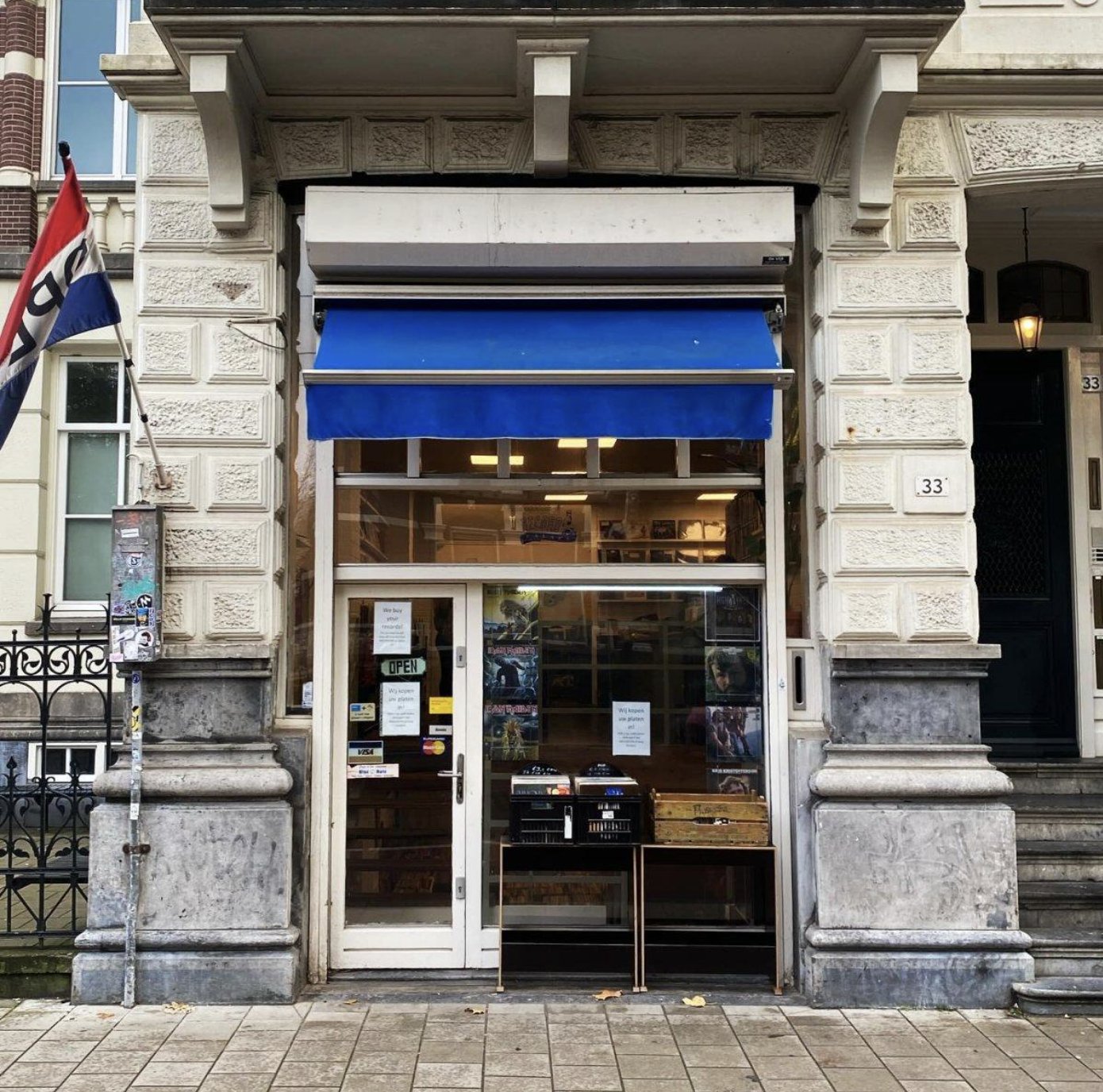
A small shop opposite a big music venue
Walk along the Weteringschans, close to the Leidseplein, and you could easily pass Record Palace by. It is not an imposing building. There are no enormous shop windows or loud advertising. Behind the façade at number 33A lies a world of record sleeves, music history and thousands of stories. Inside, the crates stand close together. Records by famous artists sit next to obscure recordings that have not been made for decades.
Rock, jazz, soul, blues, punk, reggae and pop from different decades. Some records cost a few euros. Others are prized collector's items that enthusiasts have been searching for for years. But perhaps the most striking thing about this shop is its location. Across the road is Paradiso, one of the most famous music venues in the Netherlands. Artists from all over the world have performed there since 1968.
And many of those artists share one habit. When they are in Amsterdam for a concert, they cross the street to browse the records at Record Palace. There, world stars briefly become ordinary music lovers.
It started in a former dry cleaner's
Record Palace opened its doors in September 1988. The building on the Weteringschans had previously been a dry cleaner's. The new owners were Jan van Dorsten and Joe Schwab. Joe was an American Belgian who already had experience in the record trade. He owned The Collector, a record shop in Brussels. Jan, by then, already had a very different life in the music world behind him.
He had started out as a roadie for the Delft pop group Tee-Set. Later he worked as a barman and DJ at the Belle Amie disco in Scheveningen. After that he began dealing in second-hand records. He visited record fairs, bought up special copies and sold them on to collectors. It was through that work that he met Joe Schwab. The two decided to open a record shop together in Amsterdam.
And not just anywhere. They chose a building directly opposite Paradiso. A better spot for a shop for music lovers was hardly imaginable.
Opening a record shop while everyone buys CDs
There was something peculiar about their decision. In 1988, the future of the LP looked highly uncertain. The compact disc was on a massive rise. Music lovers were buying CD players in droves. Record companies were releasing more and more albums digitally. And many shops were shrinking their vinyl racks to make room for the new silver discs.
It was the period in which the CD was presented as the successor to the gramophone record. Less crackle. Less maintenance. And easier to use. Anyone starting a new music shop at that time might well have concentrated on selling CDs. But Jan van Dorsten thought differently. He believed there would always be people who wanted to collect records.
People for whom music was not just something to listen to. But also something you could hold. A beautiful sleeve. A special pressing. An old recording that was no longer available anywhere else. That is why Record Palace was full of vinyl from the very start. Even while the rest of the music industry was heading in another direction.
It turned out to be a good decision.
The record dealer who knew his customers
After a few years Joe Schwab withdrew from the business. Jan van Dorsten remained as the owner. Record Palace became a one-man business. He did what he had been doing for years. Finding records. Buying records. Selling records. But perhaps the most important thing was that he got to know his customers. Jan knew what music someone collected. Who was looking for a rare single.
Who wanted every album by a particular artist. And who would rather discover an unknown record than buy yet another familiar masterpiece. For him, the shop was not simply a place where you paid for a product. He helped people search. Sometimes for records they had almost stopped believing they would ever find.
It was precisely those encounters that made him enjoy his work. In 2018 he told music journalist Robert Haagsma that many customers had been coming to him for years. Some he knew so well that he knew their stories. But his clientele was not limited to Amsterdam. Visitors came from Japan, China, Russia, Argentina and other countries.
Every day was different. And Jan never knew who would walk in.
The day Robert Cray finally found his record
One of the loveliest stories from Record Palace concerns blues guitarist Robert Cray. Cray is one of the best-known American blues musicians of his generation. He has won several Grammy Awards and played with big names in the music world. But famous musicians, too, have records they have been searching for for years. When Cray visited Record Palace one day, he found an album by B.B. King.
Not just any record. According to Jan, he had been looking for that particular album for twenty years. And suddenly there it was. In a small Amsterdam record shop. It is hard to imagine how special a find like that can be for a collector. Twenty years of looking at record fairs. In shops. With other collectors. And then finally finding that one album.
Not in Los Angeles, London or New York. But on the Weteringschans in Amsterdam. For Jan, it was moments like these that made the trade special. A record that had sat in a collection for years finally found the owner who had been searching for it for so long.
The R.E.M. guitarist signed his own record
Record Palace has a special interior. On the wall hang signed record sleeves from artists who have visited the shop. The collection did not come about according to some grand plan. Every now and then Jan would ask a musician whether they would sign an album. Then he would hang the sleeve up. Slowly a collection of names from international music history grew.
One day Peter Buck walked in. The R.E.M. guitarist was himself a fanatical record collector. He knew the shop. And he knew about the signed albums on the wall. According to Jan, Buck spontaneously pulled an R.E.M. record out of the crate and offered to sign it. It sums up the atmosphere at Record Palace. Not a big organised event with photographers and autograph hunters.
But a musician who simply walks into a shop and decides to add something to the collection. The wall thus increasingly became a special archive. A collection of memories of artists who once rummaged through the record crates of Amsterdam.
Paul Weller, Billy Corgan and Henry Rollins
The list of famous customers is impressive. Paul Weller came by regularly. The British musician, known from The Jam and The Style Council, is himself a fanatical vinyl collector. Jan sometimes put special records and singles aside in case Weller turned up again. Billy Corgan, singer and guitarist of The Smashing Pumpkins, also dropped in.
As did Thurston Moore of Sonic Youth. Lenny Kaye, Patti Smith's guitarist. Jello Biafra of Dead Kennedys. Peter Buck of R.E.M. And Henry Rollins, the American singer, writer and former frontman of Black Flag. Rollins was particularly enthusiastic about the shop. He once wrote that it was virtually impossible for him to leave without buying a few great records.
Timothy B. Schmit of the Eagles also came by several times. The list grew over the years. And many visitors returned. That is perhaps the most remarkable quality of Record Palace. For people who travel the world and can visit record shops anywhere, this small Amsterdam shop became a regular haunt.
Quentin Tarantino among the records
Film director Quentin Tarantino also visited Record Palace in the 1990s. That fits his well-known interest in music. In films such as Reservoir Dogs and Pulp Fiction, music plays a major role. Tarantino often uses existing songs to give scenes a distinctive atmosphere. He has a fondness for older pop, rock, soul and lesser-known recordings.
Exactly the kind of music you find in shops like Record Palace. His visit became part of the rich collection of stories told about the shop. A director famous worldwide for his films, yet in Amsterdam simply hunting for special records. It shows that a love of music can connect people from very different backgrounds.
Whether someone is a world-famous filmmaker or an Amsterdammer who does his regular round of record shops every Saturday. Among the crates, everyone is looking for the same thing. Music that does something to them.
The rapper looking for samples
Record Palace attracted not only rock musicians and lovers of old pop music. Hip-hop producers liked coming there too. One of them was The Alchemist. The American producer is known for his distinctive beats and his extensive knowledge of old records. Hip-hop regularly makes use of samples: short fragments of existing music that are worked into a new composition.
For that, obscure records can be especially valuable. An unknown jazz recording. A strange snippet of film music. A forgotten soul single. For a producer, exactly that kind of fragment can form the basis of a new track. Jan helped The Alchemist discover special music. The producer later said that the quality of a record shop is largely determined by the person who puts the collection together.
A good shopkeeper knows more than just which records are in stock. He understands why a particular customer might find that one obscure recording interesting. That is knowledge you cannot simply pull from a search engine.
The singer who didn't give her name
One of the funniest stories about the shop appeared in a VICE feature in 2017. Jan told of a woman who came in one day. She asked whether he had any records by Macy Gray. Macy Gray was an internationally known American soul singer, famous among other things for her hit I Try. Jan had to disappoint her.
The records had sold out. The woman carried on through the shop and discovered an old poster for a Charles Mingus concert at Paradiso. She wanted to buy the poster. She offered 130 euros for it. But Jan did not want to sell it. The poster belonged to the shop. He even joked that for that price she might as well buy the whole place.
Then the woman made clear who she was. Macy Gray. The very singer whose records she had just asked about. So at that moment Jan had no idea he was talking to the famous singer herself. In the end he made an exception. She got the poster. It is a typical Record Palace story. A world star who is not treated as a world star.
But as an ordinary customer looking for music.
The artist who shared his find from the stage
Mike Scott, singer of The Waterboys, is also among the visitors who made no secret of their enthusiasm for Record Palace. According to a 2018 account, during one visit he bought records for a considerable sum. Later that evening, during his show at Paradiso, he told the audience about the special shop across the road. It is just about the best advertising a record shop can get.
No paid advert. No big campaign. But a musician telling his audience from the stage where he found great music that afternoon. After all, the crowd at Paradiso consisted largely of exactly the people who were interested in special records. In this way the two places reinforced each other. Paradiso brought artists from all over the world to Amsterdam.
And Record Palace offered those artists a place to set off on a musical voyage of discovery of their own.
A record shop that turned thirty
In September 2018 Record Palace celebrated its thirtieth anniversary. Jan was not particularly bothered about it at first. He had let the 25th anniversary pass almost unnoticed too. But friends and regular customers felt that thirty years was a special milestone. They decided to throw a party. And where better than Paradiso?
On Friday 7 September 2018, the Kleine Zaal (small hall) of Paradiso was the setting for an anniversary evening. The programme consisted of musicians who themselves liked coming to Record Palace. Among those involved were Tim Knol, Rudeboy, Phantom Frank, Max Meser, Dirk Polak and Mark Ritsema. Polle Eduard, Michel van Dijk and Ferdinand Bakker also performed.
People from different generations of the Dutch music world. For Jan it was a special moment. A small shop that had started in a former dry cleaner's was celebrating its birthday in one of the most famous music venues in the Netherlands. With performances by musicians who had not been booked as random acts. But who were also simply customers.
The LP never really went away
The history of Record Palace runs parallel to that of the LP. When the shop opened in 1988, the CD was pushing vinyl aside. In the 1990s the CD grew into the most important physical music format. Then the world changed again. The internet made it possible to download music digitally. Next came streaming services, with which almost anyone could listen to millions of songs.
For traditional music shops these were difficult developments. Many record shops disappeared. It seemed as though physical formats would slowly become redundant. But things turned out differently. Vinyl became popular again. Young people discovered the appeal of a real record. The big sleeve. The sound of a turntable. The ritual of sliding an album out of its inner sleeve and carefully placing it on the deck.
And the pleasure of searching for a special pressing. For Record Palace that development was not so much a new start. After all, the shop had never stopped selling vinyl. From the beginning Jan had believed there would always be collectors. And more than thirty years later he was proved right.
2022: the end of an era
After 34 years, Jan van Dorsten decided in 2022 to say goodbye to his shop. It was a significant event. For many regular customers, Record Palace was inseparable from Jan. He knew the records. He knew the visitors. And over all those years he had built up a special reputation. But the shop did not have to disappear.
A successor came along. Bas Kleijn. Bas already had experience in the record trade himself. He owned Homesick Records, a record shop known above all for its large collection of Bob Dylan music. The two businesses were a remarkably good fit. Record Palace had a rich history and a loyal clientele. Homesick Records brought its own collection, specialisms and new ideas.
Bas took over Record Palace and moved his collection to the Weteringschans. With that, a new chapter began. The shop remained independent. And the name Record Palace was kept.
The man with thousands of Bob Dylan records
Bas Kleijn is known as a great connoisseur of Bob Dylan's work. The American singer-songwriter has an enormous musical history. Since the early 1960s he has released dozens of albums. On top of that there are countless live recordings, special pressings, singles, compilations and books. For collectors it is a world of its own. Homesick Records specialised in exactly that kind of material.
When Bas took over Record Palace in 2022, he brought his Dylan collection with him. This created a special combination. The history of Jan van Dorsten, centred on rock, blues, jazz, soul and pop. And the world of Bas Kleijn, with a strong emphasis on Bob Dylan and music from the 1960s and 1970s. According to a 2026 overview of Amsterdam record shops, the shop's Dylan specialism comprises more than two thousand records, CDs, singles and books.
For fans of the American musician, that makes it a special address. But you don't have to be a Dylan collector to find something there. The broad collection has remained.
The shop gets a second life
After the takeover, Record Palace was refitted. The stock of Homesick Records found a place among the existing collections. The shop remained a destination for lovers of older rock music, jazz, soul and special second-hand records. An international feature by the music platform Louder Than War in January 2026 described how the shop had come back to life after the takeover.
The writer, who had been visiting Record Palace for many years, remembered how Jan had always welcomed him warmly. When Jan retired in 2022, it marked the end of a personal tradition for him. But on his return he discovered that the shop had kept its character. The crates were still full. Special finds.
And people who were happy to share their knowledge. The new owner had not tried to turn it into a completely different business. He built on what Jan had created. That may well be the best way for a small independent shop to carry on. Not by erasing its history. But by adding a new chapter to it.
Still opposite Paradiso
Record Palace has now been around for more than 38 years. The shop is still located at Weteringschans 33A, opposite Paradiso. It is listed in current Amsterdam shopping guides and specialist overviews of record shops. In 2026 Record Palace can also be found as a business in the Handelsregister, the Dutch trade register. The shop is not part of a national chain. It is an independent Amsterdam specialist shop with its own collection and character.
Anyone who walks in still finds a broad selection of second-hand vinyl. From well-known rock albums to obscure records that are not easy to find elsewhere. And of course Bas's special Bob Dylan collection. The proximity of Paradiso also remains an important part of its identity. Musicians and concertgoers still pass through the area around the shop.
Nobody knows which world-famous artist will walk in tomorrow. But history shows that you needn't be surprised.
Why a city needs shops like this
Buying music has changed completely over the past forty years. In 1988 you went to a record shop to discover music. You flicked through crates, listened to recommendations and sometimes took home an album by an artist you didn't yet know. Today you can play almost any song instantly on your phone. That is enormous progress.
But something has changed along with it. Algorithms increasingly decide what music you get to hear. You discover new artists through playlists and recommendations compiled on the basis of what you have listened to before. A good record shop works differently. There you sometimes come across something that doesn't fit your previous listening habits at all. An unknown jazz record.
A forgotten single. Or a musician from a country whose music you barely know. That happens because someone has selected the records. A person with their own taste and knowledge. That is what makes shops like Record Palace valuable. They don't just sell music. They also preserve musical knowledge and bring together people with different tastes.
An ordinary shop for extraordinary visitors
The story of Record Palace contains many famous names. Quentin Tarantino. Robert Cray. Paul Weller. Billy Corgan. Peter Buck. Macy Gray. Henry Rollins. But in the end the history of the shop is not only about those world stars. It is just as much about the Amsterdammers who came there for years. The music lover who did his regular round every Saturday.
The collector who finally found a missing record. The boy who bought his first LP. And the woman who discovered an album that reminded her of the music of her youth. For Jan, those ordinary customers were at least as important as the famous artists. He knew their stories. Knew what they were looking for.
And he enjoyed the moment when he could make someone happy with a special find. That is where the strength of an independent shop lies. Not in the size of the range alone. But in the relationship between the people who work there and the people who come in.
The record shop where the music never stops
A lot has changed on the Weteringschans since 1988. The city got busier. Shops disappeared. Others took their place. The music industry moved from vinyl to CD, from CD to downloads and from downloads to streaming. Jan van Dorsten retired. Bas Kleijn took over. And the collection changed with it. But one thing stayed the same.
Across the road from Paradiso there is still a shop where people walk in to discover music. Not because a computer tells them exactly what to listen to. But because they are curious. Because they want to search. And because somewhere among thousands of records there might be exactly the one they have been missing for years. That makes Record Palace more than a shop.
It is a meeting place. A music archive. And a piece of Amsterdam where a love of music still matters more than the speed at which you can order something. Record Palace shows that the best shops are not always the ones where you find exactly what you are looking for. Sometimes they are precisely the shops where you discover something you didn't know you were looking for.
And that makes Record Palace one of the most special independent shops in Amsterdam.
Sources
Record Store Day (30 jaar Record Palace [30 years of Record Palace] and Platenzaak van de maand [Record shop of the month], September 2018), Heaven Magazine (Record Palace: 30 jaar vinylliefde [30 years of vinyl love], August 2018), VICE (record dealers on their most famous customers, 2017), Café L&B (Bas Kleijn koopt Record Palace [Bas Kleijn buys Record Palace], October 2022), Louder Than War (Amsterdam Vinyl Record Shops, January 2026) and I amsterdam (De beste platenzaken van Amsterdam [The best record shops in Amsterdam]). The anecdotes about famous visitors come from public interviews with Jan van Dorsten. You'll find Record Palace at Weteringschans 33A, opposite Paradiso.
Comments (0)
Log in to leave a comment.
More stories about Amsterdam
All stories →
The siege of Felix Meritis: the day Amsterdammers turned on each other over a war 1,500 kilometres away
Redactie Amsterdammers.love · 17 min read
Vlieger: the Amsterdam paper shop that has refused to be ordinary for 157 years
Redactie Amsterdammers.love · 15 min read
Fred Oosting (76): sixty years on the Waterlooplein, from old mops to tourist souvenirs
Redactie Amsterdammers.love · 10 min read