Amsterdammer · week 41
Joyce Aboagye (54): the woman who cares for babies who don't yet have a cot
In Amsterdam-Zuidoost, children are born every day into families who cannot even afford nappies. Some mothers have no home of their own, no residence permit or no one who can help them. Joyce Aboagye decided that these children must not be left to fend for themselves. She founded her own maternity care organisation and helped set up a unique shelter where even undocumented mothers can welcome their baby into the world safely. Her story is about much more than maternity care. It is about what happens when someone refuses to look away.
A phone call just before the birth
A woman calls Joyce Aboagye. Her baby is due in two weeks. Is it still possible to get kraamzorg? For most maternity care organisations she is very late. In the Netherlands, pregnant women are advised to register early for kraamzorg, the home maternity care that every new mother is entitled to in the first days after birth. Because of staff shortages, many organisations fill up quickly.
But Joyce hears stories like this often. Some women only call when their contractions start. Others get in touch once their baby has already been born. Joyce picks up her canary-yellow notebook, writes down the details and tries to find room.
In 2023 she told Vrij Nederland that she feels responsible for the families in her postcode area. Even if she cannot offer all the usual hours, she wants to try to arrange a few hours of help a day.
That is typical of the way Joyce works. Not first looking at why something cannot be done. But exploring what is still possible.
The women who cannot afford maternity care
Joyce works in Amsterdam-Zuidoost, a district where people from very diverse backgrounds live. Behind some front doors she finds young families who have prepared everything well. A furnished nursery. Baby clothes in the wardrobe. A pram. Family standing by.
But there are other situations too. Mothers with no fixed place to live. Parents who are barely making ends meet. Women who do not speak Dutch and do not know how maternity care works. Or families living in a small room, with no space for a cot.
Joyce sees up close what poverty means when a child is born. Because a newborn baby cares nothing for money worries, residence permits or complicated forms. It needs warmth, food, hygiene and a safe place to sleep.
And a mother who gets enough rest to recover. Yet even those basic conditions cannot be taken for granted for everyone.
The office on the Bijlmerdreef
In 2009 Joyce started her own organisation: Joy Kraamzorg. With it, she deliberately chose a different approach. She had previously worked for a private maternity care organisation. There she could sometimes stay with a family for two weeks, into the evening.
When she came back to her own neighbourhood, she was regularly approached by women who had just become mothers. They had questions. About colic. About vitamins. About breastfeeding. About caring for their baby.
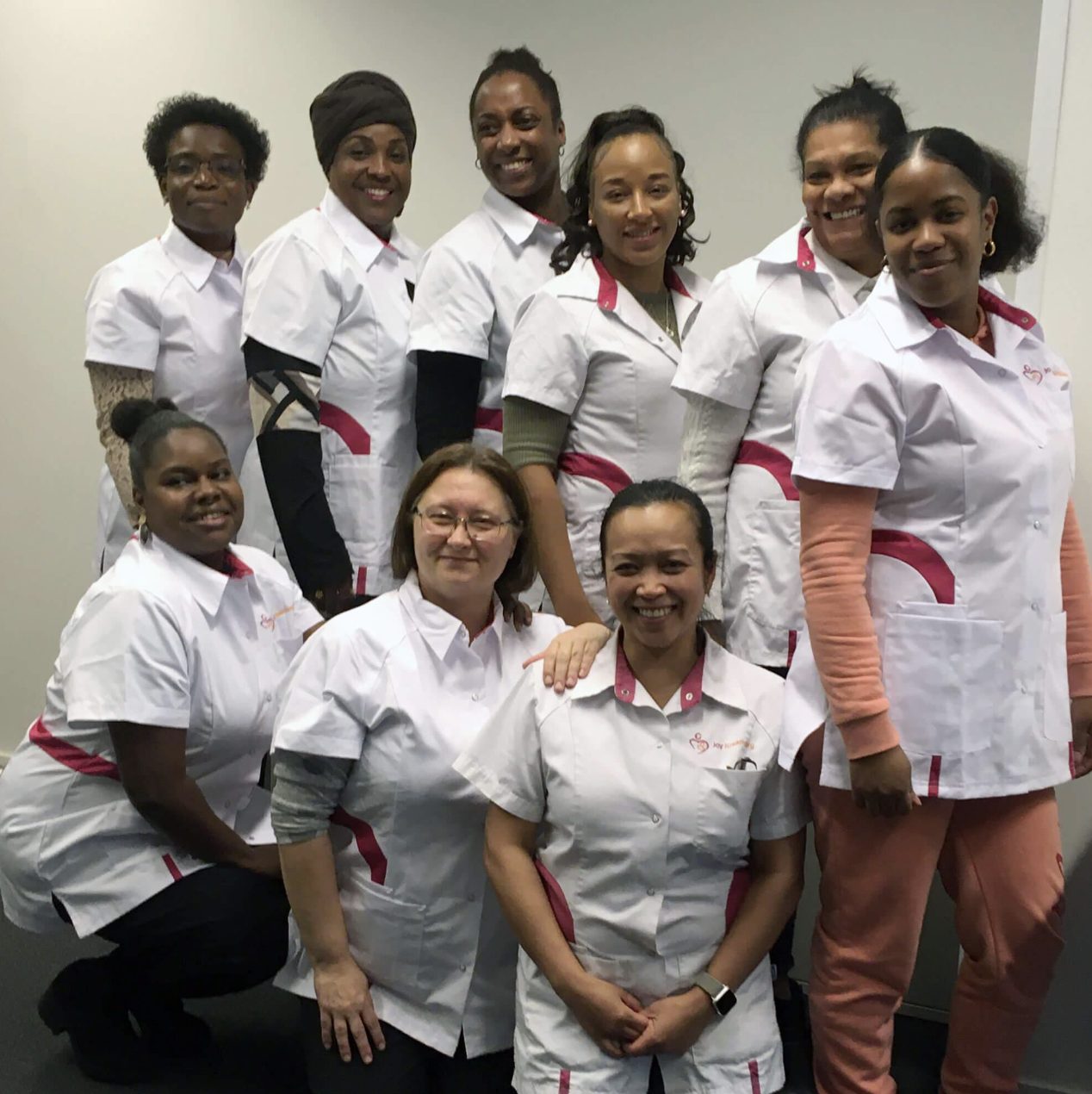
And Joyce noticed that many of these women had nowhere easy to turn. So she started Joy Kraamzorg in Zuidoost. She put together a team of maternity carers with different cultural backgrounds and language skills.
Because in Zuidoost it can matter that a maternity carer not only understands what needs to happen medically, but also knows the family's customs and language. In her office on the Bijlmerdreef there are maternity packs, which she makes available free of charge to families who cannot afford them.
Cupboards hold donated baby clothes. And anyone without a cot or car seat can sometimes borrow one. It is maternity care, but also much more than that.
A baby in a home with no safe place to sleep
In November 2025 Het Parool published a moving story about Joyce and the families she visits in Zuidoost. Sometimes she comes to parents who want to do everything for their child but simply do not have the means.
A newborn baby without a cot of its own. A mother with no fixed place to live. A family moving from one temporary shelter to the next. Joyce then has to look beyond medical care. Because you can explain to a mother how to let her child sleep safely, but what if there is no safe place to sleep at all?
You can advise a woman to rest after giving birth, but what if her housing situation is precarious? And you can point a family towards professional help, but what if the parents are afraid of official bodies because of their residence status?
Joyce does not just try to care for the baby. She tries to improve the circumstances in which that child grows up. That sometimes means phoning, organising, working with other care providers and looking for practical solutions that appear nowhere in a standard maternity care protocol.
The mother who was unsure about bath time
A report by Vrij Nederland from June 2023 shows how personal her work can be. Journalist Brechtje Keulen spent a day with Joyce. Among others, they visited Grace, a mother who had recently had a son by caesarean section.
Grace was unsure of herself. Thirteen years earlier she had had her first child in Ghana. Back then her mother, aunts and grandmothers had taken over much of the care. Now she lived in Amsterdam and had to learn all over again how to look after a newborn herself.
Maternity carer Tina helped her. During the bath the little boy began to cry and wriggle. Grace grew nervous. Tina showed her how to hold the baby calmly and reassured her.
After the bath, too, Grace needed help. She wanted to care for her son's skin, but became tense when dressing him did not go smoothly straight away. To an outsider these are small moments. For a young mother they can be decisive for her self-confidence.
Joyce saw that Grace needed extra support. So she discussed with Tina whether she could keep coming for a little longer. Not because it was on the schedule. But because she saw that it would help the family.
It is a different way of looking at care. Not just counting how many hours someone gets, but understanding what a family needs.
Sometimes she does work nobody pays for
During the same report, Joyce went to visit a woman who had registered for maternity care at the last minute. She drove to a block of flats, took out her notebook and called the woman. No answer. Still, she decided to go upstairs.
At the front door it turned out that the woman did not live at that address. She may have given the wrong address. Joyce went back outside. She wanted to contact the midwife so she could still find the woman.
Because it is precisely at a first home visit that she can see whether someone needs help. Does the expectant mother have a safe place to live? Is there family who can help? Are there money worries? Are there medical problems?
And does the woman actually understand what maternity care involves? Joyce does not always get paid for a visit like this. But if she does not do it, a mother can disappear from view completely. And with her, her baby.
The first ten days of a new life
In 2024 Joyce, together with midwife Willemijn Speelman, helped bring about a remarkable initiative. A shelter for women without residence documents who have just given birth. The reason behind it was distressing.
Some women had no safe place to spend their postnatal period. Others were staying somewhere professional care providers were not welcome. That could mean mother and child received barely any medical support after the birth.
Joyce and Willemijn wanted to change that. Together with the City of Amsterdam, the GGD (the municipal public health service), midwives and youth healthcare organisations, among others, a shelter was set up in Zuidoost.
A place where women can stay for ten days. They get a room of their own and share facilities such as the kitchen and bathroom. Maternity carers can do their work there. A midwife can drop by.
And a youth healthcare nurse can check how the baby is doing. For many mothers it means a moment of rest for the first time after a period full of uncertainty. In November 2025 the City of Amsterdam wrote that the shelter could accommodate up to 36 women a year.
A small number, perhaps. But for every mother who finds a place there, it can make a big difference.
A mother without papers is still a mother
Behind the initiative lies a simple idea. A newborn child cannot help the circumstances into which it is born. It does not choose where its mother was born. Nor whether she has a residence permit.
Nor whether there is enough money for a cot. Yet it is precisely those circumstances that can determine what care a child receives in its first days of life. Joyce found that unacceptable. Together with other care providers, she tried to create a practical solution to a problem far bigger than her own organisation.
It was not only about medical support. It was also about trust. Some women do not dare to seek professional help because they are afraid of the consequences for their residence situation.
In the shelter they can recover in a safe environment and learn how to care for their baby. In an interview with the city, one of the women said she felt helped, partly because the staff spoke her own language.
That may seem a detail. But for someone in an unfamiliar country, understanding what a care provider is saying can make a world of difference.
Ten days centred entirely on mother and child
The first period after giving birth is intense. A mother has to recover physically. At the same time, she has to learn to cope with a newborn baby who needs care day and night. Feeding, temperature, weight and health all have to be monitored.
Sometimes there are complications. Sometimes breastfeeding is difficult. And sometimes a mother is mentally or physically exhausted. In a stable home situation there are often people who can help. But for women without a fixed place to live or without family nearby, that safety net is missing.
The maternity shelter tries to provide it temporarily. Joyce and the other care providers involved can keep an eye on things there, spot problems early and organise support. The shelter is not a permanent housing solution.
After ten days the women are in principle expected to move on. But in that first vulnerable period, mother and child at least receive the care and rest they need. A municipal report from July 2024 stated that the first five women had made use of the shelter.
The women were satisfied, although they also had practical suggestions for making the space more pleasant. These were subsequently worked on. It shows that Joyce and her colleagues did not just come up with an idea, but actually got a facility off the ground.
Even regular maternity care was not affordable for everyone
There is also a problem that Joyce encounters every day: the personal contribution for maternity care. Although maternity care in the Netherlands is part of the basic health insurance, for years families had to pay a personal contribution for the hours of care at home.
For many parents that was manageable. But for families who need every euro for groceries, rent and baby things, that contribution could be a reason to take less maternity care. Some families even went without it altogether.
And that while vulnerable families in particular often need more support. Since 1 November 2025 something has changed in Zuidoost. In a trial running until the end of 2028, the city, together with the Noodfonds (an emergency fund), pays the personal contribution for maternity care for families with money worries.
For women who previously had to choose between essential baby things and maternity care, that meant an important improvement. It touches on exactly what Joyce sees every day. A birth care system in which the parents' financial situation does not determine how much help a newborn child receives.
A very different Amsterdam behind the front door
Cycle through Amsterdam-Zuidoost and you see modern residential buildings, shopping centres, schools, sports fields and lively streets. It is a district with great cultural diversity and a strong community.
But behind some front doors there are problems that are not visible from the street. Joyce does go there. She sees young parents trying to make ends meet. Women living in other people's homes. Families in which several generations live together.
Mothers with hardly any support. And children who begin their lives while their parents struggle with serious worries. That work demands more than medical knowledge. It demands patience, an understanding of people and a willingness not to judge straight away.
In her years as a maternity carer, Joyce has learned that every family is different. Some parents need a lot of guidance. Others mainly need someone to reassure them. And sometimes the most important thing she can do is make sure a mother gets access to the right help at all.
That is why she seeks to work with midwives, youth healthcare, neighbourhood organisations and the city. Because no single maternity carer can solve poverty, the housing shortage or residence problems on her own.
But together, care providers can prevent a family from falling through the cracks entirely.
2026: an organisation that keeps going
In November 2025 Joyce was 53 years old. In October 2026 she is around 54. In January 2026 she was one of the five nominees for Amsterdammer van het Jaar (Amsterdammer of the Year), the award that was eventually won by Dokter Co.
By then she has more than seventeen years of experience as founder of Joy Kraamzorg, which she started in 2009. Her organisation's website still puts the same broad approach centre stage: professional maternity care for families from different backgrounds, including mothers who speak other languages and undocumented mothers.
The organisation also offers support with breastfeeding, pregnancy and young parenthood. The collaboration around the shelter for undocumented new mothers is also described by the city and the GGD Amsterdam.
The most recent in-depth personal interviews available for this portrait date from November 2025. Less is publicly known about her own daily life in October 2026. But what is certain is that in recent years Joyce has built something that reaches further than an ordinary maternity care organisation.
She has brought together a network of people who try to make sure vulnerable mothers and babies do not remain invisible.
The woman who looks beyond the cot
When we think of remarkable Amsterdammers, we often think of people who have achieved something big. Won a prize. Founded a famous company. Pulled off an extraordinary sporting feat. But Joyce Aboagye's work takes place largely in places almost nobody stops to think about.
In living rooms. In small bedrooms. By a cot. Or precisely in a room where there is no cot yet at all. Her work consists of conversations that never make the paper. Explaining to a mother how to hold her baby.
Checking a baby that is only a few days old. Helping a family that has no money for nappies. Or making sure that a woman without a residence permit does not end up on the street straight after giving birth.
None of these moments naturally earns applause. But for the families she helps, they can mean a great deal. Joyce Aboagye has not resigned herself to the idea that some children are simply born into harder circumstances.
She has tried to change that. First with her own maternity care organisation. Then with a network of care providers. And ultimately with a unique shelter for mothers who would otherwise have had nowhere to go.
Amsterdam is a city where thousands of children are born every year. Most parents will never meet Joyce. But for the families who need her, her commitment can make the difference between a frightening, uncertain postnatal period and a start in which someone looks out for them.
Because every child deserves a good start. Even when there is no cot at home yet. And that makes Joyce Aboagye a remarkable Amsterdammer.
Sources
Vrij Nederland (12 June 2023), Het Parool and Amsterdam UMC (10 November 2025), the Amsterdamkrant Zuidoost of the City of Amsterdam (November 2025), GGD Amsterdam (interview with Willemijn Speelman), NH Nieuws on the trial with free maternity care (September 2025), NAP Nieuws on Amsterdammer van het Jaar (January 2026) and the Joy Kraamzorg website. This portrait is based on public sources and does not include a new interview with Joyce Aboagye.
Comments (0)
Log in to leave a comment.
More stories about Amsterdam
All stories →
The siege of Felix Meritis: the day Amsterdammers turned on each other over a war 1,500 kilometres away
Redactie Amsterdammers.love · 17 min read

Zoë van der Meer (16): the girl who no longer dared go to school, and wrote a book about it
Redactie Amsterdammers.love · 10 min read
Vlieger: the Amsterdam paper shop that has refused to be ordinary for 157 years
Redactie Amsterdammers.love · 15 min read