Event · week 30
The Eel Riot of 1886: how a forbidden game in the Jordaan ended in 26 deaths
It began on a sunny Sunday afternoon with an eel, a rope and a few men in a rowing boat. Two days later 26 Amsterdammers lay dead, dozens of people were badly injured and the army had fired live rounds at residents of the Jordaan. The Eel Riot (Palingoproer) of 1886 ranks among the bloodiest popular uprisings in Amsterdam's history. But how could a seemingly innocent folk pastime end in a bloodbath? The answer reveals a great deal about the Amsterdam of the past.
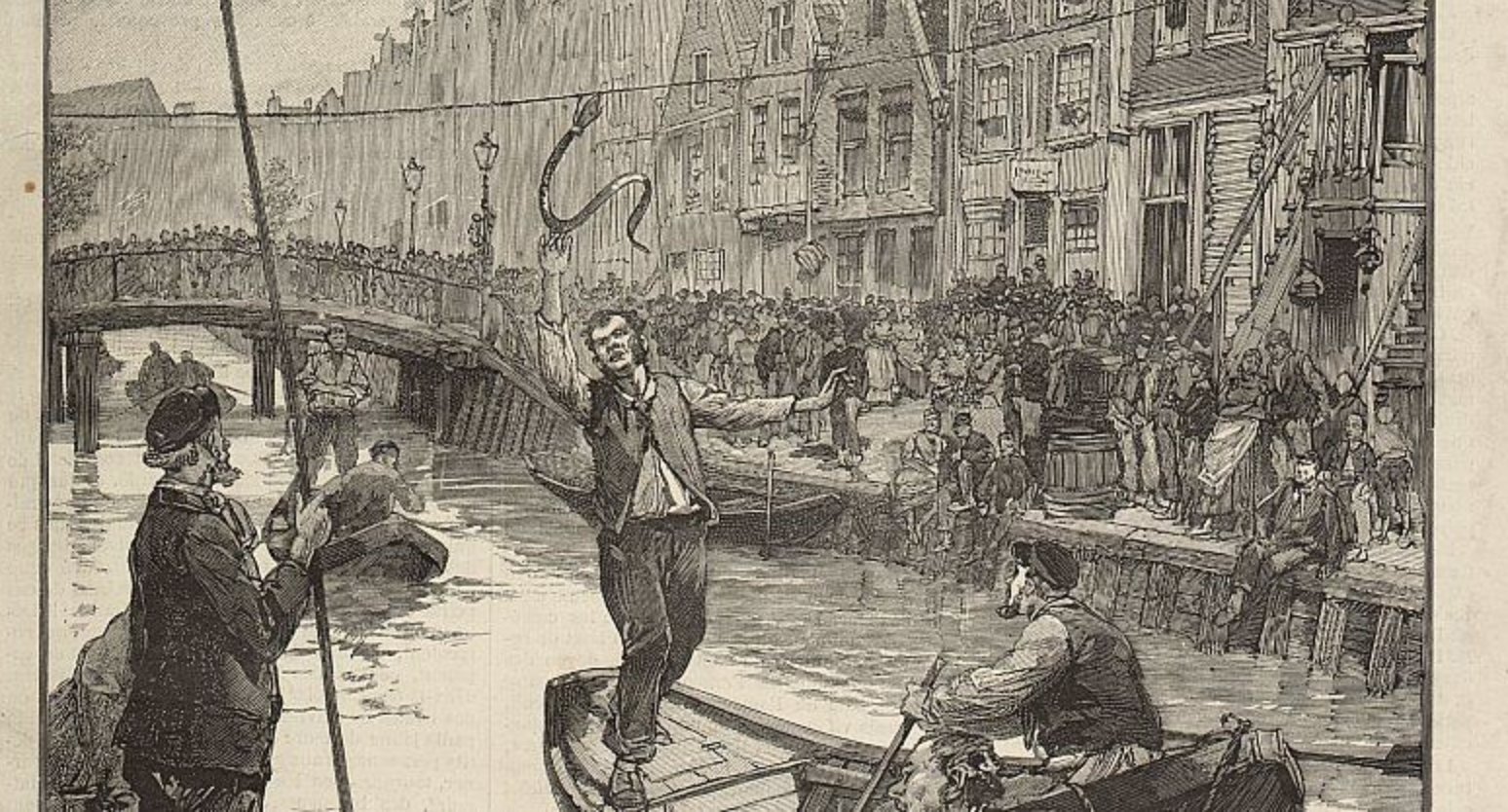
A summer Sunday on the Lindengracht
It is Sunday 25 July 1886. Amsterdam is sweltering in the summer heat. In the Jordaan, then a working-class district, residents are gathering around the Lindengracht. Men stand talking, women look on and children try to find a spot from which they can see everything. Something special is about to happen. A group of local residents has decided to breathe new life into an old Amsterdam folk pastime.
Palingtrekken, or eel-pulling. Today it sounds almost unbelievable, but in the nineteenth century it was a well-known game. A rope was stretched across a canal. From it hung a live eel, sometimes smeared with soap to make the creature even more slippery. The participants rowed under the rope in little boats and tried to grab the wriggling eel and pull it loose.
Whoever succeeded won. The eel by no means always survived. It was a cruel custom, but for some residents of the Jordaan it was part of their neighbourhood's traditions. And that Sunday afternoon they fancied a bit of fun. No one could have guessed what was about to happen.
The Amsterdam where the police were not welcome
To understand the riot, we first need to look at the Jordaan of 1886. The neighbourhood was utterly different from the popular residential area of today. Tens of thousands of labourers, porters, craftsmen, small traders and their families lived there. Many people were poor. The homes were small, damp and overcrowded. Families sometimes shared a single room. Proper sanitation was lacking and diseases could spread easily.
Work was precarious. Anyone who fell ill or lost their job could quickly find themselves in serious trouble. Social provision as we know it today barely existed. Most people had to fend for themselves. And it was precisely in those conditions that a strong sense of solidarity grew. The residents knew one another. They helped each other out when needed.
But they also kept outsiders at arm's length. The police in particular were unpopular. Officers were seen as representatives of a government that imposed rules but did little to improve the harsh existence of Amsterdam's poorest. So when an officer interfered in a popular pastime, it was often about more than just that one game.
It was also about authority. About interference from outside. And about the question of who was really in charge in the Jordaan.
The forbidden game
Eel-pulling had been banned for years. In 1875 the authorities had outlawed the game because of its cruelty to animals. But laws do not change traditions overnight. In the Jordaan there were plenty of people who felt they could decide for themselves how to spend their free Sunday afternoon. So when a group of residents stretched a rope across the Lindengracht on 25 July 1886, it was no mere spontaneous children's game.
They knew the police could stop it. The rope was strung near the Zaterdagsebrug, a bridge over the canal, between buildings on either side of the water. Interest was huge. People crowded along the water's edge. The participants readied their boats. The eel hung above the canal. Everything was set for the game. Then a few police officers appeared.
One cut with a knife
The officers made it clear that eel-pulling was forbidden. The game had to stop. But the crowd had no intention of simply going home. So the police decided to intervene themselves. An officer cut the rope from which the eel was hanging. And at that moment the mood changed completely. The crowd became furious. What only moments before had been a festive Sunday afternoon turned into a confrontation between residents and police.
People started shouting. Officers were pushed, beaten and attacked. The officer who had cut the rope was set upon and thrown into the canal. The police tried to get reinforcements. But every extra officer who appeared seemed only to fuel the crowd's anger further. Within a short time the whole area around the Lindengracht was in uproar.
The Jordaan fights back
The disturbances spread to the surrounding streets. Fierce fighting broke out in the Lindenstraat. Officers tried to disperse the crowd. But the residents would not give in. They used whatever they could find. Stones. Sticks. Loose objects from the street. And fresh attacks came from the homes above the street. Residents threw flowerpots, jugs and other household items down below.
According to a reporter from the Rotterdamsch Dagblad, boiling water was even poured over police officers. A sergeant was hit on the head with an iron pot and had to be taken to the Wilhelmina Gasthuis hospital. By now it was no longer a row about an eel. It was an open battle between part of the Jordaan and the police.
The forces of law and order were driven further and further into a corner. And the police organisation proved poorly prepared for such a large outburst of violence.
The police lose control
The Amsterdam police of 1886 were not equipped for modern large-scale public order policing. There were few means of communication. Calling for reinforcements took time. And officers had to move through densely populated streets with limited resources. Later research showed that problems within the police organisation made the situation worse. There were internal tensions and the leadership did not always respond effectively.
A request for help was not taken seriously enough. A key police commissioner turned out to be unreachable at a crucial moment. And as the disturbances grew, more and more officers were injured. In the end some two hundred officers were injured in the riot, 122 of them seriously. That was roughly a third of the entire Amsterdam police force. It shows just how serious the situation was.
The police faced a large, furious crowd in a neighbourhood where many residents sided with the rioters. Over the course of Sunday evening calm seemed slowly to return. By around ten o'clock order had been restored for the time being. But the worst was yet to come.
Monday morning: the barricades go up
On Monday 26 July 1886 the violence flared up again. Early in the day groups of young people and other residents gathered around the Lindengracht. This time they were prepared. Paving stones were prised loose. Cobbles were dug out of the road to serve as projectiles. Barricades appeared in several places. The streets were sealed off with improvised barriers. A red flag was hoisted on the Zaterdagsebrug.
A freedom song was sung to the tune of the Marseillaise. These were symbols that went beyond resistance to a ban on eel-pulling. Discontent over poverty, unemployment and the balance of power between workers and those in charge had been growing in the city for some time. Socialist ideas were gaining influence. Not all the rioters were socialists, and the uprising was not simply organised by a political movement.
But the events did take on an increasingly social and political character. It was as if years of pent-up frustration had suddenly found an outlet.
The army enters the Jordaan
The police could no longer control the situation. So the army was called in. Armed soldiers marched into the Jordaan. For the residents this was an enormous escalation. What had begun as a conflict with a few officers was now a confrontation with soldiers carrying rifles. The military units tried to remove the barricades and reopen the streets.
But the crowd did not give way. Men and women stayed behind the barriers. Stones and other objects were thrown at the soldiers from windows and rooftops. Some residents even openly taunted the troops. According to a historical newspaper report, a young woman shouted at the soldiers that they should go ahead and shoot. And they did.
The shots that changed the Jordaan
Soldiers opened fire in several places. Not with blanks. But with live ammunition. The streets turned into a battlefield. People were hit and fell. The wounded were carried away. Bystanders tried to get away, while others kept fighting. Even when shots were fired, not everyone retreated. A reporter from the Rotterdamsch Dagblad described his astonishment at the crowd's tenacity.
The residents kept throwing stones, even after the first shots had rung out. For the soldiers the situation was dangerous and confusing. For the people on the street it was life-threatening. The violence went on for hours. Only late in the evening did calm return. What had begun with an eel on a rope had ended in one of the bloodiest confrontations between citizens and authority in Amsterdam's history.
Twenty-six dead
When the toll was taken, the scale of the tragedy became clear. According to many historical publications, 26 citizens had lost their lives. The Stadsarchief Amsterdam (the City Archives) gives 25 dead. That discrepancy recurs in various accounts of the riot. In addition there were dozens of seriously injured and more than a hundred injured in total. Among the victims were people who had taken an active part in the riot, but also residents who were caught up in the chaos and violence.
The exact circumstances of each individual death cannot always be fully reconstructed. What is certain is that the military intervention exacted a terrible toll. Many of the injured were poor. For families who were already barely making ends meet, the death or injury of a breadwinner was an outright disaster. There were no extensive social safety nets. The loss of a father, son or husband could plunge a whole family into financial hardship.
Behind the death toll, then, lay dozens of personal tragedies. Families who lost someone. Children who had to carry on without a father. People left with lasting injuries. And a neighbourhood that would live with the memory of the violence for years to come.
Why did it actually go wrong?
It seems incredible that a forbidden game could cause such a bloodbath. That is why historians have often asked what really lay behind the Eel Riot (in Dutch, the Palingoproer). The eel was the immediate trigger. But the tensions had existed for much longer. The Jordaan was a poor, densely populated neighbourhood where residents faced insecurity, bad housing and social inequality every day.
Trust in the authorities was low. Many residents did not see the police as a body that protected them, but as a power that meddled in their lives. On top of that, popular pastimes mattered. For people who worked long days and had little money, such moments of relaxation were precious. When the police banned that entertainment, it could feel like yet another restriction on an already hard existence.
Yet poverty alone does not explain why the violence escalated so far. The conduct of the police also played a part. The escalation, the poor coordination and ultimately the decision to deploy the army with live ammunition made the consequences especially grave. The Eel Riot was therefore not solely a story about rebellious residents. It was also a story about a government that lost control and then responded with heavy force.
The newspapers were divided
The events received a great deal of attention in the Dutch press. Some newspapers emphasised above all the violence of the rioters. They wrote about attacks on officers, destruction and the danger that public order would collapse entirely. Other commentaries pointed to the social ills in the Jordaan. They felt the city authorities could not talk only about law and order without also looking at the conditions in which residents lived.
The Algemeen Handelsblad, an influential newspaper at the time, largely sided with the authorities in its coverage. But even there it was later acknowledged that poverty and social problems could not be ignored. The riot exposed a deep divide. For the authorities it was above all a matter of order and authority. For many residents it was about whether their voices and their circumstances were being heard at all.
It was written about even abroad
The Eel Riot attracted international attention. On 7 August 1886 the French magazine L'Illustration published a large illustration of the fighting in Amsterdam. The print was based on a drawing by Frédéric de Haenen, who recorded the events as a special correspondent. It shows armed soldiers facing the barricades in the narrow Amsterdam streets. There is smoke.
Stones and debris lie scattered. And the buildings of the Jordaan form the backdrop to a violent confrontation. It is a striking image. A Dutch working-class neighbourhood appearing in an international illustrated magazine as the scene of bloody street fighting. The event was thus no longer just an Amsterdam story. Beyond the Netherlands, too, people saw how deep the social tensions in the city could run.
A song that became a memorial to the dead
The Eel Riot also left its mark on popular culture. Before the events there was already a simple song about eel-pulling. After the riot it took on a new meaning. A verse added later sang of the Zaterdagsebrug and the bullets that had fallen there. The song thus changed from a reminder of a folk pastime into a reminder of the violence.
That is telling. For while officials and police recorded the events in reports and official statements, residents kept their own memories alive. With stories. With songs. And with the names of people who had been there. The Eel Riot became part of the identity of the Jordaan. A neighbourhood known for being headstrong, combative and not easily impressed by authority.
The start of a long history of resistance
The Eel Riot was not the last major popular uprising in the Jordaan. In 1917, during the First World War, the Aardappeloproer (Potato Riot) broke out. Amsterdam women rose up against food shortages and the unequal distribution of food. There were deaths then too. In 1934 came the Jordaanoproer (Jordaan Riot), after a cut in benefits for the unemployed. Once again barricades appeared in the streets and heavy force was used to restore order.
They were different events with different immediate causes. But they had something in common. Time and again, residents of poor Amsterdam neighbourhoods clashed with a government they experienced as distant or unjust. The Eel Riot of 1886 thus became an early symbol of the social struggle that would characterise Amsterdam in the nineteenth and twentieth centuries.
The Lindengracht still exists, but the canal has gone
Anyone walking along the Lindengracht today can hardly imagine what happened here in July 1886. The spot where rowing boats once passed beneath a rope with an eel looks completely different. The Lindengracht was filled in in 1895. The water disappeared and made way for a broad street. Today a market is held there. There are trees and benches.
Residents walk their dogs. Tourists visit the shops and cafés in the area. It is a much-loved part of the Jordaan. But beneath that everyday calm lies a history of poverty, revolt and violence. The Zaterdagsebrug, which played an important role in the events at the time, no longer exists in its original form. Anyone who does not know what happened can easily walk past the place where soldiers once stood facing Amsterdam citizens.
140 years on
This week, on 25 and 26 July 2026, it is exactly 140 years since the Eel Riot took place. The event remains an important subject in the writing of Amsterdam's history. The Stadsarchief keeps historical photographs, documents and images of the riots. The Rijksmuseum also has prints and other objects in its collection relating to the riot.
In 2025 Ons Amsterdam published new historical research into the consequences for the police officers involved. Among other things, it showed how severely the Amsterdam police organisation had come under pressure during the events. The internal mistakes and poor organisation also came to light once again. This autumn a HOVO course (higher education for older learners) at the Vrije Universiteit Amsterdam covers several historical popular uprisings, including the Eel Riot.
That shows the event is still considered relevant. Not because anyone today wants to reintroduce eel-pulling. But because the story raises questions far bigger than the forbidden game. How does collective anger arise? When does a government lose the trust of its citizens? How can a small conflict turn into large-scale violence? And how far may the authorities go to restore public order?
It did not really begin with an eel
It is tempting to tell the story of the Eel Riot as an absurd snippet of Amsterdam history. A few men want to pull an eel off a rope. The police step in. And suddenly dozens are dead. But it was not that simple. The forbidden game was the spark. The fuel had been there for years. Poverty. Discontent. Bad housing.
A growing gap between citizens and those who governed them. And a neighbourhood that wanted to protect its own customs and autonomy. When the police cut the rope, much of that pent-up frustration burst out. What followed was a chain of violence, miscalculation and escalation. First the attack on the officers. Then the barricades. Then the arrival of the army.
And finally the shots. According to the most widely accepted historical count, twenty-six people would never come home. Their names have largely been forgotten by the wider public. But the event that cost them their lives earned a permanent place in the history of Amsterdam.
The Sunday afternoon Amsterdam never forgot
There are events that change a city because something big is built. A new bridge. A railway line. A station. And there are events that change a city because something terrible happens. The Eel Riot belongs to the latter category. It showed how deep the tensions between rich and poor, government and people could run.
It revealed the vulnerability of a police organisation that was not prepared for large-scale violence. And it made clear how dangerous things become when a conflict keeps escalating and, in the end, live ammunition is fired at citizens. Today the Jordaan is one of Amsterdam's best-loved neighbourhoods. The houses have been done up. The streets have changed.
And the Lindengracht has long since ceased to be a canal. But on Sunday 25 July 1886 the world here looked very different. A crowd gathered by the water. An eel hung from a rope. A police officer drew his knife. And with a single cut, one of the bloodiest chapters in Amsterdam's history began.
The Eel Riot reminds us that great historical events often have small triggers, but that the real causes lie much deeper. And that makes it one of the most remarkable, but also most tragic, events in the history of Amsterdam.
Sources
Stadsarchief Amsterdam (Palingoproer), Ons Amsterdam (25 en 26 juli 1886: Palingoproer in de Jordaan [25 and 26 July 1886: the Eel Riot in the Jordaan], July 2020), Ons Amsterdam (Tamarah de Groot, Politie, bedankt! [Police, thank you!], 5 May 2025), Gemeente Amsterdam (Het harde leven in de Jordaan [Hard times in the Jordaan], 2020), Stadsherstel Amsterdam (Tweede Goudsbloemdwarsstraat 6), the Rijksmuseum collection and the HOVO course Oproeren in Amsterdam (1535–1934) [Riots in Amsterdam] at the Vrije Universiteit. The death toll varies by source: most give 26 dead, the Stadsarchief 25.
Comments (0)
Log in to leave a comment.
More stories about Amsterdam
All stories →
The siege of Felix Meritis: the day Amsterdammers turned on each other over a war 1,500 kilometres away
Redactie Amsterdammers.love · 17 min read

Zoë van der Meer (16): the girl who no longer dared go to school, and wrote a book about it
Redactie Amsterdammers.love · 10 min read
Vlieger: the Amsterdam paper shop that has refused to be ordinary for 157 years
Redactie Amsterdammers.love · 15 min read