Place · week 44
Ruigoord: the Amsterdam village that was meant to disappear, but has refused to die for 53 years
Somewhere between the huge oil tanks, industrial estates and cargo ships of the Port of Amsterdam lies a village that, by rights, should no longer exist. It was given up, squatted, threatened with bulldozers and for years hemmed in by advancing industry. But Ruigoord survived. What was once a farming village became a vrijplaats, a free haven for artists, poets, hippies and people who would rather make their own rules. And after more than half a century of struggle, something happened at the end of 2025 that almost nobody thought possible any more: Ruigoord was officially allowed to stay for at least another 25 years.
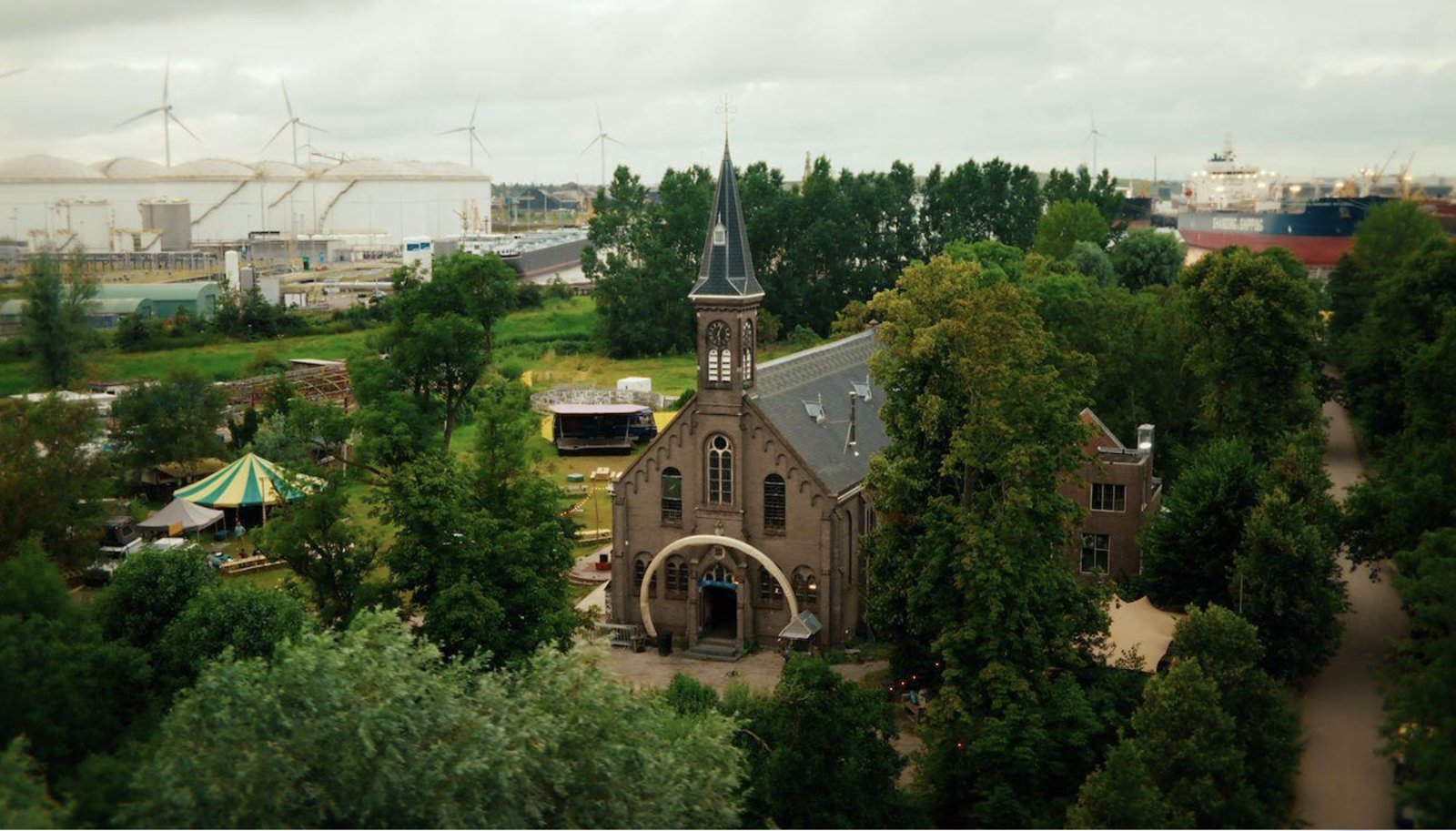
A village you would not expect here
Drive from Amsterdam towards the western port area and you see a landscape given over entirely to industry. Enormous storage tanks. Tall cranes. Long pipelines. Lorries and business parks. It is a world of goods, energy and international trade. But turn off at the right spot and follow the road to Ruigoord, and you suddenly find yourself in another world.
An old church appears among the greenery. Around it stand small houses, studios, sheds and remarkable artworks. There are painted façades, home-made sculptures and corners where nature seems to go its own way. On a sunny day you might hear music. Or someone reciting a poem. Or a group of people preparing for an unusual ritual.
It hardly seems possible that this place is part of Amsterdam. But it is. Ruigoord lies on the western edge of the city, in the middle of the port area. It is not an ordinary village. It is not a museum. Nor is it simply a festival site. Ruigoord is a cultural vrijplaats, a free haven. A place where, since 1973, artists have been trying to show that there is another way of living together.
And the remarkable thing is that the village should have disappeared decades ago.
Ruigoord was once an island
The history of Ruigoord begins long before the artists moved in. Ruigoord was once a small island in the IJ. It lay in a watery area between Amsterdam and Haarlem, surrounded by water, reed beds and mudflats. The name refers to the rough vegetation of the area. When large parts of the IJ were reclaimed as polders in the nineteenth century, the landscape changed dramatically.
Around 1872 the Houtrakpolder was created. The former island now lay in the middle of new land. Farmers settled there, some of them from Zeeland and West-Friesland. They set up farms and worked the fertile soil. Their farmhands and other residents settled in the little village. A church was built. Houses followed. And a close-knit community grew up in which the Catholic faith played an important role.
In those days Ruigoord was above all a quiet farming village. Daily life was governed by the seasons, the work on the land and the people round about. Amsterdam was not far away, but it felt like another world. That would change completely in the 1960s.
Amsterdam wanted to become a world port
After the Second World War the Dutch economy grew rapidly. International trade increased. Ports grew larger and industrial companies needed ever more space. Amsterdam wanted to expand too. The city had big plans for the area west of the existing port. New harbours, industrial estates and storage facilities were to be built there. Ruigoord lay right in the area earmarked for them.
In the city council's plans there was really no longer any room for the little village. The farmers were bought out. Residents left for places such as Halfweg, Spaarndam and Zwanenburg. Houses stood empty. Some were demolished. Part of the polder was raised with sand to make way for future port development. Slowly Ruigoord turned into a ghost village.
Where families had once lived and farmers had worked, there were now abandoned homes. The end seemed inevitable. But the port expansion went more slowly than originally planned. And that is exactly what gave a group of Amsterdam artists an unexpected opportunity.
Two days after the last church service
On Sunday 22 July 1973 the last regular Mass was held in Ruigoord's Sint-Gertrudiskerk (St Gertrude's Church). It was a symbolic moment. The old village community had largely disappeared. And the church, for years the centre of the village, seemed to be losing its purpose too. But two days later something remarkable happened. On 24 July 1973 a group of artists and free thinkers moved into the abandoned village.
Among them were the poet Hans Plomp and the writer Gerben Hellinga. They had heard that Ruigoord was going to be demolished. And they decided not simply to accept it. The empty houses were squatted. The artists wanted to breathe new life into the village. Not as an ordinary residential area. But as a place where people could work, think, experiment and live together freely.
It fitted the spirit of the age perfectly. In the 1960s and 1970s Amsterdam had a strong counterculture. Provos (the playful anarchist protest movement of the 1960s), hippies, artists, squatters and other innovators were experimenting with alternative ways of living. They rebelled against consumer society, authority and fixed social expectations. Ruigoord offered exactly what they were looking for. Space. Freedom. And above all a place where not everything had already been arranged.
A village without ordinary rules
The first years were far from comfortable. Many houses were empty and dilapidated. There was cleaning, repairing and building to be done. Facilities were limited. And nobody knew how long the artists would be allowed to stay. Yet gradually a lively community emerged. Painters set up studios. Poets found places to write. Musicians began to play together. Sculptors made artworks.
And visitors from Amsterdam came to look at this curious village on the edge of the city. Ruigoord developed into a place where not everything revolved around money or possessions. Organising something together mattered more than a tight business plan. A party could happen spontaneously. An empty building could become a studio. And anyone with an unusual idea could usually find someone willing to help.
That does not mean there were never quarrels, or that everyone always agreed. A free haven, too, is home to people with different characters, interests and views. But there was a shared starting point. Ruigoord had to remain a place for experiment and imagination. A place where things were possible that were becoming ever harder in the ordinary city.
The church became the beating heart
In the new Ruigoord the old Sint-Gertrudiskerk took on a completely different role. Where church services had once been held, artists, musicians and poets now gathered. Performances were staged. Exhibitions held. Poems recited. And unusual gatherings organised in which art, music and spirituality flowed into one another. The church became the beating heart of the free haven. But its religious past did not vanish entirely.
The special atmosphere of the old church building turned out to suit its new use well. For some Ruigoorders the church became a place where people could give meaning to life in their own way. Not tied to a single church tradition. But open to different ideas, rituals and forms of spirituality. Later the interior grew ever more colourful.
Artists painted the walls and other surfaces. The church itself thus became a work of art. It is one of Ruigoord's remarkable contradictions. A Catholic farming village turned into a free haven for Amsterdam's counterculture. But the old church remained at its centre.
The festival where everyone could be an artist
In 1975 one of Ruigoord's best-known traditions was born: the Landjuweel. The name refers to historical gatherings at which different groups competed with one another in art, culture and recitation. But in Ruigoord the festival took on a character all of its own. It became a festival lasting several days in which theatre, music, poetry, visual art, performances and unusual rituals came together.
Visitors did not come just to watch. They were encouraged to become part of what was happening. People dressed up. Built strange installations. Put on spontaneous performances. Or helped build the temporary festival world. The first Landjuwelen took place on the large sandy plain around the village. Temporary artworks and structures rose up there. Some were ritually burned at the end of the festival.
This was art that was not meant to last for ever. It was all about the shared experience. About creating something, experiencing it and then letting it disappear again. The Landjuweel grew into one of Amsterdam's best-known alternative festivals. And into a tradition that connected generations of artists and visitors.
Nature took over the abandoned landscape
While the city kept on making plans for the port, something unexpected happened around Ruigoord. The reclaimed sand and the abandoned land were slowly taken over by plants and animals. Grasslands, scrub and remarkable natural areas emerged. Over the years flowers, birds and all sorts of other creatures appeared. Where an industrial estate was supposed to have been built, a landscape of special ecological value developed.
For the artists, this nature became part of their surroundings. A strong bond grew between the cultural free haven and the landscape. Ruigoord was defended not only as a place for artists. But also as a natural area that deserved protection. That combination made the battle over the village more complicated. Because the city wanted economic development. The artists wanted to preserve their cultural community.
And nature organisations wanted to prevent the landscape from disappearing entirely under the port expansion. The interests clashed ever more fiercely.
The bulldozers came back
In the 1990s the plans for the Afrikahaven (Africa Harbour) became concrete once again. The Port of Amsterdam wanted to expand. Ruigoord was in the way once more. The city and the port authority wanted to use the surrounding land for new industrial activity. For the artists, the end loomed again. But by now Ruigoord was no longer a forgotten village with a few empty houses.
It had grown into a well-known cultural free haven. There were artists who had lived and worked there for twenty years. Visitors came from home and abroad. And the village had developed an identity of its own. The Ruigoorders began to resist. They organised protests, sought support from politicians and tried to block the port plans through legal proceedings.
Environmental activists joined them too. A fierce struggle ensued in which art, nature, politics and economic interests were pitted against one another.
Tree houses, tunnels and a huge police operation
In 1997 the conflict came to a head. Activists from GroenFront! set up a protest camp near Ruigoord. They called it Vrijstaat Groenoord (the Free State of Groenoord). The camp was intended to stop the construction of the harbour. Tree houses were built. Tunnels dug. And structures put up to which activists could chain themselves to make eviction harder.
It was a form of protest that the Netherlands had rarely seen on such a scale at the time. On 7 October 1997 the Mobiele Eenheid, the Dutch riot police, moved in. Hundreds of officers were deployed to clear the site. Cherry pickers, diggers and other heavy vehicles were needed. The police had to reckon with activists sitting high up in the trees or entrenched underground.
During the eviction there was even danger when a tunnel collapsed. The activist inside escaped with nothing worse than a fright. It was an enormous operation. The images of the eviction showed how far the battle over Ruigoord had escalated. The city wanted to expand the port. The activists were prepared to dig themselves in, quite literally, to prevent it.
But despite all the resistance, the development of the port went ahead. A large part of the surrounding natural area disappeared. And Ruigoord lost an important part of its original surroundings.
The village survived, but changed for good
At the end of the 1990s Ruigoord's fate seemed sealed. The old residents had to leave. Port development continued. And the cultural community lost its status as a place to live. A radio report from December 1998 even spoke of the end of the Ruigoord dream. But once again the village proved harder to erase than expected.
After years of struggle and negotiation, a compromise was reached around 2000. The village could continue to exist as a cultural free haven. Studios and cultural facilities could be used. But permanent residence was no longer permitted. That meant a radical change. The original community had grown up as a place where people lived and worked together. Now Ruigoord had to carry on as a studio village and cultural meeting place.
It was not the complete victory the artists had hoped for. But nor was it the end. Ruigoord had survived once again.
A green oasis among the oil tanks
In the years that followed, the landscape around Ruigoord changed further. The Afrikahaven was developed. New industry moved into the area. Storage tanks, pipelines and other port installations appeared nearby. The contrast grew ever starker. On one side a port where enormous quantities of goods are handled every year. On the other a small artists' village where people write poems, make music and build artworks.
It seems an almost impossible combination. But it was precisely that contrast that gave Ruigoord a new identity. It became a green oasis in the middle of an industrial setting. A place where visitors could briefly escape the bustle of the city. Not by travelling to a nature reserve far outside Amsterdam. But by taking a turning between the port businesses.
The art of the strange
Ruigoord has never tried to become a respectable cultural institution. The village's strength lies precisely in the unusual. Artists make work there that would not always fit in a traditional museum. There are installations made from found materials. Paintings on façades. Unusual structures. And events in which music, theatre, poetry and rituals come together. The atmosphere is sometimes exuberant.
Sometimes mysterious. And sometimes simply, gloriously strange. For decades Ruigoord has attracted people who do not automatically feel at home in the usual cultural world. They are artists, but also visitors curious about other ways of living. As a result the village has become a place where different generations meet. People who were involved in the squat in the 1970s still come.
But young artists are discovering Ruigoord too. The art forms change. The music changes. The visitors change. But the idea of the free haven remains recognisable.
Fifty years of Ruigoord
In 2023 Ruigoord celebrated fifty years as an artists' village. An exceptional milestone. After all, how many villages squatted in the 1970s still exist half a century later? To mark the anniversary, new art projects emerged, along with plans to make the village more accessible to visitors. The Cultuurfonds (a Dutch cultural foundation) supported the initiative Ruigoord: Oase van Verwondering (Ruigoord: Oasis of Wonder). As part of it, work began on a permanent art trail through the village.
Visitors could walk past studios, artworks and special places. There were also plans for audio tours and activities intended to make Ruigoord's history and ideas understandable to new generations. The aim was not to turn the village into a museum where nothing was allowed to happen any more. On the contrary, its living character had to be preserved. Ruigoord wanted to remain a place where art is not only looked at.
But also made and experienced.
A new threat: green hydrogen
After all the earlier conflicts, Ruigoord seemed to be in danger once again around its fiftieth birthday. This time it was not only about expanding the port. It was about the energy transition. The Port of Amsterdam wants to develop into an important hub for sustainable energy, including hydrogen. That requires new installations, storage facilities and transport infrastructure. Some of these bring safety risks with them.
And Ruigoord lies right in the middle of that port area. The plans could affect the number of people allowed to attend events. The use of the church and the festival grounds was also called into question. For the Ruigoorders that was a major threat. Because a cultural free haven without visitors, festivals and communal gatherings would lose an important part of its meaning.
Once again there were difficult talks with the city and the port authority. How could the port become more sustainable without Ruigoord losing its cultural role? Did the village have to give way to economic development once more? Or was there a way for the two to coexist?
The documentary about the cosmic leak
In 2025 the documentary Ruigoord: Een kosmisch lek (Ruigoord: A Cosmic Leak), made by director Peter Wingender, was released. The film follows the artists' village during the struggle for its survival. The title refers to a special notion that lives on among the Ruigoorders. A cosmic leak. The idea that Ruigoord lies in a spot where the ordinary rules of the world seem to matter a little less.
Where creativity, chance and imagination are given more room. For some residents it is almost a spiritual concept. For others it is mainly a lovely way of describing the place's idiosyncratic atmosphere. The documentary shows artists trying to preserve their community while industry creeps ever closer. It is about meetings and negotiations. But also about friendship, growing old, making art and the question of what remains of a free haven when the original pioneers gradually disappear.
The film was screened and broadcast by VPRO in 2025. With that, the history of the village once again attracted national attention.
December 2025: good news at last
On 17 December 2025 something happened that the Ruigoorders had fought for over many years. Representatives of the city, the port authority and the cultural community gathered in Ruigoord's church. A new lease was signed. It gave Ruigoord certainty about its future. Not for a few months. Not for a few years. But for 25 years.
The lease took effect on 1 January 2026. That means Ruigoord can continue to exist as a cultural free haven until at least 2051, as long as the agreements made are honoured. For the artists it was a historic moment. After more than fifty years of uncertainty, a long-term agreement had finally been reached. There were conditions. Because of safety risks, restrictions were placed on the use of the church.
Some studios had to be moved. But there was also room for new studios and further development of the site. The big festivals could continue. And the village kept its cultural role. It was a compromise. But it was a compromise that, for the first time in a long while, gave Ruigoord a clear future.
2026: the free haven lives on
Ruigoord has now existed as an artists' village for more than 53 years. It is still active. The year did begin with sorrow, though. On 10 January 2026 co-founder Gerben Hellinga died, aged 88. Hans Plomp, the other founder, had died two years earlier. The pioneers of 1973 are passing away, but the village they squatted carries on. Dozens of artists work in studios and workshops.
Concerts, performances, workshops and other cultural gatherings are organised. The Landjuweel returned in 2026 as well. Once again the annual festival brought artists, musicians and visitors together. Ruigoord also made room for poetry, dance, visual art, children's events and special seasonal celebrations, among other things. The new agreement has not removed every challenge. The port keeps changing. In 2026 new plans and procedures were again published for hydrogen infrastructure in the Noordzeekanaal area (around the North Sea Canal).
At the end of September an information evening about the new hydrogen network was even held in Ruigoord's church. That in itself is a remarkable picture. The same church that was once the centre of a Catholic farming village, and later of Amsterdam's counterculture, is now being used to talk with local residents about the energy supply of the future. It shows that Ruigoord is still right in the middle of the city's developments.
Even if it sometimes seems like a world of its own.
Why Amsterdam needs places like Ruigoord
Amsterdam has changed enormously over the past fifty years. The city has grown more prosperous. Tourism has boomed. Business parks have been developed. And the pressure on available space has kept increasing. Places that used to be cheap and accessible for artists have often been replaced by housing, offices or commercial facilities. That does not mean all of these developments are wrong.
A city has to build homes, make room for economic activity and maintain its infrastructure. But a question also arises. How much room is left for people who want to make something without it having to turn a profit straight away? For art that does not fit within existing rules? For spontaneous encounters? For ideas that nobody knows in advance will ever succeed?
Ruigoord is one of the few places where those questions have been explored in practice for more than fifty years. Not with a policy paper. But simply by trying. By giving artists space. By organising festivals together. And by accepting that not everything always has to be predictable.
A village that does not really exist
There is something curious about Ruigoord's history. It began as an island. Became a farming village. Had to make way for a port. Was squatted by artists. Grew into a cultural community. Lost its residential function. And in the end still managed to survive. In that sense it has never quite become what others had in mind. Not an ordinary village.
Not an industrial estate. Not a museum. And not a traditional cultural institution either. Ruigoord sits somewhere between all those worlds. Perhaps that is exactly why it is so special. It resists being pigeonholed. And the same goes for the people who come here. Some come looking for art. Others for music. Others still find a sense of freedom here that they miss in the rest of the city.
For one person Ruigoord is a colourful festival site. For another an important part of Amsterdam's cultural history. And for the artists who have worked there for decades, it is a place to which their lives have become inextricably bound.
The place that refuses to disappear
Walk through Ruigoord today and you will see traces of different eras. The old church recalls the original farming village. The studios and painted buildings tell the story of the artists who came in 1973. The industry on the horizon shows why the village was so often under threat. And the visitors who still gather there prove that the free haven is not just history.
Ruigoord is alive. Perhaps less boundless than it used to be. Perhaps with more permits, contracts and safety rules than the first squatters would ever have thought possible. But the core has remained. A place where art, nature and human curiosity come together. A place where people try to make something different from the world they already know. And a place that has proved time and again that disappearing is not always inevitable.
In December 2025 it was finally settled that Ruigoord may stay for at least another 25 years. A remarkable outcome for a village that had already been written off in the 1960s. Ruigoord shows that a city does not acquire special places only by building something new, but sometimes precisely by not demolishing something. And that makes Ruigoord one of the most special places in Amsterdam.
Sources
Ruigoord (ruigoord.nl, including on the Landjuweel 2026), Ons Amsterdam (Overlevingskunstenaars: Ruigoord is er nog steeds na 50 jaar [Survival artists: Ruigoord is still here after 50 years]), NPO Doc (Ruigoord: Een kosmisch lek, June 2025), NH Nieuws (Ruigoord mag nog 25 jaar blijven [Ruigoord may stay another 25 years], 17 December 2025, and Schrijver en Ruigoord-oprichter Gerben Hellinga overleden [Writer and Ruigoord founder Gerben Hellinga dies], January 2026), the Cultuurfonds (Ruigoord: Oase van Verwondering) and Gasunie on the Noordzeekanaalgebied hydrogen network (2026). The new lease gives Ruigoord long-term security, but the use of certain buildings and grounds remains subject to safety conditions. More information: ruigoord.nl.
Comments (0)
Log in to leave a comment.
More stories about Amsterdam
All stories →
The siege of Felix Meritis: the day Amsterdammers turned on each other over a war 1,500 kilometres away
Redactie Amsterdammers.love · 17 min read

Zoë van der Meer (16): the girl who no longer dared go to school, and wrote a book about it
Redactie Amsterdammers.love · 10 min read
Vlieger: the Amsterdam paper shop that has refused to be ordinary for 157 years
Redactie Amsterdammers.love · 15 min read