Amsterdammer · week 44
Gershwin Bonevacia (33): the boy who struggled to read and became one of the Netherlands' most important poets
At primary school it was far from certain that he would even be allowed to sit the Cito test. Reading was hard going, writing a struggle. Years later he became Amsterdam's city poet, sold thousands of poetry collections and, in 2026, became the youngest ever winner of the Gouden Ganzenveer. The story of Gershwin Bonevacia is about a boy who thought words had let him down, but eventually discovered he could build a world of his own with them.
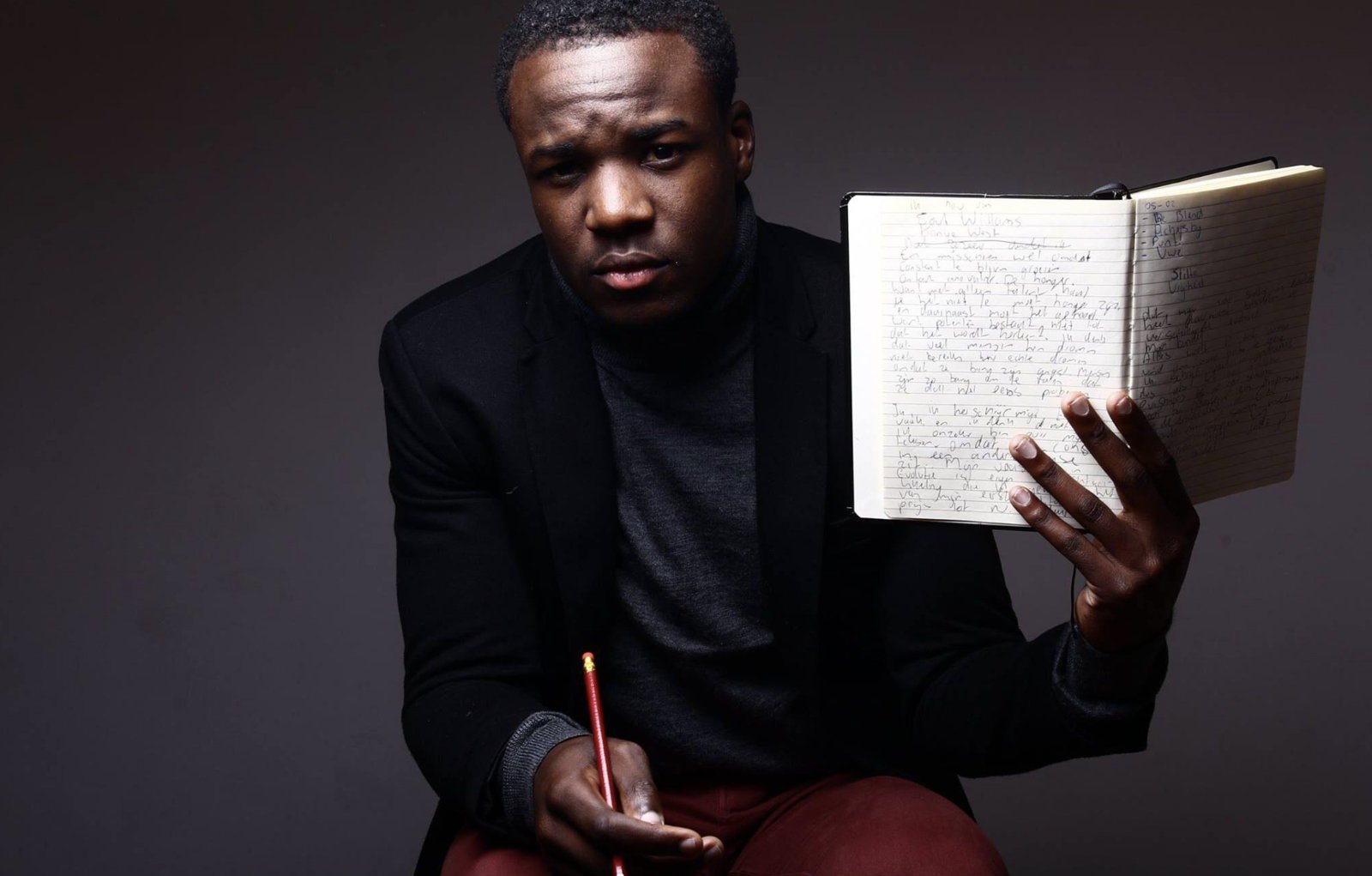
The boy who couldn't read well
Gershwin Bonevacia was about ten when it became clear that something was wrong. His results at school were lagging behind. Reading in particular was difficult. While other children got through texts more and more easily, he kept struggling with letters and words.
His reading level was in fact so low that there was doubt over whether he would be allowed to sit the Cito test, the national exam at the end of primary school, in groep acht, the final year. Assessment showed that he had dyslexia. He was given extra support. But that help consisted mainly of more practice. Even more reading, even more writing.
Only much later did Gershwin truly begin to understand what dyslexia meant for him. In a 2026 interview with the HOI Foundation he described how for a long time he had seen himself through the eyes of others. His school results and his difficulty with reading had affected his self-image.
What is remarkable is that it was in language, of all things, that he would eventually discover his greatest talent. Because when he couldn't spell a word properly, he had to think of something else. A synonym. A different description. Sometimes an entirely new image.
His disability forced him to be creative with language. What began as a way of avoiding difficult words became, years later, a recognisable part of his writing style.
From Curaçao to Rotterdam-Zuid
Gershwin was born in Rotterdam in 1992. He spent part of his childhood on Curaçao. In 2002 he returned to the Netherlands. He ended up in Rotterdam-Zuid, the south of the city, in the area around the Prinsenplein.
It was a neighbourhood where different cultures and lives crossed paths. Gershwin saw families who were doing well there, but also families facing serious problems. He learned at a young age how differently people can grow up.
Some children had a stable home. Others lived with insecurity, poverty or conflict. Racism, too, was part of the world he saw around him. As a child he could not yet make sense of many of those things.
Only later did he discover how much those experiences had shaped him. In 2024 he told Uitagenda Rotterdam that his childhood had taught him to embrace the differences between people and not to judge too quickly.
He wanted to understand why people did what they did. That curiosity would eventually form the basis of his work as a poet.
First he wanted to be a footballer
Like so many boys, Gershwin did not initially dream of a career as a writer. He wanted to be a professional footballer. He played in the youth ranks of Sparta Rotterdam. Football offered him a world with clear rules, a team and a goal.
But a professional football career never materialised. Gradually he discovered another way to express himself. He was inspired by stories about Nelson Mandela and became increasingly interested in social issues and in the power of words.
Instead of the football pitch, the stage eventually became his place. It is a remarkable turn. A boy who struggled with written language chose writing, of all things, as his main instrument.
Six thousand books, without a big publisher
In 2017 Gershwin brought out his first poetry collection: Ik heb een fiets gekocht (I Bought a Bike). Not through a major publishing house organising big campaigns for him. He published the book himself. And he went out and sold it himself.
It was an approach more reminiscent of an independent musician selling his own records than of the traditional literary world. Gershwin performed, met people and took his poems straight to his audience.
In the end he sold more than 6,000 copies. For a self-published poetry collection, that was a striking result. The book was later reissued by the publisher Das Mag. The boy who had found reading so hard at school had by now got thousands of people reading.
The city became his stage
In March 2019 Gershwin was appointed Amsterdam's eighth stadsdichter, or city poet. He was 26. The role put him in a special position. Amsterdam has a long literary history, with writers and poets who have described the city in countless ways.
Now a young poet with Curaçaoan roots and a childhood in Rotterdam-Zuid was given the task of putting the Amsterdam of his time into words. He wrote poems every month for Het Parool and performed at events in the city.
But his time as city poet was about more than official occasions. Gershwin also wanted to reach people who would normally hardly come into contact with poetry. Young people. People from different neighbourhoods. Amsterdammers who do not automatically recognise themselves in the traditional literary world.
For him, poetry should not exist only in books and theatres. It had to be able to live on the street too. His poems dealt with identity, origins, living together, vulnerability and the ways in which people can understand one another.
He held the post until January 2022. In 2024 De stad is ook van mij (The City Is Mine Too) was published, collecting his work as city poet. The title said a lot. Amsterdam does not belong only to the people who have lived there for generations, or to those who can afford to stay living in the heart of the city.
A new Amsterdammer can make the city his own too.
Back to the boy on the Prinsenplein
In 2023 Gershwin took a new step. He moved into theatre with the autobiographical show Terug naar Prinsenplein (Back to Prinsenplein). In it he returned to his childhood in Rotterdam-Zuid. To the ten-year-old boy.
To the events he had lived through as a child but only truly began to understand as an adult. The show was about family, identity, origins and social differences. But also about memories that keep resonating for years.
Audiences did not see a traditional play. Gershwin used poetry, spoken word, music and images to tell his story. The show was received with acclaim. NRC gave it five balls, the paper's top rating, and Het Parool counted the production among the best shows of 2023.
Gershwin performed the show almost a hundred times, in the Netherlands and the Caribbean. He played in places including Amsterdam, Rotterdam, Suriname, Bonaire and Curaçao. A special detail was that the show won the Wijkjuryprijs (neighbourhood jury prize) in both Amsterdam and Rotterdam.
It was precisely audiences who are not regular theatregoers who turned out to be moved by his story. The boy who had once struggled with his own words was now able to touch full houses with those same words.
A poet who doesn't only write for adults
Gershwin also remained committed to young people. That is understandable given his own experiences at school. He knows what it feels like to struggle with reading and writing while the world around you uses exactly those skills to judge how well you are doing.
He contributed to projects that bring children and young people into contact with poetry. He also translated books by the American poet and spoken-word artist Amanda Gorman, including Zo klinkt verandering (Change Sings) and Ooit, ergens (Something, Someday).
In 2022 he co-wrote 3PAK, the free gift of the Boekenweek van Jongeren, the Dutch youth book week. For the first time a poet was part of the writing team. It underlined his conviction that language is not just for a certain group of people.
Everyone can tell a story. And sometimes it is precisely people who struggle with language who find an unexpected way to use it.
An important moment for Amsterdam
In 2024 Gershwin stood on the stage of the Ziggo Dome during the festive opening of the celebrations for Amsterdam's 750th anniversary. It was a big moment in a city he had represented as city poet only a few years earlier.
His own career now ranged from small poetry performances to large theatres and national events. But he kept looking for new forms. In 2025 a short film was released based on his collection Toen ik klein was, was ik niet bang (When I Was Little, I Wasn't Afraid).
That same year he appeared at the theatre festival De Parade with Gershwin Unplugged, in which he showed more of his musical side. In his work, poetry became increasingly linked with jazz, soul, rap and other musical influences.
He was no longer just a poet. He was developing into an artist who brought different disciplines together.
2026: the highest recognition for his words
On 24 January 2026 came remarkable news. Gershwin Bonevacia was awarded the Gouden Ganzenveer (Golden Goose Quill). It is an important Dutch cultural award for someone who has meant a great deal to the written word.
Gershwin was 33. That made him the youngest winner in the history of the prize. Previous recipients included Adriaan van Dis, Geert Mak and Nelleke Noordervliet. The jury praised his use of language, his social engagement and his ability to connect people through his poems.
Jury chair Kim Putters highlighted, among other things, his bond with his Curaçaoan background and with young people who, like him, have dyslexia. On 13 April 2026 the prize was presented in Amsterdam. The contrast with his childhood could hardly have been greater.
At primary school there had been doubts over whether he could read well enough to take part in the Cito test. More than twenty years later he received one of the most important Dutch awards for language and literature.
Not in spite of the fact that he approached language differently, but partly thanks to the creativity he had developed in the process.
Why dyslexia is more than a disability for him
In 2026 Gershwin spoke candidly with the HOI Foundation about his experiences with dyslexia. He said that as a child he was mainly given extra exercises, but little explanation of what dyslexia actually meant.
A lot of attention went to the things that were not going well. Much less to the ways in which his brain worked differently. Later he discovered that his unusual relationship with language had also given him something.
Because he sometimes couldn't spell words, he went looking for alternatives. As a result he developed a large vocabulary and learned to think in images and metaphors. That did not mean the problems went away.
But he learned to look at his own abilities differently. It is an important part of his story. Not because every pupil with dyslexia can end up becoming a well-known writer. But because success at school does not always predict which talents someone will develop later on.
His new world: music
In the summer of 2026 Gershwin was back at De Parade, this time with the music show Gershwin's Garden. He combined spoken word, singing and music. In the same year he was working on Omhoog (Upwards), his announced debut album.
He also performed with a live band and the ZO! Gospel Choir in museums, including the Van Gogh Museum in Amsterdam. The project Concert at the Museum brought poetry together with gospel, jazz, soul and rap. So Gershwin did not rest on his success as a writer.
He explored how his words could change when they became part of music. After the poetry collections, the city poet role and his theatre work, this became a new chapter in his artistic life.
From Rotterdam-Zuid to Amsterdam, and beyond
Gershwin is not an Amsterdammer who has lived in the same street all his life. He was born in Rotterdam, grew up partly on Curaçao and spent important years of his youth in Rotterdam-Zuid. Only later did Amsterdam become his home.
That perhaps makes him an especially interesting Amsterdammer for this series. After all, a city is not made up only of people who were born there. It is also made up of people who come to it, grow there and add something to it.
For three years Gershwin gave Amsterdam words as its city poet. He wrote about the people and events that shaped the city. And Amsterdam gave him a stage on which he could develop further.
His story connects different places, cultures and generations. Not because they are all the same. But because together they are part of who he has become.
The boy who found his own words
At 33, Gershwin has already achieved a great deal. He has sold thousands of books, won national prizes, filled large venues and spent years writing poems on behalf of Amsterdam. But his story does not begin with a prize or a stage.
It begins with a boy at primary school who struggled to read. A boy whose marks lagged behind and whose future was anything but certain. A boy who discovered that words could be complicated, but could also produce something beautiful.
And who never stopped searching for his own way of using them. That he eventually became a poet is remarkable. That he became the youngest winner of an important Dutch language prize is exceptional.
But perhaps the most important part of his story lies elsewhere. In the fact that he has not only found a place for himself in the world of literature, but is also trying to make that world more accessible to others.
For young people who don't recognise themselves in books. For people who think poetry isn't meant for them. And for children who struggle with reading and writing at school and may therefore start to doubt their own abilities.
Gershwin Bonevacia shows that you don't always have to be good at the way something is taught in order to eventually do something special with it. And that makes him a remarkable Amsterdammer.
Sources
Official biography at gershwinbonevacia.nl, interview about dyslexia with the HOI Foundation (2026), NOS on the Gouden Ganzenveer (24 January 2026) and an interview in Uitagenda Rotterdam (2024). This portrait is based on public sources and does not contain a new interview.
Comments (0)
Log in to leave a comment.
More stories about Amsterdam
All stories →
The siege of Felix Meritis: the day Amsterdammers turned on each other over a war 1,500 kilometres away
Redactie Amsterdammers.love · 17 min read

Zoë van der Meer (16): the girl who no longer dared go to school, and wrote a book about it
Redactie Amsterdammers.love · 10 min read
Vlieger: the Amsterdam paper shop that has refused to be ordinary for 157 years
Redactie Amsterdammers.love · 15 min read