Amsterdammer · week 39
Hans van Onna: the Amsterdammer who was still teaching exercise classes to other older people at 96
He grew up in pre-war Amsterdam, served two years as a soldier in the Dutch East Indies, built up a clothing company with sixty employees and watched an entire industry disappear. But when Hans van Onna retired, perhaps the most remarkable chapter of his life began. He became the eyes and ears of the Indische Buurt, wrote dozens of stories about his neighbourhood and, at 96, was still teaching exercise classes to other older people. His life story spans almost a century of Amsterdam history.
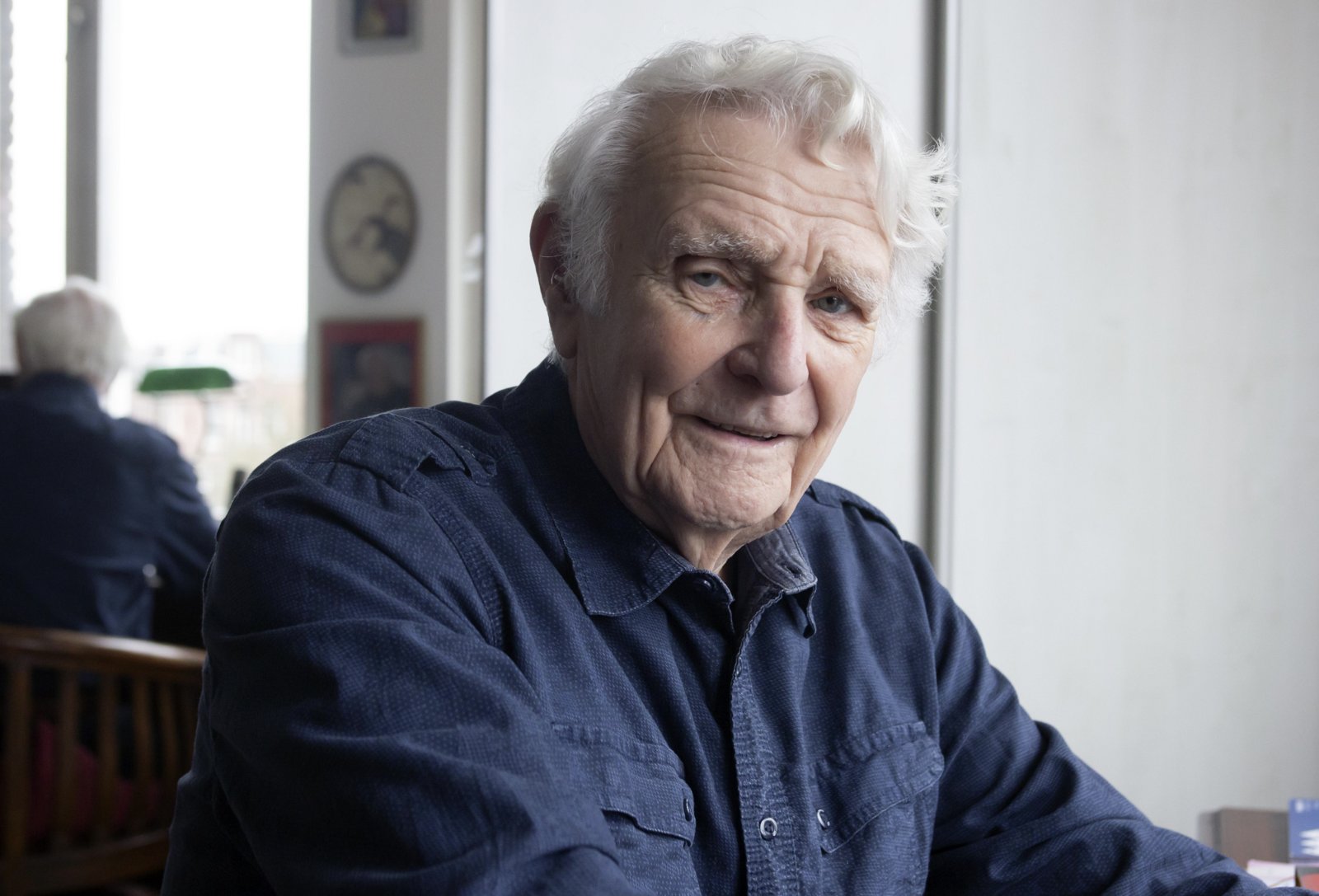
The 96-year-old exercise teacher
It is July 2025. At Dagcentrum Kramat, a day centre in Amsterdam-Oost, a group of older people are ready for a quarter of an hour of exercise. Most of the participants are sitting on chairs. Carefully, they move their arms, stretch their legs and follow the instructions of the man sitting in front of the group. Their exercise teacher is called Hans van Onna.
He is 96 years old. Hans is actually a visitor to the day centre himself. Two days a week he comes in for activities, a cup of coffee and some company. But one day the regular exercise instructor was unable to come. Hans put his hand up.
Might he perhaps take over? He had once done a course in leading exercise activities for the over-sixties. Why not put that knowledge to use? The staff discovered that Hans was excellent at motivating the group.
And so a new habit was born. When Hans is there, people get moving. In July 2025, a journalist from the local newspaper de Brug came to see how it all worked. Hans took a moment to get used to having a photographer there. But the exercises carried on as normal.
He encouraged the group and made sure everyone joined in.
A 96-year-old man helping other older people to keep moving.
Anyone who knows only that story knows just a small part of what Hans has experienced in his life.
A boy from Amsterdam-West
Hans was born around 1928 or 1929 and grew up on the Van Kinsbergenstraat, in the Chassébuurt in Amsterdam-West. It was a different city from the Amsterdam of today. Daily life took place much more within your own neighbourhood. There were small shops, craftsmen and shopkeepers who knew their customers personally.
People bought their goods from the butcher, the baker and the shopkeeper round the corner. The Van Onna family knew the world of trade well. Hans' father dealt in meat and visited butchers to sell his products. Two uncles had shops on the Damrak. One was a pastry baker, the other had a chocolate shop.
In those days, working often meant long days. For small business owners, a holiday was by no means a given. Hans later recalled that his father never really went on holiday. There was work to be done.
These were the years when Amsterdam was still shaped to a large extent by the small independent business owner. People who started early, came home late and sometimes ran their business for their whole lives. That world would have a great influence on Hans' own career.
His father's bowler hat
One of Hans' earliest memories takes place at the Begijnhof, the city's historic almshouse courtyard. He was about five years old when he went there with his father. At that time, the Catholic faith played an important role in the daily lives of many Amsterdam families. The churches were often well attended.
One special Catholic tradition was visiting seven churches. As a little boy, Hans went along with his father too. His father wore a bowler hat for the occasion. As they approached a church, he would briefly raise his hat as a sign of reverence.
It was a small gesture that made a deep impression on Hans. Almost ninety years later he still remembered it exactly. In June 2024, Hans stood at the Begijnhof once more, this time during a celebration at the Catholic chapel. By then he was 95 years old.
He told those present about the walks he had taken with his father as a five-year-old boy. And he had brought something special with him. His father's bowler hat. An object from an almost vanished world.
He held the hat up and explained how his father used to use it. It was a special moment. A 95-year-old Amsterdammer standing in the same spot where, ninety years earlier, he had walked with his father as a little boy. The city had changed.
The people were gone. But the memory had remained.
Two years in the Dutch East Indies
Hans also experienced a very different side of Dutch history. After the Second World War, he served two years as a soldier in the Dutch East Indies, present-day Indonesia. In those years, the Netherlands tried to use military force to hold back the independence movement in its former colony. It was a period of war, violence and great loss of life.
In public interviews, Hans has said little about exactly what he experienced there. Speaking to the magazine Ons Amsterdam in March 2025, he described himself as a veteran.
It is an important chapter in his life, but also a chapter that raises questions. Where exactly was he stationed? What did he go through?
How did he later look back on his role as a soldier? And how did his view of the Dutch colonial past change in the decades that followed? Those personal answers have not been recorded in any detail in the public sources. But one thing is clear: Hans belonged to a generation who were sent to the other side of the world as young men and then returned to the Netherlands with those experiences.
For many of them, that past stayed with them for a lifetime.
A business owner with sixty employees
After his time in the army, Hans built a life in business. He became an entrepreneur in the sportswear industry. Over the years his company grew into a business with around sixty employees. Sixty people.
A company of that size meant a great deal of responsibility. Customers had to be found, products made and employees paid. Hans worked hard. The business demanded much of his time and energy.
But meanwhile the clothing industry was changing. More and more production moved to countries where wages were lower. India, Indonesia and Bangladesh, among others, became major manufacturing countries. As a result, Dutch textile and garment companies faced ever more competition.
For many businesses it became impossible to keep producing in the same way. Hans was affected by this too. His company was eventually wound up. In 1998 he retired.
In an interview with Ons Amsterdam years later, he said that he often thought back to that difficult period. It had not been easy. A business you have worked on for so many years does not simply vanish from your thoughts. But for Hans, the end of his company did not mean the end of his working life.
It became the beginning of a new chapter.
A fresh start in the Indische Buurt
On 19 March 1998, the first residents moved into a new residential building on the Sumatrastraat. The building was named De Mammoet. It had twenty owner-occupied flats and twenty rented flats. Hans and his wife Innes chose a flat on the fourth floor.
With a lift, so that the flat would remain easy to reach in old age. The building was in the Indische Buurt, a neighbourhood in Amsterdam-Oost whose streets are named after places in the former Dutch East Indies. A district that was very much on the move in the 1990s. Hans barely knew Amsterdam-Oost from his youth.
In fact, his parents had warned him as a boy not to wander around there. They thought some parts of the neighbourhood were too rough. In his youth, the colonial museum, today's Wereldmuseum, was regarded as more or less a boundary. But now, seventy years later, he was going to live there himself.
And in time he would feel completely at home there.
The man who wanted to improve his street
When Hans and Innes moved into De Mammoet, the residents still had to get to know each other. The building was new and everyone was starting a new chapter at more or less the same time. Hans saw this as a good opportunity to do something for the area. Together with Innes and other residents, he began working for the neighbourhood.
They cleared up litter. They removed bottles and plastic from the square. They helped create façade gardens, the narrow strips of planting along the fronts of houses. And Hans organised activities for his fellow residents.
For him, a neighbourhood was not just the place where you lived. It was a community to which everyone could contribute. As early as 2003, a story about his involvement appeared on Geheugen van Oost. At the time, Hans used email to keep in touch with the district council and the environmental police.
If there was a nuisance, he reported it. If something could be improved, he offered ideas. He was also involved with the neighbourhood website Cyburg, a digital initiative of what was then the Zeeburg district. For it, he visited schools, businesses and other organisations.
He took photographs and collected stories. At an age when many people slowly become less active, Hans discovered a whole new world. That of neighbourhood journalism.
Fourteen binders full of stories about his neighbourhood
Hans began writing more and more about the Indische Buurt. He followed changes in squares and streets. He visited special places. He photographed activities.
And he recorded memories. His stories appeared on, among other places, Geheugen van Oost ("Memory of the East"), a website on which residents share their memories and experiences. In 2013, for example, Hans described how the small Atjehplein was redesigned. Residents had contributed ideas to the plans.
The square was given new paving, benches, greenery and three special trees. A walnut tree. A sweet chestnut tree. And a honey tree.
Hans followed the work and wrote about it. He saw how the first residents used the new benches and how children began to play on the square. He was proud of the improvement. But he immediately asked himself whether the neighbourhood would keep the square tidy.
It is typical of his commitment. Hans did not just want the council to create something nice. He felt that residents should then look after it together. In March 2025, he said that he keeps his chronicles in binders.
He had reached number fourteen, containing 75 stories. That is perhaps his most important contribution to the history of Amsterdam-Oost. Because while cities are constantly changing, many small stories disappear unnoticed.
The opening of a shop. The arrival of new residents. The laying out of a small park. The memories of people who lived there for many years.
Hans recorded them.
The world from his own cockpit
In 2025, journalist Katja Kreukels visited him for Ons Amsterdam. She sat with Hans in the study at his home. From the window he looked out over the Sumatraplein and the surrounding streets. For Hans, that view was almost an observation post.
He could see when rubbish was left lying around. When people threw bread down for the birds, which also attracted rats. Or when a shop changed hands. He knew many of the business owners in the neighbourhood.
With some of them he had a special bond because he had been a business owner himself for many years. He understood their worries about rent, customers and turnover. He liked chatting with the cheesemonger across the road, for instance. He enjoyed asking how business was going.
Or paying a compliment on a nice shop window. These are conversations that seem unimportant at first glance. But they make sure people know each other. And that was exactly what Hans considered important.
The ironmonger's that disappeared
Some of the changes in the area Hans found a pity. Such as the disappearance of Theo van Kalken's ironmonger's. In the old days you could walk in there if you needed a single screw. You didn't have to buy a whole pack.
The owner gave advice and helped you out. The shop was part of the familiar network of the neighbourhood. When it disappeared and made way for a hairdresser, what Hans missed most was the personal service. Not because everything was better in the old days.
But because some small shops offered something that big chains and online shops find hard to replace. Attention. Expertise. And the feeling that you were known as a customer.
In that, Hans recognised something of the world in which his father and uncles had worked. A world of small independent traders who spent their whole lives among their customers.
A broken hip changes his life
Around 2020, Hans was faced with a life-changing event. He broke his hip. At an advanced age, a fracture like that can have serious consequences. Hans had to undergo rehabilitation at the Flevohuis.
He received therapy and learned to use a rollator. A muscle disease also made it difficult for him to use his hands. That made everyday tasks more complicated. For example, he could no longer easily type up his stories himself.
For a while someone helped him with this, until that person moved away from Amsterdam. His mobility declined too. Where Hans used to walk the whole neighbourhood, he became increasingly dependent on aids and support. But his need to stay active did not go away.
He kept walking whenever he could. And when he started coming to Dagcentrum Kramat, he once again found a way to do something for others.
A home-made bag for his rollator
When de Brug visited in July 2025, Hans was sitting at a sewing machine. Next to him stood a cup of coffee. He was working on a practical project. His rollator worked perfectly well.
But something was missing. A handy bag in which he could keep his phone and wallet. So he decided to make a solution himself. It was a small project, but it revealed something of his past.
After all, Hans had worked in the clothing industry for decades. He knew how to handle textiles. And despite his physical limitations, he enjoyed making something himself. So for him, the day centre was not just a place where he received care and company.
It was also a place where he could keep using his knowledge and skills.
Sixty-six years together
In 2025, Hans and Innes had been married for 66 years. A marriage that began in a very different time. Together they had been through a business, a family and various stages of life. They had known difficult times.
And they had grown old together. In 2025 they were still living independently on the Sumatrastraat. Innes was by then ninety years old. She was also Hans' carer.
The visits to Dagcentrum Kramat gave them both some breathing space. Hans could do activities there, meet people and run his exercise class. That gave Innes a temporary break from her caring duties. Hans joked that it was also good not to be sitting at home together all the time.
After so many years of marriage, they naturally knew each other inside out. But a little variety was welcome. It is a lovely detail in his life story. Because behind the active resident, business owner and volunteer was also a man who had shared his life with the same woman for decades.
Almost a century of Amsterdam in one life
Hans has lived through almost a century of Amsterdam. The Amsterdam of small shopkeepers.
Of pre-war Catholic traditions. Of the Second World War and the aftermath of Dutch colonial history. Of the rise and fall of the Dutch clothing industry. And of urban renewal in the Indische Buurt.
He saw the city change. But he also kept actively contributing to it himself. Not by putting up great buildings or holding important political office. But by paying attention to the streets, shops, squares and people around him.
The value of someone who keeps taking part
So what actually makes Hans van Onna so special? Perhaps not his age. There are other Amsterdammers who live to be over ninety. And there are other people who ran a business for many years.
What is special is the combination. A man who, after a busy life in business, found new meaning in his neighbourhood. Who did not keep his experiences to himself, but began collecting stories. Who, at an advanced age, kept helping to improve his surroundings.
Who went to a day centre with a rollator and did not just take part in activities there, but started running one himself. It is tempting to see old age mainly as a period in which people can do less and less. Hans' life shows another possibility. That someone can still contribute, even with physical limitations.
That knowledge and experience remain valuable. And that you don't have to stop being curious about the world around you.
An Amsterdammer who won't let go of his city
In 2025, Hans said that he never wanted to leave the Indische Buurt. He felt at home there. He knew the people. He knew the shops.
And for years he had worked to make the neighbourhood a little nicer and friendlier. Perhaps that is the most beautiful thing about his story. He only moved there when he retired. After a long and busy working life, he could have chosen to enjoy his old age quietly behind his own front door.
But Hans did the opposite. He went outside. He got to know people. He cleared up litter.
He wrote stories. He organised activities. And at 96 he was even teaching exercise classes.
Hans van Onna shows that you are never too old to do something for your neighbourhood. And that a city is built not only by architects, administrators and entrepreneurs, but above all by people who feel responsible for the place where they live.
And that makes him a remarkable Amsterdammer.
Sources
Ons Amsterdam (Katja Kreukels, Ik vind het jammer dat de ijzerwinkel er niet meer is [I'm sorry the ironmonger's is no longer there], 3 March 2025), de Brug (Linda van den Dobbelsteen, In Dagcentrum Kramat weet iedereen: als Hans (96) er is, gaan we gymmen [At Dagcentrum Kramat everyone knows: when Hans (96) is here, we exercise], 16 July 2025) and stories by Hans van Onna himself on Geheugen van Oost. This portrait is based on public sources and does not include a new interview with Hans van Onna.
Comments (0)
Log in to leave a comment.
More stories about Amsterdam
All stories →
The siege of Felix Meritis: the day Amsterdammers turned on each other over a war 1,500 kilometres away
Redactie Amsterdammers.love · 17 min read

Zoë van der Meer (16): the girl who no longer dared go to school, and wrote a book about it
Redactie Amsterdammers.love · 10 min read
Vlieger: the Amsterdam paper shop that has refused to be ordinary for 157 years
Redactie Amsterdammers.love · 15 min read