Event · week 18
No home, no coronation: the day Amsterdam became a battlefield
On 30 April 1980 Amsterdam was supposed to throw one big party. Princess Beatrix was becoming queen, the Dam was packed with onlookers and the Dutch political and royal elite had gathered in the Nieuwe Kerk. But a few streets away, paving stones were flying through the air. Water cannon drove through the city centre, barricades were set alight and thousands of demonstrators clashed with the police. By the end of the day almost two hundred people had been injured. It became one of the most violent days in Amsterdam's post-war history.
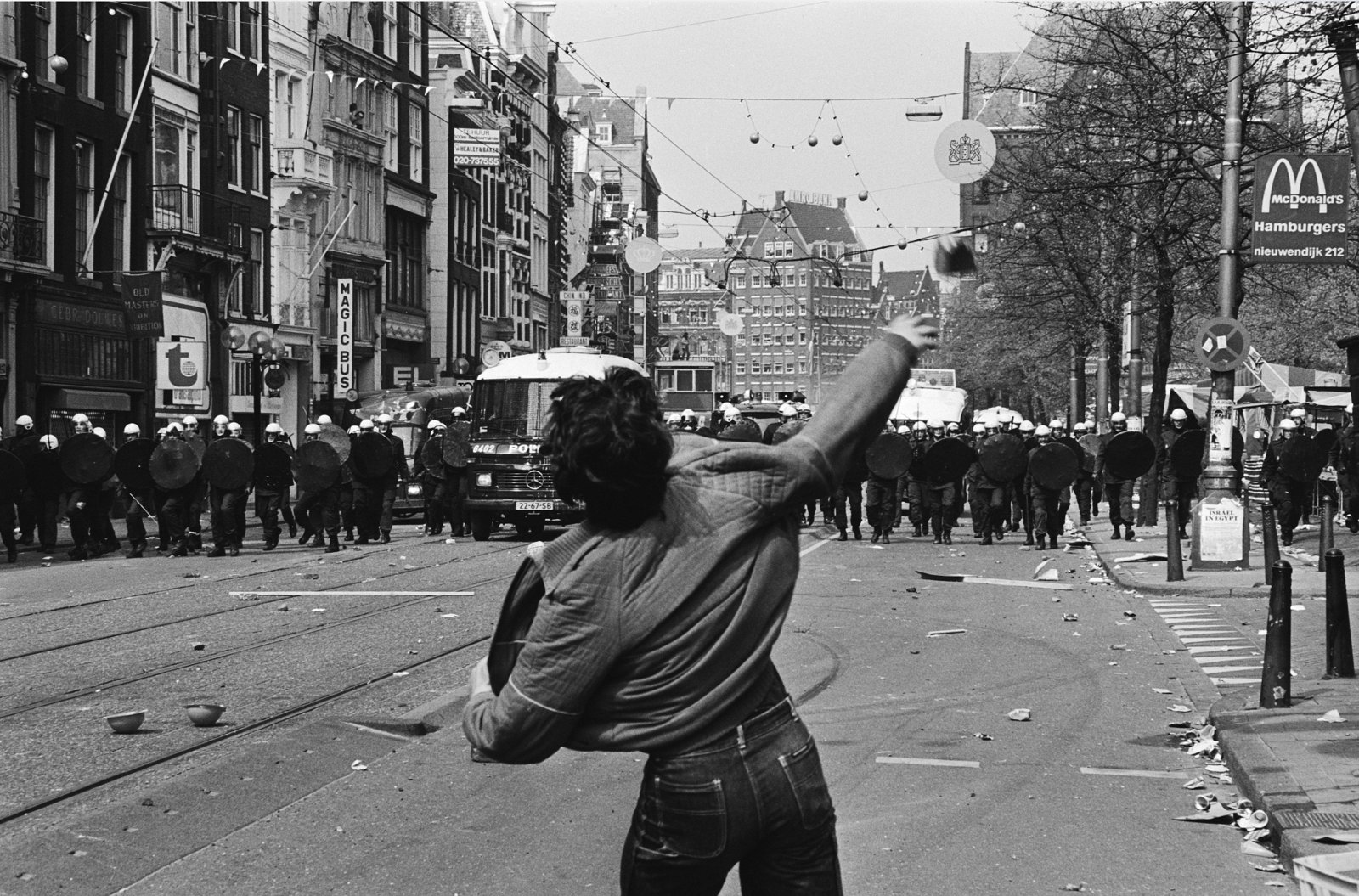
A festive day nobody would forget
It is Wednesday 30 April 1980. Amsterdam is preparing for a special occasion. After more than 31 years on the throne, Queen Juliana is abdicating. Her eldest daughter Beatrix is to become the new Queen of the Netherlands. The city is decked out with flags. Stands have been built, streets closed off and thousands of police officers called in to keep the peace.
For the royal family it is meant to be a historic day of celebration. But the mood in Amsterdam is tense. All over the city, posters carry a very different message. Geen woning, geen kroning (No home, no coronation). It is the slogan of the kraakbeweging, the squatters' movement. The activists find it incomprehensible that millions are being spent on the royal festivities while thousands of Amsterdammers cannot find an affordable home.
They have announced that they will not let the inauguration pass unnoticed. And this time those are not empty words.
Amsterdam has a huge housing problem
At the end of the 1970s Amsterdam is in the grip of a housing crisis. Young people and students in particular can barely find anywhere to live. The waiting lists are long. Many old homes are in poor condition. At the same time buildings stand empty, sometimes for years, because their owners are waiting for demolition, renovation or a more lucrative use. For young Amsterdammers that is hard to accept.
Why are houses standing empty when so many people have nowhere to live? As a result the squatters' movement grows fast. Young people move into empty buildings and make them fit to live in. Sometimes that happens without much trouble. But more and more often there are confrontations with owners and the police. At that time squatting is legally possible under certain circumstances. Especially when a building has been empty for a long time, squatters have ways of being allowed to stay.
It leads to a peculiar situation. While the city tries to renew itself, groups of residents take matters into their own hands. The squatters' movement becomes ever better organised. There are squatters' cafés, action groups, print shops and its own communication networks. For many participants it is not only about a roof over their heads. They want a different city. A city in which housing matters more than property ownership and speculation.
De Groote Keijser: a symbol of resistance
One of the best-known squats is on the Keizersgracht. There, a row of six squatted buildings becomes known as De Groote Keijser. The residents expect an eviction. They build barricades and prepare to defend the building. De Groote Keijser becomes a symbol of the movement. Not just because of the homes.
But because the squatters want to show that they will no longer simply let themselves be sent away. The authorities fear an eviction could lead to serious violence. Mayor Wim Polak is worried that people might be killed. Tensions keep rising. And then, in March 1980, something happens that changes relations in the city for good.
The tanks in the Vondelstraat
On 29 February 1980 a building on the Vondelstraat is squatted again. The police try to intervene. But the squatters and their sympathisers put up fierce resistance. Barricades are erected. Paving stones are prised from the road. And the Mobiele Eenheid, the Dutch riot police, finds itself facing a large crowd of demonstrators who refuse to leave.
The confrontations last for days. In the early morning of 3 March the government decides to bring in heavy equipment. Armoured vehicles roll into the Vondelstraat to clear the barricades. The images are seen all over the country. Armoured military vehicles driving down a residential street in Amsterdam. Not in wartime. But in a dispute over squatted homes.
For many Dutch people the images are shocking. For the squatters' movement they confirm the feeling that the government is prepared to go a long way to uphold its authority. And for the police they make clear that the confrontations are becoming ever more dangerous. Beatrix's inauguration is scheduled just eight weeks later. The authorities know it could go wrong again.
The mayor fears the worst
When Queen Juliana announces on 31 January 1980 that she will abdicate on 30 April, Mayor Wim Polak is immediately worried. Under the Dutch Constitution the inauguration of a new king or queen must take place in Amsterdam. Moving it elsewhere is therefore not a simple option. Polak also remembers the events of 1966.
That year Beatrix married the German diplomat Claus von Amsberg. Smoke bombs were thrown at the wedding procession and riots broke out in Amsterdam. But the situation in 1980 is far more serious. The squatters are better organised. Relations with the police have deteriorated sharply. And there are now groups who want to go further than peaceful protest.
The city prepares for an exceptional security operation. Police officers are called in from all over the Netherlands. Plans are drawn up and routes closed. But nobody knows exactly what will happen on 30 April.
The morning begins with a squat
On the morning of 30 April the first groups of squatters take to the streets. At the junction of the Kinkerstraat and the Bilderdijkstraat an empty building is squatted. The action has a clear message. While the Netherlands prepares for the inauguration of a new queen, the squatters want to show that there are still people in Amsterdam without a home.
The police intervene. The Mobiele Eenheid's orders are initially mainly to keep the tram lines clear. But poor communication causes confusion about what exactly needs to be done. Officers try to clear the building. Fierce confrontations break out. Demonstrators throw stones. The riot police charge. Early in the day people are already being injured.
The violence spreads. And while the official ceremonies have yet to begin, part of Amsterdam has already become a battleground.
10.06 am: Beatrix becomes queen
At 10.06 am Beatrix is officially Queen of the Netherlands. Queen Juliana has abdicated. The formal transfer of the throne takes place in the Paleis op de Dam, the Royal Palace on Dam Square. The inauguration in the Nieuwe Kerk follows later. Inside, a solemn ceremony unfolds. Members of the Staten-Generaal (the Dutch parliament), ministers, foreign guests and representatives of the royal house are present.
Beatrix wears the historic royal mantle. Music is performed, including Mozart's Coronation Mass (Krönungsmesse). But outside the sounds are very different. Police sirens. Helicopters. Whistling and jeering. And, more and more often, the sound of breaking glass and exploding smoke bombs. The two worlds are within walking distance of each other. Inside, a new monarch is being inaugurated. Outside, thousands of people are trying to make their discontent visible.
The demonstration from the Dokwerker
At two o'clock in the afternoon a large demonstration begins at the Dokwerker (the Dockworker statue) on the Jonas Daniël Meijerplein. The participants want to march to the Dam. There are squatters, left-wing activists, autonomists, young people and other demonstrators. Groups that are mainly out for confrontation join in too. According to historical reconstructions, they include football supporters from Ajax's hard core.
So it is not a homogeneous group. Not everyone has come for the same reason. Some want to protest peacefully against the housing shortage. Others are against the monarchy. Others again want to confront the police. But one slogan rings out everywhere. Geen woning, geen kroning. The police have orders to prevent the demonstrators from disrupting the inauguration on the Dam.
So key access routes are sealed off. One of those places is the Blauwbrug. And it is precisely there that the conflict will escalate completely.
The Battle of the Blauwbrug
The Blauwbrug connects the Waterlooplein with the area around the Amstelstraat. It is an important route towards the centre. The demonstrators want to cross it. The Mobiele Eenheid tries to stop them. Within a short time a major confrontation develops. Stones are thrown. Police officers charge. Tear gas is used. The bridge and the surrounding streets turn into a chaotic battleground.
The riot police try to push the demonstrators back, but the crowd is large. Some groups manage to break through the police lines. Others move off into the surrounding streets. The violence shifts towards the Amstelstraat and the Rokin. Again and again the police try to form new lines. But it is hard to keep track of what is going on.
Different groups of demonstrators are moving through the inner city. And then it turns out that the police communication system is not working properly either.
The squatters disrupt the police radio
One of the strangest details of the coronation riots is that the police cannot always communicate reliably with their own units. A jamming transmitter is used from De Groote Keijser to disrupt the police radio traffic. Officers hear whistles and interference on their channels. That causes confusion. Officers sometimes do not know where reinforcements are needed.
Orders reach units too late or not at all. And the situation keeps changing. New confrontations break out at the Blauwbrug, the Waterlooplein and the Rokin, while the commanders try to get their people to the right place. Remarkably, some of this radio communication has survived. In 2024 the Scannermuseum received cassette tapes with recordings of the police radio channels from that day.
On them you can hear the conversations between police units caught up in the middle of events. Not as a reconstruction recorded later. But as genuine communication from 1980. You hear the police trying to understand what is happening on the streets. And how hard it is to bring the situation under control.
Water cannon and burning barricades
On the Rokin the confrontations get further out of hand. Demonstrators break up paving stones. Barricades are built. Rubbish and other material is set on fire. The Mobiele Eenheid deploys water cannon. Armoured vehicles drive through the streets. The images from that day become world-famous. A water cannon driving through the centre. Demonstrators running through clouds of smoke.
Paving stones flying at police vans. And officers with shields and helmets trying to advance. But not everyone out on the street is taking part in the violence. There are also curious bystanders, residents, journalists and visitors who had come to Amsterdam for the royal festivities. Sometimes they unexpectedly find themselves caught up in the middle of the clashes.
Reporters are in danger too. Surviving television footage shows journalists trying to do their work between the police and the demonstrators. By now the city centre is barely recognisable as the festive place it was supposed to be that morning.
The police commander who thought he might have to give the order to shoot
One of the most harrowing stories about the coronation riots comes from police commander Joop van Riessen. On 30 April he is responsible for a large part of the inner city. Years later he tells NPO Radio 1 about an order he had been given that day. The inauguration had to go ahead no matter what. And if demonstrators actually forced their way into the Nieuwe Kerk and threatened the ceremony, he was, as a last resort, to give the order to shoot.
Van Riessen later described how heavily that order weighed on him. At the Rokin he stands with other officers facing the advancing demonstrators. Some officers are wearing ordinary police uniforms. They do not have the same protective gear as the Mobiele Eenheid. The tension is enormous. The demonstrators are approaching the Dam. But in the end the innermost line of defence is not breached.
The feared scenario does not come to pass. No live rounds are fired at the demonstrators. In hindsight that turns out to be one of the most important facts of the day. Despite the enormous violence, nobody is killed.
Inside, the ceremony simply carries on
While outside the city seems to be on fire, the inauguration in the Nieuwe Kerk continues. Beatrix addresses those present. She reflects on the changes and uncertainties in society. It is a striking contrast. The new queen speaks about responsibility and the future of the country. Outside, young people are protesting because they feel their own future is being blocked by the housing shortage.
The ceremony is not cut short. The traditional balcony scene goes ahead too. The royal family appears on the balcony of the Royal Palace on the Dam. There are cheers from the square. For the television cameras, the inauguration thus seems a success. But out of the royal family's direct view, the riots go on. According to the Stadsarchief (Amsterdam City Archives), Princess Juliana later told Mayor Polak that she and some of her grandchildren had watched the fighting in the Damstraat and Oude Hoogstraat from an upper floor of the palace.
It must have been a strange sight. A few hours earlier, after more than thirty years, she had taken leave of the throne. Now, from inside the palace, she watched the streets of Amsterdam turn into a combat zone.
Almost two hundred injured
Calm does not return until late at night. The damage is enormous. According to an overview by NOS, the Dutch public broadcaster, more than a hundred civilians and 93 police officers are injured. Other historical publications give higher totals, depending on which injuries and records are counted. The exact number of injured therefore varies from source to source. But that there were a great many is beyond doubt.
Dozens of arrests are made. The streets are strewn with stones, shards of glass and rubble. Police vehicles have been damaged. Shops and other buildings have suffered damage. The total material damage is later estimated at around 7.5 million guilders. An enormous sum for the time. But perhaps most remarkable of all is that nobody is killed. Given the scale of the violence and the risks on the streets, the day could have ended very differently.
The new queen visits injured officers
The day after her inauguration, Beatrix visits seven injured police officers in hospital. It becomes one of her first public acts as queen. With that, the day after the festive transfer of the throne takes on a very different meaning. Instead of looking back only on a successful inauguration, much of the attention goes to the violence that has struck the capital.
Mayor Polak also has to deal with the consequences. He receives letters from all over the country. Some people express their support for the police. They feel the demonstrators went much too far. Others are furious about the conduct of the Mobiele Eenheid. They describe excessive violence and feel that innocent bystanders were also treated harshly.
The Stadsarchief still keeps files containing complaints, messages of support, operational plans, damage reports and lists of the injured. In total there are 110 police files relating to this single day. An impressive administrative legacy of an event that would preoccupy Amsterdam for years to come.
A city that had to find itself again
After 30 April 1980 relations between the squatters' movement and the authorities change. The violence has made a deep impression. The police take a critical look at their own organisation, communication and way of operating. The squatters' movement comes under pressure too. Some sympathisers feel the violence went too far. Others feel instead that the events showed how harshly the authorities deal with people who resist.
The conflict is not easily resolved. In the years that follow there are more major confrontations over squatted buildings. The debate about housing, vacancy and ownership remains an important part of Amsterdam politics. But the coronation riots of 1980 become the best-known symbol of that period. A day on which the city's various tensions came together. And on which the violence became so great that even experienced police commanders feared people would be killed.
A book about the Battle of the Blauwbrug
The events also make a deep impression on artists and writers. In 1983 De slag om de Blauwbrug (The Battle of the Blauwbrug), a novella by A.F.Th. van der Heijden, is published. The story is linked to the events of 30 April 1980 and describes the atmosphere of a city in which demonstrations and violence run into one another. The book becomes part of his larger cycle of novels, De tandeloze tijd (The Toothless Time).
With that, coronation day also earns a place in Dutch literature. Not only as a historical fact. But as an event that reveals the feelings and tensions of an entire generation. For the riots were more than a conflict between squatters and police. They were also a clash between different visions of the Netherlands. On one side, a country proud of tradition, monarchy and continuity.
On the other, young people who felt that existing society offered too little room for their future. On 30 April 1980 that contrast proved particularly explosive.
The old radio tapes resurface
More than forty years after the riots, new historical material unexpectedly comes to light. In 2024 the Scannermuseum receives a collection of cassette tapes with recordings of police communications during the inauguration. The recordings were made at the time with a radio scanner. On the tapes you can hear conversations between the Mobiele Eenheid, the traffic police, patrol units and other services. They are remarkable documents.
Because many historical reconstructions are based on the memories of people recounting events decades later. These recordings come straight from the day itself. You hear confusion. Orders being given. Units trying to reach one another. And in between the conversations you can hear how various services still have to carry out ordinary police work. There are reports that have nothing to do with the riots.
A missing little dog. A broken radio set. A vehicle that needs fuel. It is an unexpected detail. While large parts of the centre are in chaos, ordinary life in the rest of the city simply goes on.
2025: the eyewitnesses speak again
In August 2025 the radio programme De Publieke Tribune turns its attention to the coronation riots. By then it is 45 years ago. Presenter Liesbeth Staats talks to people who experienced the events up close. Both on the side of the demonstrators and on the side of the police. The broadcast does not only look back on the violence. It also asks another question.
What is left of the ideals of that time? For many participants, after all, the housing shortage was the main reason to take to the streets. They wanted affordable homes, a different distribution of the available space and more say in how their city developed. Social circumstances have changed a great deal since then. Squatting has been illegal since 2010.
The city has renewed many neighbourhoods. And in many respects Amsterdam has become more prosperous. But the shortage of affordable housing has not gone away. Indeed, for many young Amsterdammers finding a suitable home is still extraordinarily difficult in 2026. That makes the history of 1980 strikingly topical. The world has changed. But the question of who gets to live in Amsterdam is still very much alive.
46 years on
This week, on 30 April 2026, it is exactly 46 years since Amsterdam turned into a battlefield during Beatrix's inauguration. The Nieuwe Kerk still stands on the Dam. The Royal Palace on the Dam is still an important symbol of the Dutch royal house. And every day cyclists, cars and trams cross the Blauwbrug.
Walk along the Rokin now and you see shops, restaurants, tourists and passers-by. There is hardly anything that directly recalls the events of 30 April 1980. The paving stones lie neatly in place. The police vans have gone. And where barricades once burned, people walk by with shopping bags. But the history has not disappeared. The Stadsarchief keeps the documents.
The Nationaal Archief (National Archives) has historical photographs. Beeld & Geluid (the Netherlands Institute for Sound & Vision) preserves television and radio reports. And the eyewitnesses of the time keep telling their stories. As a result the event is still being researched and discussed. Not only as an example of extreme street violence. But also as a moment when the social divisions in the Netherlands became particularly visible.
Who actually won?
On 30 April 1980 Beatrix duly became queen. The official inauguration went ahead. In the end the police managed to stop the demonstrators reaching the Nieuwe Kerk. From that perspective the authorities achieved their main goal. But the squatters' movement had achieved something too. That day the housing shortage became national and international news. The slogan 'Geen woning, geen kroning' grew into one of the best-known political slogans in Dutch history.
At the same time everyone paid a high price. Many people were injured. There was enormous material damage. And relations between the police, demonstrators and the authorities became even more strained. The events also made clear how great the differences were within the protesting groups. Not every squatter wanted violence. Not every demonstrator was against the monarchy. And not everyone who threw stones did so out of a political ideal.
It was precisely those different motives that made the day so hard to control. It was not a simple struggle between two clearly defined sides. It was an explosive mix of frustrations, convictions and confrontations.
The day two Amsterdams stood face to face
Perhaps the most remarkable thing about 30 April 1980 lies in the contrast. In the Nieuwe Kerk a new queen was inaugurated. With historic symbols, solemn music and representatives of Dutch society. A few streets away, young people stood facing police officers. With stones, shields, smoke bombs and water cannon. Inside, it was about continuity. Outside, it was about change.
Inside, the future of the monarchy was under discussion. Outside, people wondered whether they would ever be able to find a home of their own. That these two events took place on the same day and in almost the same place made 30 April 1980 unique. That day Amsterdam showed two faces. The official capital of the Netherlands. And the rebellious city of young people who felt unheard.
46 years later the housing shortage is once again one of the biggest issues in Amsterdam. That does not mean circumstances are the same as in 1980. But history does show how deeply housing can affect people's lives. And how dangerous things become when social tensions, violence and a deadlocked relationship between citizens and government come together.
On 30 April 1980 the Netherlands got a new queen. But Amsterdam also gained a day that would forever remain part of its history. The day on which the Dam was supposed to celebrate and the streets around it turned into a battlefield. Geen woning, geen kroning. A slogan that still sounds familiar after 46 years.
And that makes the coronation riots of 1980 one of the most remarkable events in Amsterdam's history.
Sources
Stadsarchief Amsterdam (Geen kroning [No coronation], Inhuldigingsrellen [Inauguration riots] and Harder slaan [Hit harder]), NOS (Inhuldiging en rellen op 30 april 1980 [Inauguration and riots on 30 April 1980]), Andere Tijden (Oranje en het oproer [The House of Orange and the uprising]), Beeld & Geluid (television footage of 30 April 1980), the Scannermuseum (recordings of police communications, donated in 2024), NPO Radio 1 (interview with Joop van Riessen, 2020) and De Publieke Tribune (Ooggetuigen van 1980 [Eyewitnesses of 1980], August 2025). The number of injured varies by source; this story follows the NOS reconstruction.
Comments (0)
Log in to leave a comment.
More stories about Amsterdam
All stories →
The siege of Felix Meritis: the day Amsterdammers turned on each other over a war 1,500 kilometres away
Redactie Amsterdammers.love · 17 min read
Vlieger: the Amsterdam paper shop that has refused to be ordinary for 157 years
Redactie Amsterdammers.love · 15 min read
Record Palace: the Amsterdam record shop where world stars simply browse the crates
Redactie Amsterdammers.love · 16 min read