Event · week 47
The Dam shooting of 7 May 1945: the massacre on the day Amsterdam already felt liberated
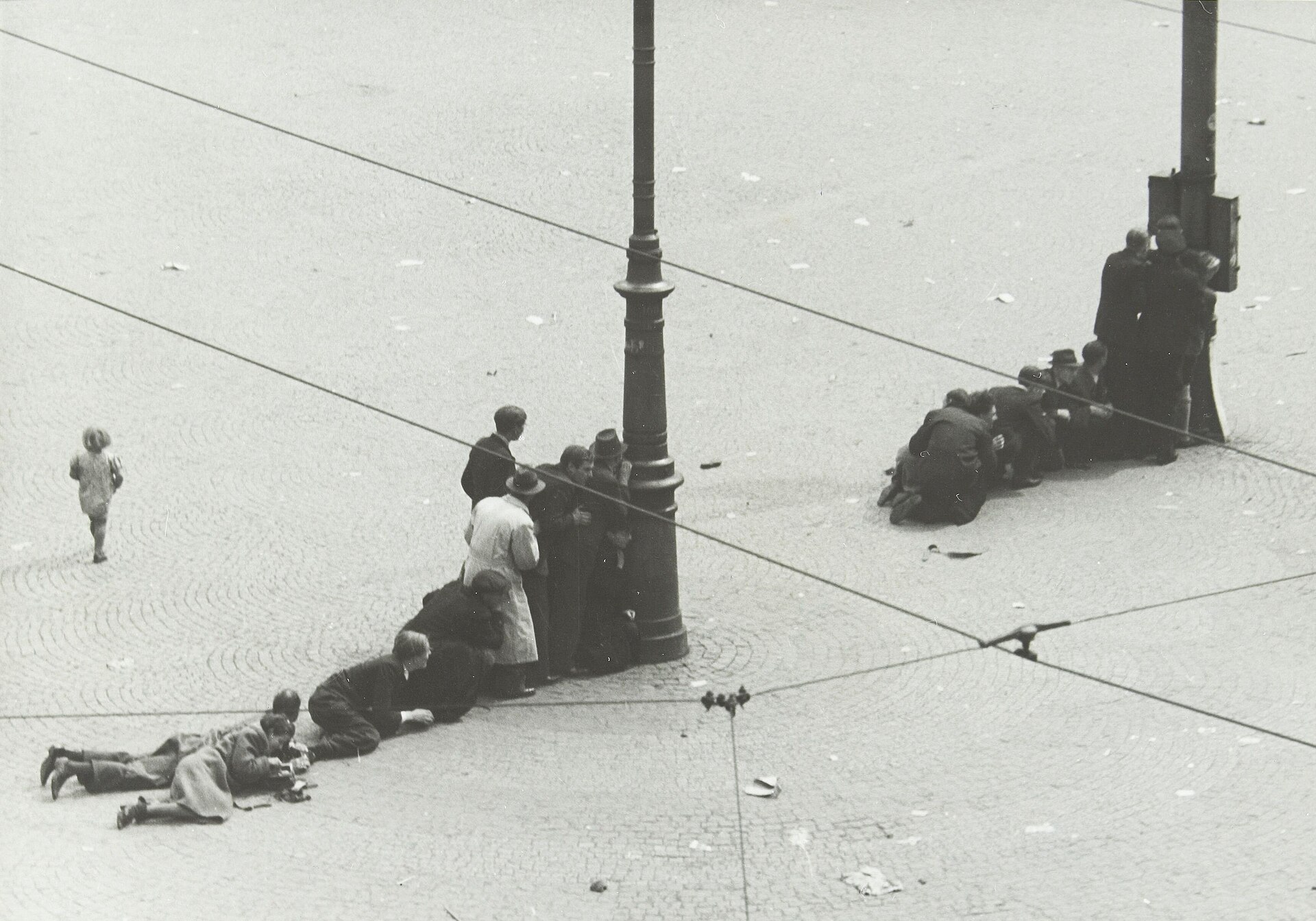
Two days after the German capitulation, thousands of Amsterdammers gathered on Dam Square to celebrate the arrival of the Allies. Around three that afternoon, German navy soldiers opened fire on the crowd from the Groote Club. Within two hours, dozens were dead and more than a hundred wounded, on the day the war was supposed to already be over for Amsterdam.
A city that already felt liberated
On Saturday 5 May 1945, the German army in the Netherlands surrendered. The signing took place at Hotel De Wereld in Wageningen, where Canadian general Charles Foulkes accepted the surrender from German commander Johannes Blaskowitz. For most of the already-liberated Netherlands, the war was over at that point. But Amsterdam and the rest of the western Netherlands, still garrisoned by heavily armed German troops, had to wait two more days before Allied units actually entered the city.
Those two days formed a strange in-between state. The occupier was still there, weapons and all, but authority was already slipping away. The streets carried a mixture of euphoria and impatience. On 6 May, local papers reported that Canadian troops would reach Amsterdam the next day. On the morning of Monday 7 May, thousands of Amsterdammers headed to the city centre, and especially to Dam Square, to welcome the liberators. Flags, orange ribbons and improvised music filled the streets. No one expected that morning that the day would end in one of the deadliest shootings of the entire war.
Armed Germans among the crowds
Around noon, the German guard posts on the Dam — including those at the Groote Club on the corner of the Dam and Kalverstraat — were still being relieved as usual, a sign that the local German command structure was still functioning despite the capitulation elsewhere in the country. Inside the Groote Club, an upscale gentlemen's club, dozens of German Kriegsmarine sailors were billeted at the time.
Shortly after one o'clock in the afternoon, a British reconnaissance patrol of Humber armoured cars, led by officer Richard Taite, drove onto the Dam. The vehicles were immediately swarmed by cheering Amsterdammers climbing onto them. Unable to reach their headquarters this way, the soldiers withdrew via the Rokin to await reinforcements. It was a preview of what was to come that afternoon: a city behaving as if it were already liberated, while the actual liberation had not yet taken place.
Operation Three Castles
Meanwhile, the Dutch Domestic Armed Forces (Binnenlandse Strijdkrachten, BS) seized the moment to take the initiative themselves. Around a quarter to three, a unit led by H.A.L. Trampusch carried out Operation 'Three Castles': resistance fighters took control of the head office of the Dutch central bank, the main post office and the Royal Palace on the Dam, disarming the German guards they found there. Captured Germans were brought to the palace.
It was a bold move, carried out at a moment when German troops in the city still formally held authority and were heavily armed. That the BS could act relatively unhindered that afternoon reinforced the feeling, among both resistance fighters and ordinary citizens, that the occupation was effectively already over — a feeling violently shattered minutes later.
The shot near Paleisstraat
Around a quarter to three, shortly after the action at the palace, Dutch resistance members arrested two German soldiers at the corner of Paleisstraat and Spuistraat, close to the Groote Club. One of the two refused to surrender his weapon and fired a shot at some point in this timeframe. Exactly what happened next, and in what order, cannot be reconstructed with certainty even today — eyewitness accounts from 1945 diverge on this point. What is established is that shortly afterward, shooting began from the Groote Club itself, first with pistols and quickly escalating to machine guns.
Gunfire from the Groote Club
Around three o'clock that afternoon, German navy soldiers began firing from the windows, balcony and roof of the Groote Club into the crowd packed onto the Dam. Panic was instant. People fled via the Nieuwendijk, the Rokin and the Damrak, stumbling over one another in the narrow streets around the square. Those who could not flee in time took cover behind lamp posts, behind a small truck parked on the square, and behind the barrel organ 'Het Snotneusje', which happened to be set up on the Dam that day.
Resistance fighters of the Domestic Armed Forces returned fire on the Groote Club, which only intensified the gun battle. According to one of the most often-repeated accounts from that afternoon, a girl named Tiny van der Hoek angrily walked back toward the Groote Club after her ice cream fell to the ground — a small, almost absurd detail amid the chaos that has stuck in the memory of that day ever since.
Two hours under fire
The shooting lasted roughly two hours, until around five in the afternoon. During that time, people remained pinned behind their hiding spots as German bullets flew across the square. Scouts, Red Cross members and nurses repeatedly ventured into the line of fire to pull out the wounded and give first aid. Among them was nurse Bep Vink, whose name would later be linked to the first commemorative plaque two years on.
The dead were provisionally laid out on the corner of the Nieuwendijk; later that day, most bodies were moved to the Zuiderkerk, which served as a temporary mortuary. Victims were also found in the alleys behind the Dam — people who had sought cover there and were hit regardless. The wounded were taken to the Binnengasthuis, then the city centre's main hospital.
Fighting at Central Station too
The Dam was not the only place in Amsterdam where fighting broke out that day. A gun battle also erupted at Central Station between Dutch and German forces. Sergeant Jan de Jongh was killed there — a man who, shortly before his death, had tried to help end the shooting on the Dam, together with Dutch major Carel Frederik Overhoff and German Hauptmann Bergmann. German casualties also occurred at the station.
How the shooting finally stopped
Two conflicting accounts exist of exactly how the shooting on the Dam came to an end, and neither is undisputed. In one version, Major Overhoff persuaded German Hauptmann Bergmann to go into the Groote Club and order his men to cease fire. In the other version, the shooting had already died down before they arrived, after Dutch resistance fighters had threatened — or actually attempted — to fire a bazooka at the building.
Around eight that evening, British commander Taite, Major Overhoff, Amsterdam's mayor Feike de Boer and German Ortskommandant Hans Schröder met at the town hall. There, the effective surrender of German troops in Amsterdam was arranged, although the formal handover would still take a few more days.
The Canadians arrive after all
On 8 May, Canadian units actually entered Amsterdam. The next day, 9 May, tens of thousands gathered on the Dam once again — this time without gunfire — to celebrate the liberation and listen to speeches, including one by Prime Minister Pieter Sjoerds Gerbrandy. The German navy soldiers who had barricaded themselves in the Groote Club were arrested by the Canadians that day and soon sent back to Germany. No real criminal investigation ever took place into exactly who fired and why — the chaos of the liberation days and the swift return of the Germans involved to their home country made a thorough reconstruction almost impossible.
How many victims were there, exactly?
To this day, there is no full certainty about the exact death toll. Newspapers from 1945 reported between 19 and 22 dead and 100 to 120 wounded. No official victim list was ever published at the time. Only decades later, thanks to research by the Stichting Memorial voor Damslachtoffers 7 mei 1945, did a fuller picture emerge: this foundation identified 32 fatalities, 26 of whom died that same day and five others who succumbed to their wounds in the weeks that followed. The last known fatality died on 22 June 1945 — more than six weeks after the shooting, and well after the official liberation of the whole of the Netherlands. The exact number of wounded also remains uncertain; the figures from newspapers of the time have not since been improved upon with hard sources.
Never thoroughly investigated
Historians and the descendants of victims have long pushed for a proper investigation into exactly what happened: who gave which order, who fired the first shots, and whether the German soldiers acted out of panic, revenge or some other motive. That investigation never materialised in the decades after the war. Both the English and Dutch-language accounts of this history acknowledge that large parts of the story — the exact sequence of events, the precise death toll, who was responsible — have never been fully clarified, and probably never will be.
Major Overhoff: honoured, then stripped
Major Carel Frederik Overhoff, who in 1945 was seen as one of the men who helped end the gun battle, was awarded the Military Order of William in 1947 for his actions — the Netherlands' highest decoration for bravery in combat. His name remained tied to the end of the Dam shooting for a long time. But in 1952, the honour was revoked after Overhoff was convicted of embezzlement and served a prison sentence. It is a footnote that shows how layered and uncomfortable the aftermath of that day remained — even the recognition given to the man credited with ending the shooting did not hold up.
A plaque without names
On 7 May 1947, exactly two years after the shooting, a first commemorative plaque was unveiled on the corner of the Dam, Paleisstraat and Kalverstraat, in the presence of, among others, nurse Bep Vink, who had helped the wounded during the shooting. The plaque names no victims — for decades there was no central, public place where all the names of the dead could be found together.
Thousands of virtual stones
That gap was only filled in 2015-2016, seventy years after the shooting. Through the project 'Plaats een steen' (placeastone.nl), people could 'place' a virtual stone online between June 2015 and March 2016, bearing the name of a victim of the war in Amsterdam. For the Dam victims, this resulted in 15,509 virtual stones, which together formed the names of the dead. On 1 March 2016, these virtual stones were transferred to physical stone reliefs, set into the paving of the Dam.
The memorial on the Dam today
On 7 May 2016, exactly 71 years after the shooting, Amsterdam's then-mayor Eberhard van der Laan unveiled the renewed memorial on the Dam, following a ceremony at the Nieuwe Kerk. Since then, the names of the victims lie literally in the paving stones of the square where they fell. Anyone walking across the Dam today — among tour guides, street performers and tourists photographing the palace — walks, without realising it, over the names of people who died here on the day the war already seemed to be over. Every year on 4 May, during the National Remembrance of the Dead, the Dam victims of 1945 are remembered on the square along with all other Dutch war victims.
Sources
This story is based on the English-language Wikipedia ('1945 shooting on Dam square, Amsterdam'), the Anne Frank House (timeline entry 'Shooting on Dam Square'), DutchReview ('Amsterdam liberated: the infamous shooting at Dam Square on May 7, 1945'), the website de-dam-zevenmei1945.nl (with witness- and time-based reconstructions) and background reporting by NOS and NH Nieuws on the memorial and commemoration. Historical 1945 newspapers and the later findings of the Stichting Memorial voor Damslachtoffers 7 mei 1945 disagree on some details; this story notes where sources diverge on death tolls and the final phase of the gun battle, rather than presenting a single figure or account as the only truth. The detail about Tiny van der Hoek and her ice cream is a frequently repeated anecdote from eyewitness accounts, but could not be fully verified against an official source.
Nieuwsbrief
Krijg een unieke kijk van en over Amsterdam in je mailbox
De laatste verhalen, en af en toe een verrassing uit het archief.
Comments (0)
Log in to leave a comment.
More stories about Amsterdam
All stories →
Wynand Fockink: the tiny Amsterdam liqueur house that has poured jenever for over three centuries
Redactie Amsterdammers.love · 10 min read
Otter with pup filmed in Diemerpark: the first otter birth in Amsterdam since 1963
Redactie Amsterdammers.love · 6 min read
21 November 1981: the day Amsterdam saw its largest-ever peace demonstration
Redactie Amsterdammers.love · 7 min read
The 1928 Olympic Games: how Amsterdam invented the eternal flame
Redactie Amsterdammers.love · 11 min read
Spinoza: the boy from the Houtgracht excommunicated by his own community
Redactie Amsterdammers.love · 13 min read
The Waag: the city gate that became a weigh house, a dissection theatre and almost a cathedral
Redactie Amsterdammers.love · 14 min read