Amsterdammer · week 48
Spinoza: the boy from the Houtgracht excommunicated by his own community
How a merchant's son from Amsterdam's Jewish quarter was excommunicated at twenty-three — and became one of Europe's most influential philosophers
In the autumn of 1632, a boy was born in a narrow house on the Houtgracht, on the artificial island of Vlooienburg between the Amstel and the Zwanenburgwal, into a Portuguese-Jewish merchant family. His parents named him Bento — Portuguese for "blessed" — and in the synagogue he received the Hebrew name Baruch, which means the same. Later, once he was long gone from that community, he would give himself the Latin form of that name: Benedictus de Spinoza. Today most people know him only as a philosopher, a name from a history book about the Enlightenment. But before he ever put pen to paper to write about God, nature and freedom, he was first and foremost one thing: a boy from Amsterdam's Jewish quarter, raised among ledgers and prayer books, aware that his family, like so many others on Vlooienburg, had had to leave a country behind in order to be allowed to be who they were here.
An island of refugees
Vlooienburg had existed for only a few decades when the Spinoza family moved there. It had been raised in the 1610s as part of the city's expansion, a new piece of Amsterdam between the Amstel and the still-young canal ring, and it quickly drew the Portuguese and Spanish Jews settling in the city. Many of them, or their parents, had been forced to convert to Christianity in their home countries — "New Christians" or Marranos, who attended Mass in public and kept practicing Judaism in the privacy of their homes, with the constant risk that the Inquisition would expose them. Amsterdam, which since the late sixteenth century had maintained a practical form of religious tolerance, was for them one of the few places in Europe where they could again be openly Jewish.
Spinoza's father Michael was one of them: a man born in Portugal who built a new life as a merchant in the Dutch Republic, trading among other things in citrus fruit, and who had enough standing in the young community to be elected in 1649 as one of the governing officers (parnassim) of the newly united Talmud Torah congregation. Spinoza's mother, Hana Deborah, died when he was six. His father remarried Esther, who had grown up as a New Christian in Portugal and mostly spoke Portuguese at home — the language the Spinoza household generally used, while Hebrew and Spanish were the languages of the synagogue and the school. As far as the record shows, the family lived no more than a few houses from the Bet Ya'acov synagogue on the Houtgracht — today part of the Waterlooplein area, then the heart of what Amsterdammers simply called "the Jewish quarter," though in the seventeenth century it was not yet a separate or enclosed district: Christian Amsterdammers lived right alongside it, including, a few streets away, the painter Rembrandt.
School on the Houtgracht
A few doors from home, young Bento attended the Talmud Torah school attached to the synagogue, then led by the authoritative senior rabbi Saul Levi Morteira. Instruction there, as in the household, was largely in Spanish; pupils learned to read the prayer book and the Torah in Hebrew and studied the commentaries of Rashi. Spinoza's name disappears from the school's registers after age fourteen — an age at which many boys from merchant families already went to work in their father's business. Later biographers have long wondered whether he ever personally studied under more famous teachers of the community, such as the learned rabbi and diplomat Menasseh ben Israel; that is not certain, and much of what is claimed about Spinoza's youth rests on later reconstruction rather than hard documentation.
One figure from those years is well documented, and may have cast a long shadow: Uriel da Costa, a distant relative through Spinoza's mother, was a freethinking doubter within the Portuguese-Jewish community who was excommunicated twice. In 1639, when Spinoza was still a child, Da Costa was made to lie down on the threshold of the synagogue as a humiliation so that congregants could step over him. A year later he was dead, by his own hand according to tradition. Spinoza was eight at the time; whether the story reached him as a child cannot be said with certainty, but it shows that the tension between individual conscience and communal rules existed long before Spinoza himself encountered it.
The collapse of the trading house
Around age fourteen, Spinoza likely left school to help with the family business. Things did not go well for the merchant family: during the First Anglo-Dutch War (1652–1654), English privateers seized ships and cargo belonging to the firm, leaving the house deeply in debt. When his father Michael died in 1654, the then 21-year-old Spinoza, together with his brother Gabriel, had to take charge of what remained of the business. Within a year, most of the family's wealth had evaporated.
In March 1656, Spinoza took a step that caused considerable friction within the community: he had himself declared an orphan by the city authorities in order to escape his father's debts. In doing so he bypassed a rule of the Talmud Torah congregation that disputes between members had to be settled within the community itself, not before a city judge. In the eyes of the parnassim, it was a unilateral act by a young man who had for some time already paid little heed to what was said about him in the synagogue.
The ban
On 27 July 1656, the leaders of the Talmud Torah congregation, among them the influential rabbi Isaac Aboab da Fonseca, pronounced the cherem — the harshest disciplinary measure the community knew — against the twenty-three-year-old Spinoza. The surviving document speaks in general terms of "abominable heresies" and "monstrous deeds," confirmed by witnesses "in the presence of the said Espinoza," but names no specific belief or statement that prompted it. That lack of concrete detail has led historians ever since to speculate: was it doubts Spinoza had expressed about the immortality of the soul, about the literal truth of the Torah, or simply the accumulation of a series of conflicts around the family, including the matter of the estate? There is no certainty. What is certain is that the community's leaders asked the city government to ensure that no one associate with him, and that the ban — unlike many other such bans of the period — was never lifted. As recently as 2015, rabbis in Amsterdam again discussed whether the ban against Spinoza should be revoked; the outcome of that meeting was that it should stand.
For Spinoza, the cherem meant a definitive break with the world he had grown up in: no more access to the synagogue, no more contact with family and old friends within the community, no longer part of the Portuguese-Jewish network that had until then shaped his entire social and economic life.
A new life outside the community
After the ban, Spinoza continued to live in and around Amsterdam and Leiden for several more years, earning his living as a private tutor and as a grinder of lenses for spectacles, microscopes and telescopes — a craft well suited to his growing interest in the new science of his time. In the mid-1650s he took Latin lessons from Franciscus van den Enden, a former Jesuit with his own freethinking circle of friends and pupils in Amsterdam, among them the poet and merchant Jarig Jelles, the glass-grinder and writer Pieter Balling, and the physician and classicist Lodewijk Meyer. In that company of freethinkers, outside the established church and synagogue communities, Spinoza found a new intellectual home.
Around 1658 he audited some lectures on Cartesian philosophy at Leiden University, without formally enrolling or earning a degree. Not long after, he left the Amsterdam region for good: first to Rijnsburg, where he worked on what would become known after his death as the Short Treatise, then to Voorburg near The Hague — the exact reason for that move is unknown — and finally, in 1670, to The Hague itself.
The work that secured his place in history
In The Hague, Spinoza completed most of the work for which he is remembered in the history of philosophy. In 1663 he published, anonymously under his own name, his exposition of the philosophy of René Descartes, Principia philosophiae cartesianae — the only work to appear under his own name during his lifetime besides one other. Seven years later, in 1670, he published, now fully anonymously and under a false imprint, the Tractatus Theologico-Politicus, in which he argued, among other things, for freedom of thought and for a sharp separation between religion and state power. The book was fiercely attacked in the Republic and eventually banned outright, though in practice it kept circulating.
His most famous work, the Ethics — an attempt to give, in the strict geometric form of propositions and proofs, a coherent account of God, nature, the human mind, and the path to happiness — remained unpublished during his lifetime. Spinoza's views, in which he identified God with nature itself rather than with a personal, intervening creator, struck contemporaries as every bit as radical as his earlier break with the synagogue. Historians and philosophers still argue over the precise nature of those views — do they make him a pantheist, someone who equates God with nature, or essentially an atheist expressing himself in religious vocabulary out of caution? — a debate that will likely never be fully settled, simply because Spinoza himself never described himself in those terms anywhere in his writing.
In his final years, Spinoza corresponded with scholars across Europe and in 1676 hosted the German philosopher and mathematician Gottfried Wilhelm Leibniz for several days in The Hague. He died there on 21 February 1677, aged 44, attended by his physician and friend Georg Hermann Schuller. The most widely accepted cause of death is tuberculosis, possibly worsened by lung damage from years of lens grinding. He left no will and was buried four days later in the Nieuwe Kerk in The Hague. That same year, his friends arranged the publication of his Nagelate Schriften, which contained the first printed edition of the Ethics.
Back to Amsterdam, two centuries later
Only long after his death did Amsterdam find its own visible way to commemorate the boy from the Houtgracht who had left the city as a philosopher. Near the Spinoza Lyceum in Amsterdam-Zuid, named after him, stands a marble statue over three metres tall by sculptor Hildo Krop. In 2008, a second tribute was added: a monument by artist Nicolas Dings in front of the city hall on the Zwanenburgwal, just a few hundred metres from where Vlooienburg once lay — the place where Spinoza spent his first, and last, years within Amsterdam's Portuguese-Jewish community.
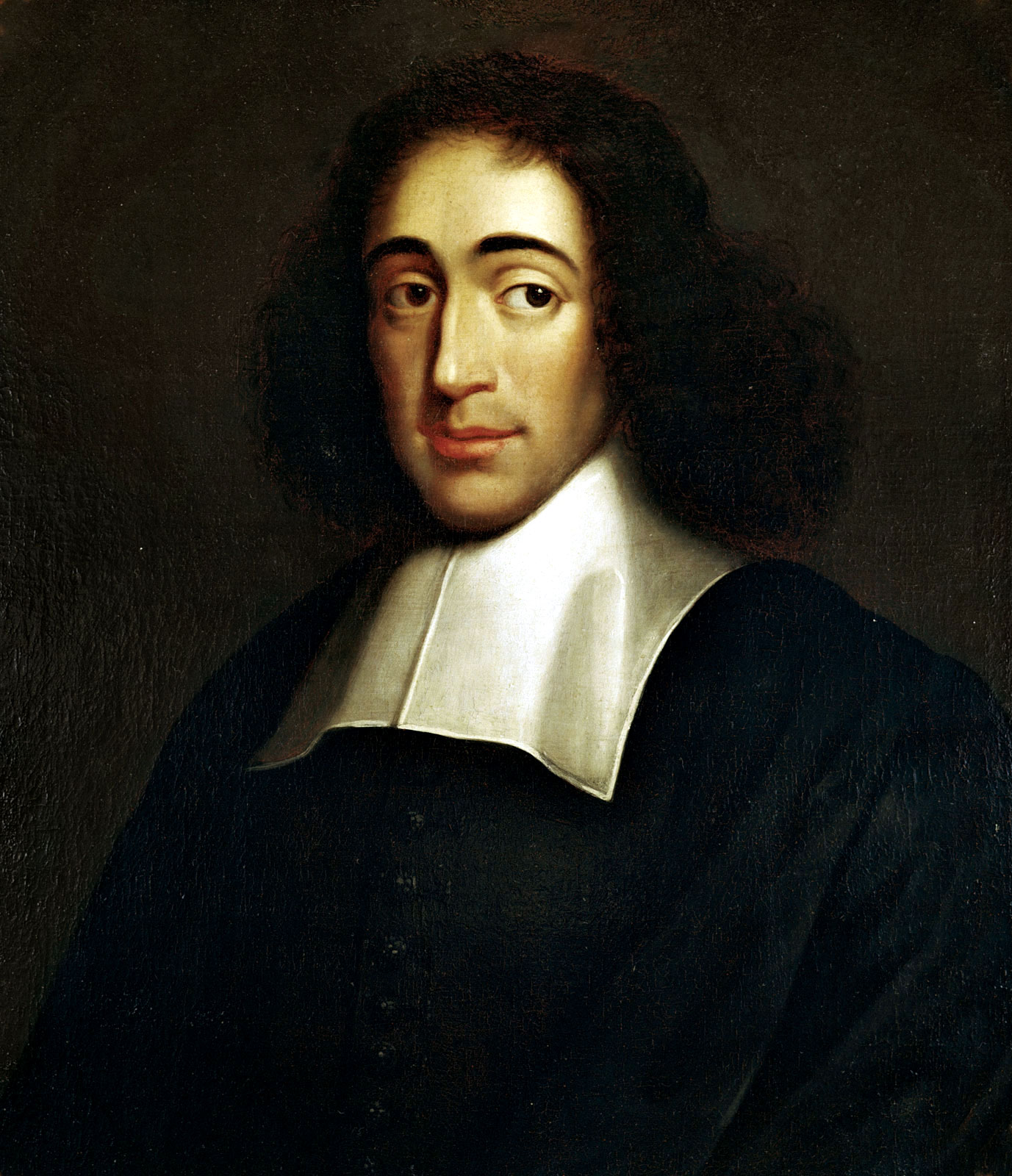
The Jewish Historical Museum in Amsterdam holds one of the many later portraits made of him — no one knows for certain what Spinoza actually looked like, since no portrait painted from life has ever been definitively established. The best-known painting, made by an unknown painter around 1665 and now held at the Herzog August Library in Wolfenbüttel, Germany, is the image most people picture when they think of Spinoza: a young man with dark, wavy hair and an alert, slightly wary look, like someone who knew his ideas would win him not only admirers but enemies too.
Sources
This story is based on the English-language Wikipedia article on Baruch Spinoza (accessed November 2026), which in turn draws on established biographical scholarship on Spinoza. The Dutch-language Wikipedia article on Spinoza could not be consulted while writing this story due to a technical problem retrieving that page; facts are described with some caution where relevant as a result. Uncertain or disputed among historians: the precise reason for the 1656 cherem (the ban document names no concrete cause), whether Spinoza ever personally studied under rabbis such as Menasseh ben Israel, the reason for his later move from Rijnsburg to Voorburg, and the characterization of his religious thought as pantheist versus atheist. The image accompanying this story is the well-known anonymous portrait of Spinoza, made around 1665 and held at the Herzog August Library in Wolfenbüttel, via Wikimedia Commons (public domain).
Nieuwsbrief
Krijg een unieke kijk van en over Amsterdam in je mailbox
De laatste verhalen, en af en toe een verrassing uit het archief.
Comments (0)
Log in to leave a comment.
More stories about Amsterdam
All stories →
The Waag: the city gate that became a weigh house, a dissection theatre and almost a cathedral
Redactie Amsterdammers.love · 14 min read
The 1928 Olympic Games: how Amsterdam invented the eternal flame
Redactie Amsterdammers.love · 11 min read
No home, no coronation: the day Amsterdam became a battlefield
Redactie Amsterdammers.love · 17 min read
The Eel Riot of 1886: how a forbidden game in the Jordaan ended in 26 deaths
Redactie Amsterdammers.love · 14 min read
Bet van Beeren (1902–1967): the queen of the Zeedijk who made her own rules
Redactie Amsterdammers.love · 16 min read
Hans van Onna: the Amsterdammer who was still teaching exercise classes to other older people at 96
Redactie Amsterdammers.love · 13 min read