Event · week 48
The 1928 Olympic Games: how Amsterdam invented the eternal flame
Six years after two failed bids, Amsterdam finally got to host the Olympic Games. A brand-new stadium rose on reclaimed sand, a queen who would rather have stayed away opened proceedings by proxy, and a flame above the Marathon Tower that nobody had officially ordered would change the Games forever. Women competed in athletics for the first time, Johnny Weissmuller swam to gold, and the Netherlands won nineteen medals. The story of the summer Amsterdam welcomed the world.
A city that tried three times
In 1912, the Dutch cavalry officer and IOC member Frederik van Tuyll van Serooskerken first suggested that Amsterdam should host the Olympic Games. It would take another sixteen years before that actually happened. Amsterdam first lost out to Antwerp, which was awarded the 1920 Games as a form of restitution for Belgium's devastation in the First World War. The city then lost again, this time to Paris, which hosted the 1924 Games.
In that same decision, on 2 June 1921, the IOC also announced that Amsterdam would get its turn in 1928. Los Angeles, the only other candidate, had to wait until 1932. For Amsterdam, it was a unique opportunity. A relatively small city on the IJ, still grappling with housing shortages and post-war reconstruction in the 1920s, was about to become the centre of the international sporting world.
A stadium built on reclaimed sand
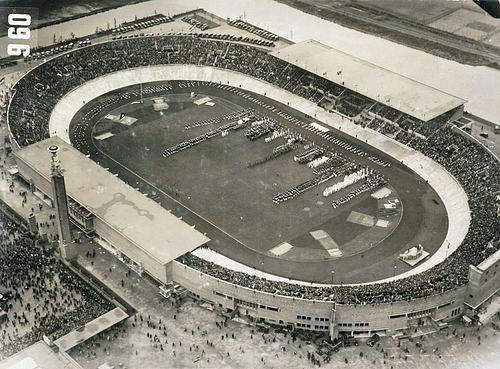
Amsterdam already had a sports park in the south of the city, designed by architect Harry Elte. The original plan was simply to extend that stadium. That idea was rejected. Instead, a completely new stadium was built further west, on the edge of the Olympic Quarter that architect H.P. Berlage had just designed.
Construction began long before any stadium was visible. From January 1926, the marshy site was raised using 750,000 cubic metres of sand. Only in October that year, once the ground had settled sufficiently, could work begin on the pile foundations. On 18 May 1927, Prince Hendrik, husband of Queen Wilhelmina, laid the first stone. Roughly two million more followed.
Architect Jan Wils was commissioned to design the stadium. Working in the Amsterdam School style, Wils deliberately matched the stadium to Berlage's surrounding Stadionbuurt development. The design proved more than just functional: at the 1928 Games themselves, Wils won a gold medal for his stadium design in the architecture art competition, then still an official part of the Olympic programme.
The pitch measured 114 by 75 metres. Around it ran a 400-metre athletics track with eight-metre-wide lanes, and beyond that a 500-metre cycling track. Besides athletics and the opening and closing ceremonies, the stadium hosted equestrian sport, hockey and gymnastics, with korfball featured as a demonstration sport.
A capacity kept secret
Exactly how many spectators the Olympic Stadium could hold remained surprisingly unclear during the Games themselves. Different sources give different figures, somewhere between 33,000 and 41,000, depending on how many standing places were counted. Afterwards, the Dutch Olympic Committee put the capacity at around 31,600 seats, with roughly 5,900 more places on the cycling track.
That the Games happened at all was no foregone conclusion. For the first time in Olympic history, the Games were funded entirely with private money, without support from the Dutch government. In the end it was a close-run thing financially: costs came to just over $1.18 million against receipts of about $1.165 million, a shortfall of roughly $18,000 that left the organisers on edge.
The queen who would rather not have come
On Saturday 28 July 1928, the Games of the IX Olympiad officially opened. Queen Wilhelmina was not there. According to tradition, she was not keen to open the Games herself. She reportedly viewed the modern Olympics as a pagan spectacle, something that sat uneasily with her deeply held Christian faith. She was also on holiday in Norway at the time and did not want to interrupt the trip.
So it was Prince Hendrik who, with the Queen's permission, opened the Games in her place. Wilhelmina only returned to the Netherlands later. She did attend the closing ceremony on 12 August, where she presented the first prizes shortly before the Games were formally closed.
During the opening ceremony, something happened for the first time that has recurred at every Olympics since: the parade of nations entered with Greece first, as a tribute to the birthplace of the Games, and the host nation, the Netherlands, last. That order has remained Olympic tradition ever since.
A flame nobody had ordered
Perhaps the most iconic image of the 1928 Games is the Marathon Tower beside the stadium, topped with a large bowl in which a flame burned day and night. It was the first time in modern Olympic history that a permanent fire burned throughout the Games, a tradition every subsequent Olympics has continued, although the now-famous torch relay from Olympia to the host city only began in 1936, at the Berlin Games.
According to Dutch sports historian Jurryt van de Vooren, who worked as a curator at the Olympic Stadium for many years, the idea for the eternal flame came from the stadium's own architect, Jan Wils. By day mostly smoke was visible, by night the fire itself, since flames show up better after dark. Van de Vooren notes that the lighting of the flame was not officially announced as part of the opening ceremony protocol and had not been arranged with the IOC beforehand. Once it was burning, the IOC apparently liked the idea, because from that point on it became a permanent part of the Games.
It should be said that this is the only source that so explicitly credits the idea to Wils; other sources confirm that 1928 was the first Games with a burning Olympic flame, without naming who came up with it. Amsterdammers at the time nicknamed the bowl on the Marathon Tower 'the KLM pilots' ashtray', since it was clearly visible from the air. Horn blowers sounded signals from four balconies high up in the tower, while four Philips loudspeakers broadcast results and announcements across the Olympic grounds, another novelty for its time.
A record number of countries, a record number of women
The Amsterdam Games drew 46 nations and a total of 2,883 athletes: 2,606 men and 277 women. Germany, excluded from the Games in 1920 and 1924 after the First World War, returned and finished second in the medal table with 31 medals. Newcomers included Malta, Panama and Rhodesia, present-day Zimbabwe.
The biggest sporting innovation of these Games was the entry of women into athletics, alongside the debut of women's team gymnastics. Five events were added to the programme: the 100 metres, the 800 metres, the high jump, the discus and the 4x100 metre relay. That women's athletics featured at all owed a great deal to one French woman, Alice Milliat.
The woman who forced the IOC's hand
Milliat, herself a rower and long-time president of the French women's sports federation, had already asked the international athletics federation in 1919 to admit women's athletics to the 1924 Games. The request was turned down. Milliat did not let the matter rest and organised her own 'Women's Olympiad' in Monte Carlo in 1921. A year later a much larger edition followed in Paris, the Women's Olympic Games, with athletes from five countries and an estimated crowd of around twenty thousand.
The International Olympic Committee was far from pleased that a rival women's event was using the word 'Olympic'. Negotiations followed, and the result was a compromise: Milliat's federation renamed its competition the Women's World Games, in exchange for which the IOC would admit women's athletics to the 1928 Amsterdam Games. Five events, against twenty-two for the men. For Milliat that was nowhere near enough, and the British women's athletics association agreed it was too thin a programme: it decided to boycott Amsterdam altogether in protest.
Even so, it was a breakthrough that, without Milliat's persistence, would probably not have happened, or at least not so soon. It was only after her death in 1957 that the women's Olympic programme gradually expanded further. In 2021 the French Olympic Committee finally unveiled a statue of her at its Paris headquarters.
A controversial 800 metres
After the women's 800 metres, reports circulated that several competitors had collapsed from exhaustion. Those reports turned out to be largely exaggerated, but the IOC nonetheless concluded that running events longer than 200 metres were too demanding for women. As a result, the women's 800 metres was dropped from the Olympic programme until well into the 1960s.
Poland's Halina Konopacka became the first-ever female Olympic athletics champion, winning gold in the discus. Sixteen-year-old American Betty Robinson won the 100 metres in a world-record time of 12.2 seconds, in what was essentially her first ever competitive race over that distance.
Nurmi, Weissmuller and a golden marathon
The men's events also produced unforgettable moments. Finland's Paavo Nurmi, one of the greatest runners of all time, won his ninth and final Olympic gold medal in Amsterdam, over 10,000 metres. Canada's Percy Williams won both the 100 and 200 metres, a rare double.
Johnny Weissmuller, later world-famous as a film actor playing Tarzan, took gold in the 100 metre freestyle swimming and in the relay. Japan's Mikio Oda won the triple jump with a leap of 15.21 metres, the first-ever Olympic gold medal for an Asian nation. French athlete Boughera El Ouafi, born in Algeria, won the marathon.
Pat O'Callaghan's gold in the hammer throw was Ireland's first Olympic medal as an independent nation. Future Norwegian king Olav, still crown prince at the time, won gold in the 6-metre sailing class. Uruguay retained the football world title by beating Argentina in the final, and India won the first of what would become six consecutive Olympic hockey titles.
The Netherlands itself finished eighth in the medal table with 19 medals: six gold, nine silver and four bronze, making Amsterdam 1928 one of the most successful editions for the Dutch team up to that point.
From a white sign to a can of Coke
The 1928 Games also left smaller traces still visible today. These Games saw the first use of the white sign with a blue 'P' to mark a parking area, a symbol now recognised across large parts of the world. Coca-Cola made its first appearance as an official Olympic sponsor in Amsterdam and remains the longest-running Olympic sponsor to this day.
At the time, an art competition was also still an official part of the programme, with medals for architecture, painting, sculpture, literature and music. The IOC no longer counts those art medals in its official tallies, though stadium architect Jan Wils did indeed win a gold medal for his own design.
A stadium with a long second life
The Olympic Stadium stayed very much alive after 1928. In 1937, again redesigned by Jan Wils, it gained a second tier of stands after Rotterdam's De Kuip gave it a larger rival. Capacity grew to around 64,000. On 30 May 1928, while the Games were still underway, the Dutch national football team played its first match in the stadium, losing 0-2 to Uruguay, who would go on to become world football champions.
The stadium remained in use for decades for football, athletics and major events, from the 1962 European Cup final between Benfica and Real Madrid to the notorious 1966 'Fog Match' between Ajax and Liverpool. In 1987, by then facing a real threat of demolition, it was instead designated a national heritage monument. Between 1996 and 2000 the second tier of stands was removed again, restoring the stadium's original, more open shape, along with a new athletics track. Prince Willem-Alexander reopened the stadium on 13 May 2000.
Sporting events still take place in the stadium today, from the 2016 European Athletics Championships to the start and finish of the Amsterdam Marathon and speed skating on a temporary ice rink. Since 2005 it has also been home to the Olympic Experience Amsterdam sports museum, where visitors can learn more about the history of the 1928 Games and the stadium itself.
Sources
This account is based on the English-language Wikipedia articles on the 1928 Summer Olympics, athletics at those Games, the Olympic Stadium (Amsterdam) and Alice Milliat, on Olympedia.org, and on an article by Dutch public broadcaster NOS (16 April 2024) on the history of the Olympic flame, which includes an interview with sports historian Jurryt van de Vooren. The attribution of the eternal flame idea to architect Jan Wils comes specifically from that NOS article; other sources consulted confirm that 1928 was the first Games with a burning Olympic flame but do not name an inventor. Some details, such as the exact spectator capacity of the stadium and the exact number of women's events discussed in the negotiations with the IOC, are given differently across sources; where that is the case, it is noted in the text.
Nieuwsbrief
Krijg een unieke kijk van en over Amsterdam in je mailbox
De laatste verhalen, en af en toe een verrassing uit het archief.
Comments (0)
Log in to leave a comment.
More stories about Amsterdam
All stories →
No home, no coronation: the day Amsterdam became a battlefield
Redactie Amsterdammers.love · 17 min read
The Eel Riot of 1886: how a forbidden game in the Jordaan ended in 26 deaths
Redactie Amsterdammers.love · 14 min read
Bet van Beeren (1902–1967): the queen of the Zeedijk who made her own rules
Redactie Amsterdammers.love · 16 min read
The Waag: the city gate that became a weigh house, a dissection theatre and almost a cathedral
Redactie Amsterdammers.love · 14 min read
Hans van Onna: the Amsterdammer who was still teaching exercise classes to other older people at 96
Redactie Amsterdammers.love · 13 min read
Annick van Hardeveld (21): the Amsterdam woman shot dead on the day of liberation
Redactie Amsterdammers.love · 14 min read