Shop · week 47
Wynand Fockink: the tiny Amsterdam liqueur house that has poured jenever for over three centuries
In a narrow alley just behind Dam Square stands a centuries-old tasting house where visitors still bow slightly to take their first sip of jenever. Wynand Fockink grew into one of the largest liqueur distilleries in the Netherlands, survived war, takeover and years of vacancy, and today still pours the same old recipes on the spot where it all began.
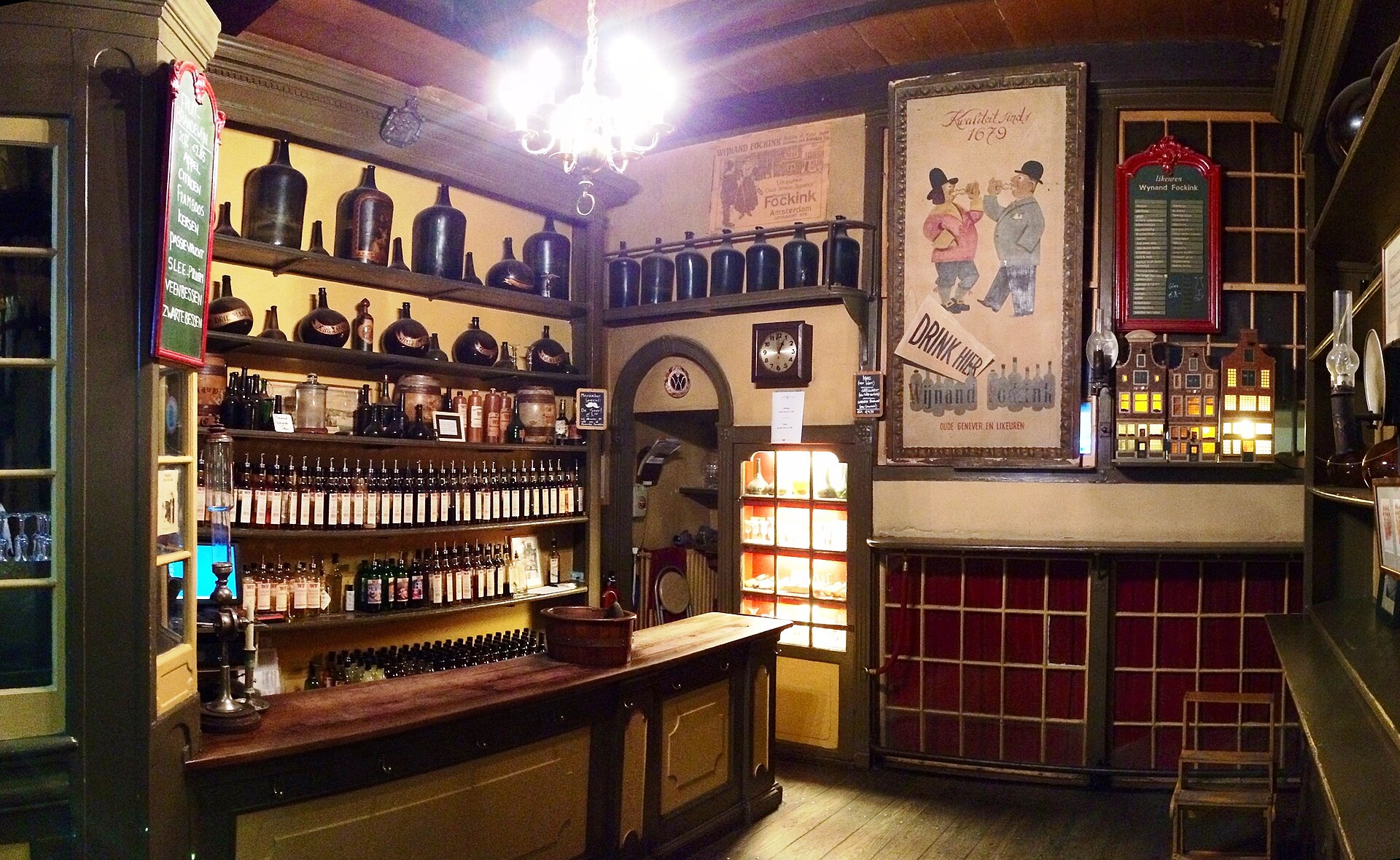
An alley with a secret
Just behind Dam Square, between Damstraat and Oudezijds Voorburgwal, lies an alley easy to walk past without noticing. The Pijlsteeg is barely wide enough for a few people to stand side by side, and at first glance looks like an unremarkable passage. Yet it hides one of the oldest surviving drinking establishments in Amsterdam. At number 31 you can still walk in for a glass of jenever or liqueur, poured here in much the same way it has been for a very long time.
The building is called Wynand Fockink. The name is known across the Netherlands as a brand of liqueurs and jenever, but anyone who walks into the Pijlsteeg arrives at the source: the small tasting house where the story began and where the tradition continues today.
A distillery from the seventeenth century
Sources differ slightly on the exact starting point of the business. According to Wynand Fockink's own official history, the building in the Pijlsteeg dates from 1679. An independent local history blog about Amsterdam businesses tells a somewhat different story, claiming the liqueur distillery was founded in 1679 by a man named Jan Bierman, with the business growing from there.
Both sources agree that the distillery has its roots in this alley at the end of the seventeenth century, at a time when Amsterdam was deep in its Golden Age. The city was an international trading hub, and spirits, herbs and spices from around the world found their way to its markets. In that climate, a liqueur distillery was a natural venture.
Wynand Fockink takes over
There is also some uncertainty about exactly when the distillery took on the name Wynand Fockink. The company's own website names 1724 as the year Wynand Fockink took over the business. The history blog mentioned above puts the takeover around 1730. The difference is small, but it illustrates how hard it is to pin down three-hundred-year-old business histories to the exact year. What is certain is that from that point on, the business carried the name still on the facade today.
Wynand Fockink himself was no small operator. Under his leadership, and that of his successors, the small distillery grew over the course of the eighteenth century into an established name in Amsterdam's drinks trade. Jenever and liqueur were in high demand, both in the city itself and among the many ships departing Amsterdam for destinations around the world.
Twelve buildings and a private passage
By the end of the eighteenth century the business had grown considerably. Wynand Fockink's own company history mentions twelve other buildings that belonged to the firm around that time, in addition to the narrow alley leading to its own front door. Another source, from the restoration organisation Stadsherstel Amsterdam, states that around 1800 the company owned six buildings on the Oudezijds Voorburgwal and six in the Pijlsteeg, and that a passage was even built between Damstraat and the Pijlsteeg at the time to make the shop more visible and accessible.
The exact numbers and names of the buildings therefore differ slightly between sources, but the picture is clear: by the start of the nineteenth century, Wynand Fockink was no longer a modest neighbourhood business but a distillery with a substantial complex in the heart of the city.
Boswandeling and Half en Half
Part of the business's success is owed to a few liqueurs that have since become part of Dutch drinking culture. Boswandeling, a herbal liqueur, and Half en Half, a blend of different bitters, made the Wynand Fockink name known nationwide in the nineteenth and twentieth centuries. These are not recent inventions but recipes passed down and refined over generations.
The house has also traditionally carried young and old jenever, korenwijn, a blended malt spirit sold under the name Superior that ages for years, and jenever made from rye and spelt, alongside various liqueurs and brandies. This was never a single-product business, but a full range that set the distillery apart from its competitors.
The ritual of the bow
Anyone visiting the tasting house in the Pijlsteeg for the first time quickly gets a lesson in local etiquette. Before drinking from your glass, you bow slightly forward to take the first sip without using your hands, keeping them behind your back. Only afterwards do you pick up the glass. It is a custom that has belonged to the tasting house for generations and is still taught to visitors by the staff behind the bar today.
The ritual feels somewhat ceremonial, yet it is disarmingly simple: it becomes natural after a try or two, and it connects today's visitor to the countless guests who have stood at this same bar over the centuries.
International trade and growing demand
Through the nineteenth century, demand for Dutch jenever and liqueur kept growing, including abroad. Wynand Fockink expanded with it. The company set up trading houses in Berlin, Vienna, Brussels and Paris to organise exports to those markets. By around 1870 the distillery operated five stills and its own steam engine, and employed roughly eighty people. The American market was served as well.
For a business that began as a small distillery in an alley, this was a remarkable scale. By the close of the nineteenth century, Wynand Fockink was no longer just an Amsterdam neighbourhood shop but an industrial enterprise with international trading ties.
A new company building on the Oudezijds Voorburgwal
That growth also brought new construction. The distillery's large nineteenth-century company building, from 1880, stood on the Oudezijds Voorburgwal, not in the Pijlsteeg itself. The exact relationship between this building and the current location in the Pijlsteeg cannot be fully explained from the sources consulted; the complex of buildings on both streets likely functioned together, with the small tasting house in the Pijlsteeg remaining the public face of the business.
The building on the Oudezijds Voorburgwal remained in use by the distillery for a long time, until sweeping changes followed after the Second World War.
Competition from Bols and a 1954 takeover
After the Second World War, Wynand Fockink struggled. Competition from the larger drinks producer Bols became too strong for the independent distillery. In 1954, Bols took over Wynand Fockink. The takeover also brought an end to production on the old scale: the distillery itself was dismantled.
Still, the name did not disappear. The small tasting house in the Pijlsteeg continued to operate as a hospitality venue, even under the new ownership. According to the history blog consulted, Bols leased the tasting house from 1948 to 1988 to Pieter Gijsberti Hodenpijl. A reader comment on that blog, from a niece of Hodenpijl named Marianne Watty, confirms this period and adds a personal memory of childhood visits to the tasting house. This kind of family recollection is valuable but cannot be independently verified, and should be read with that caveat.
Vacancy and squatting
After 1988, the tasting house fell on harder times. The business stood empty for a while, and according to tradition the building was even squatted during this period. For a business with a history of more than three hundred years, this was a vulnerable time — the kind of place that could easily have disappeared from the city centre, as happened to so many small historic businesses in Amsterdam.
A fresh start in 1993
The turning point came in 1993. Jaros Janssens and Jan Galesloot reopened the tasting house in the Pijlsteeg that year. They did more than simply revive the hospitality venue: in the adjoining buildings they started a new, small-scale distillery, bringing the production of jenever and liqueur back to the place where it had originally begun.
It was not a simple repeat of the industrial scale of the nineteenth century. This was now a smaller, artisanal operation, but one that brought the Wynand Fockink brand and recipes back to life on the original site.
Stadsherstel and the building on the Oudezijds Voorburgwal
The nineteenth-century company building on the Oudezijds Voorburgwal was given an entirely different future. Stadsherstel Amsterdam, the organisation dedicated to preserving the city's monumental buildings, restored the building into housing in 1996. The ground floor of that building is now used by the Krasnapolsky hotel, located on the adjoining square.
The current distillery and liquor shop in the Pijlsteeg occupy buildings owned by Stadsherstel. The organisation that once converted the nineteenth-century company building into housing is thus now also the landlord of the site where the business has its origins.
Jenever with a bow, today
Wynand Fockink is now run by Jan Galesloot, one of the two men who revived the business in 1993, together with distiller Paul Wanrooij. Under their leadership, the brand has been rebuilt as a quality label, with attention to the old recipes and artisanal production methods.
The tasting house itself is open daily, usually from three in the afternoon to nine in the evening, at Pijlsteeg 31. Visitors can still sample the classic jenevers and liqueurs, from young and old to Boswandeling and Half en Half, poured the old-fashioned way: filled right to the brim, so you have to bend down to take that first bowing sip without using your hands.
Three centuries in an alley
It is far from a given that a business from the seventeenth century would survive into the twentieth and twenty-first. Wynand Fockink lived through the Golden Age, grew into an industrial enterprise with international trading houses, was absorbed by a larger competitor, lost its own distillery, stood empty for years and was squatted, and ultimately found new life again in the buildings where it all began.
That not every detail of this history is recorded with certainty is to be expected in a story of this length. Exactly who founded the building — Jan Bierman or otherwise — and who Wynand Fockink precisely was when he took over the business, can no longer be established with complete certainty. What is certain is that the Pijlsteeg still smells of the jenever and herbs that have hung in the air here for centuries, and that visitors, just like countless guests before them, still bow slightly to take that first glass.
Sources
Wynand Fockink, official website (history and location): wynand-fockink.nl. Stadsherstel Amsterdam, on the tasting house and the restoration of the company building on the Oudezijds Voorburgwal: stadsherstel.nl. Frans Muthert, local history blog on Amsterdam businesses, offering a differing account of the 1679 founding and Wynand Fockink's takeover around 1730, including a reader comment from a niece of Pieter Gijsberti Hodenpijl: blog.fransmuthert.nl. I amsterdam, practical visitor information. Some dates and names from the early history of the business differ between these sources; where that is the case, this is noted in the text rather than presented as settled fact.
Nieuwsbrief
Krijg een unieke kijk van en over Amsterdam in je mailbox
De laatste verhalen, en af en toe een verrassing uit het archief.
Comments (0)
Log in to leave a comment.
More stories about Amsterdam
All stories →
Otter with pup filmed in Diemerpark: the first otter birth in Amsterdam since 1963
Redactie Amsterdammers.love · 6 min read
21 November 1981: the day Amsterdam saw its largest-ever peace demonstration
Redactie Amsterdammers.love · 7 min read
Spinoza: the boy from the Houtgracht excommunicated by his own community
Redactie Amsterdammers.love · 13 min read
The 1928 Olympic Games: how Amsterdam invented the eternal flame
Redactie Amsterdammers.love · 11 min read
The Waag: the city gate that became a weigh house, a dissection theatre and almost a cathedral
Redactie Amsterdammers.love · 14 min read
No home, no coronation: the day Amsterdam became a battlefield
Redactie Amsterdammers.love · 17 min read