Shop · week 46
Jacob Hooy & Co: the Amsterdam drugstore that has kept the same address for three centuries
Kloveniersburgwal 12, a few steps from the Nieuwmarkt. Behind the windows stand apothecary cabinets full of drawers of herbs, two intertwined wooden snakes hang above the counter, and the smell of dried tea and spices drifts outside before you have even stepped in. Jacob Hooy & Co has sold herbs, spices and drugstore goods here since the eighteenth century, first under its namesake and, since 1846, under the Oldenboom family. Seven, now eight generations later, the shop is still there, despite a rent dispute that once put its survival at risk.
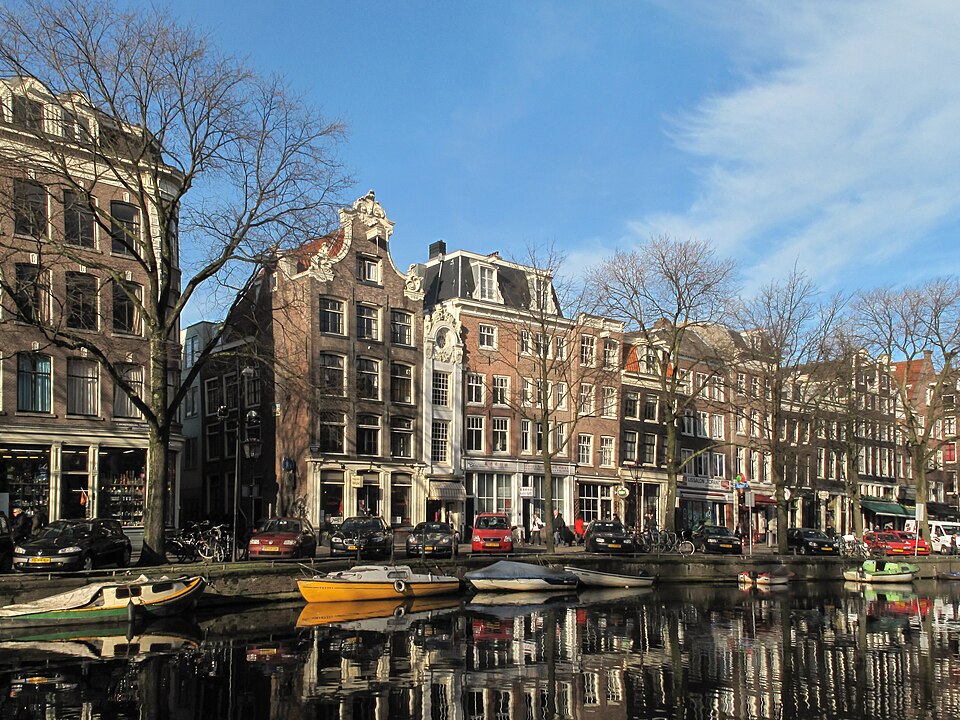
The shop that time seemed to forget
Kloveniersburgwal 12, in the heart of Amsterdam, a stone’s throw from the Nieuwmarkt. Step inside and you smell it before the door has even closed: a heavy, sweet scent of dried herbs, oils and loose tea. Wooden apothecary cabinets with hundreds of drawers line the walls. Above the counter hang two intertwined wooden snakes, a reference to Asklepios, the Greek god of healing. It is a shop interior that looks as though it stepped straight out of the eighteenth century, and for the most part that is exactly what it is.
The shop is called Jacob Hooy & Co, and for as long as anyone can remember it has sold herbs, spices, tea, cosmetics and sweets at the same address. While shops around it in the Nieuwmarkt neighbourhood have come and gone, and chains have settled in and disappeared again, this drugstore has stood its ground for centuries. That makes Jacob Hooy one of the oldest surviving shops in Amsterdam, and at the same time a shop whose history almost nobody outside the family knows in any detail.
A twenty-one-year-old on the Nieuwmarkt
The story begins, as far as it can be reconstructed, with Jacob Hooy himself. He was born in 1722, the son of a sailor, at a time when Amsterdam was awash with spices, herbs and other goods from distant lands brought in through the Dutch East India Company. At the age of twenty-one, in 1743, Jacob Hooy opened a stall on the Nieuwmarkt selling herbs and spices. Not long after, he acquired his own shop premises on the Barndesteeg, one of the narrow alleys around the square.
It was an era in which herbs and spices were not only used in the kitchen. Much of what Jacob Hooy sold was also considered medicine. Tobacco, for instance, was long touted as a remedy for all kinds of ailments. In the eighteenth century the line between drugstore owner, grocer and apothecary was far blurrier than it is today, and a business like Jacob Hooy’s served all of those needs at once.
A building bought at auction
Accounts differ on exactly when the business moved to the Kloveniersburgwal. Some publications about the shop mention 1745 as the year Jacob Hooy moved into the current premises. The company’s own website tells a different story: according to that account, Jacob Hooy bought a house and plot on the Colveniersburgwal at a public auction in 1778, for seventeen thousand guilders in cash. That building, number 12, is the shop to this day.
Both versions cannot be literally true at once, and which one is correct cannot be established with certainty from the available sources. It is possible that an earlier presence in the neighbourhood and the later, better-documented purchase of the Kloveniersburgwal building have become intertwined over time. What is certain is that Jacob Hooy found his permanent place there in the eighteenth century, and that the location has never changed since. Jacob Hooy himself died in 1788 and was buried in the Oude Kerk, according to tradition in grave 260.
The snake above the counter
What still sets the shop apart from an ordinary drugstore today is its interior. The old apothecary cabinets are still there, with compartments and drawers that each once held a particular herb, root or powder. Antique barrels bear Latin inscriptions, some dating from a time when customers could not read what was inside and simply had to trust the shopkeeper. The two intertwined snakes above the counter, the symbol of Asklepios, recall the era when this shop was as much a pharmacy as a grocer’s.
For lovers of old Amsterdam shop interiors, Jacob Hooy is therefore something of a time capsule. Not rebuilt for tourists, but kept in use simply because successive generations of owners never saw a reason to remove it. Some of those cabinets and barrels have themselves become historical artefacts, purely by virtue of having lasted so long.
The Oldenbooms take over
Jacob Hooy had no direct successor who continued the business under his own name. On the second of June, Jan Christoffel Oldenboom was granted the right to continue the herb, drugstore and dye trade previously run under the name Jacob Hooy and Company. That marked the beginning, in 1846, of the Oldenboom era, which continues to this day. The Jacob Hooy name was kept and is still written above the door, even though no Hooy has been in charge for almost two centuries.
Jan Christoffel was followed by Johan Nicolaas Oldenboom, who built the business into a thriving concern. Theodorus Oldenboom took over in 1899. A later generation, Piet and Noor Oldenboom, expanded the wholesale side and, together with their son John, bought an old bulb shed in Limmen, in North Holland, to house the wholesale operations. Theo kept running the shop on the Kloveniersburgwal. Generation after generation, the split between the Amsterdam shop and the wholesale business elsewhere in the country became fixed.
Trucks could no longer get there
Around 1975 the wholesale side of the business moved permanently to Limmen, into a former bulb shed belonging to the Valkering company. The immediate reason was practical: trucks could no longer easily reach the storage buildings near the Nieuwmarkt, in a city centre increasingly ill-suited to large-scale freight transport. The grandfather of later director Arne Oldenboom, who was in charge at the time, lived in nearby Egmond, which played a part in choosing the new location.
What began in a space of five hundred square metres grew, through successive renovations and expansions, into a business of roughly five thousand square metres. While the shop on the Kloveniersburgwal kept its eighteenth-century character, behind the scenes the company turned into a modern wholesaler supplying thousands of products to drugstores, distilleries, makers of tablets and capsules, and even to farmers who order herbal mixes for horses.
Royal supplier after two hundred and fifty years
In 1993, the year the company turned two hundred and fifty, Jacob Hooy was awarded the title of Royal Warrant Holder, the distinction given in the Netherlands to businesses that have proven themselves over the long term. For a family firm that began as a stall on the Nieuwmarkt, it was official recognition of something the neighbourhood had long known: this business belonged to Amsterdam, and Amsterdam belonged to this business.
Around the same time, brothers Arne and Rik Oldenboom took over day-to-day management. They are the seventh generation descended directly from the owners who succeeded Jacob Hooy. Before joining the firm, Arne had gained experience at a large herb company in Hamburg. Of the trade itself, he later said it had been instilled in him since childhood, a phrase that seems fitting for an eighth-generation family business.
A court case over survival
Not everything in the shop’s recent history has been quiet. In 2014 the building on the Kloveniersburgwal was sold to an investment company. The new owner reportedly preferred a different tenant, such as an ice-cream parlour or a sandwich chain, of which there are already more than enough in the city centre, according to Rik Oldenboom. Reporting by broadcaster AT5 said the family was confronted with a demand to pay several times the rent, as much as seventy-five thousand euros a year, combined with a request to vacate the premises so they could be thoroughly renovated and the historic interior removed.
The family took the matter to court and won that case. The landlord then appealed. Regular customers of the shop started a petition in protest, which by the time the AT5 article was published had already gathered more than three thousand signatures. Little recent news is available through public sources on the exact outcome of the appeal or the current state of the relationship between the Oldenboom family and the building’s owner; what is certain is that the shop at Kloveniersburgwal 12 remains open today, and that its historic interior is still intact.
The eighth generation is already behind the counter
In 2023, Rik and Arne Oldenboom celebrated the two hundred and eightieth anniversary of the business that once began on the Nieuwmarkt. Both brothers have been active for years by now: Arne since 1980, Rik since 1993. And the next generation is already stepping in. Ties and Bart Oldenboom, the eighth generation to carry the business forward, have joined the company in recent years. That makes the shop’s continuation, despite the uncertain years surrounding the rent dispute, look secure for now.
The wholesale business in Limmen today supplies roughly four thousand products, from essential oils to cosmetics, tea bags and dietary supplements. A few years ago, CBD oil was one of the best-selling products. During the coronavirus pandemic, the company benefited, according to Arne Oldenboom, from the fact that drugstores and health-food shops were allowed to stay open as essential retailers while many other businesses had to close their doors.
Neighbours who have done business for centuries
One of the striking details in Jacob Hooy’s history is its relationship with the distillery A. van Wees, another centuries-old Amsterdam business. Since the eighteenth century, Jacob Hooy has supplied herbs to this distillery, which uses them for herbal bitters and jenever, among other things. Two businesses that have both existed for so long that their supplier relationship has itself become a small piece of Amsterdam history, still active in more or less the same corner of the city centre where they each began.
The neighbourhood around the shop has also changed completely over the centuries. Where merchants, sailors and market vendors once populated the Nieuwmarkt area, tourists, local residents and curious passers-by now walk the streets, some of them stepping through the door of Jacob Hooy for the first time, drawn in by the smell of herbs that reaches them before they are properly inside.
A shop that preserves rather than replaces
Jacob Hooy is not a museum, although a first glance at the interior might make you think otherwise. It is a working shop, where customers have loose tea weighed out every day, buy herbs for the kitchen, or look for oils to treat all kinds of complaints. But precisely because the business has stayed in the same family and at the same address for so long, it is also a place where the past has not been modernised away, but has simply remained, generation after generation.
That makes the shop on the Kloveniersburgwal something rarer than just a drugstore with a long history. It is a place where the eighteenth century, the nineteenth century and the twenty-first century exist side by side: in the old cabinets, in the family name above the door, and in the young Oldenbooms who are now taking their first steps in a business older than the United States.
Sources
This story draws on the company’s own history as published on jacob-hooy.nl, an AT5 article on the rent dispute over the building on the Kloveniersburgwal (2017), a background article on the Oldenboom family in De Castricummer, the Stadsherstel Amsterdam page on the neighbouring building at Kloveniersburgwal 14, and various overviews of historic Amsterdam shops (including Amsterdam Sights and I amsterdam). Sources disagree on the exact year the business moved to the Kloveniersburgwal (1745 versus 1778); this is noted in the text. No recent public reporting could be found on the current state of the rent dispute following the appeal; the shop, in any case, remains open.
Nieuwsbrief
Krijg een unieke kijk van en over Amsterdam in je mailbox
De laatste verhalen, en af en toe een verrassing uit het archief.
Comments (0)
Log in to leave a comment.
More stories about Amsterdam
All stories →
Samuel Sarphati (1813–1866): the doctor who wanted to rebuild Amsterdam
Redactie Amsterdammers.love · 12 min read
Theater Tuschinski: the cinema a Polish immigrant built, and that outlived him
Redactie Amsterdammers.love · 12 min read
The Dam shooting of 7 May 1945: the massacre on the day Amsterdam already felt liberated
Redactie Amsterdammers.love · 11 min read
The 1928 Olympic Games: how Amsterdam invented the eternal flame
Redactie Amsterdammers.love · 11 min read
Wynand Fockink: the tiny Amsterdam liqueur house that has poured jenever for over three centuries
Redactie Amsterdammers.love · 10 min read

Otter with pup filmed in Diemerpark: the first otter birth in Amsterdam since 1963
Redactie Amsterdammers.love · 6 min read