Place · week 47
Theater Tuschinski: the cinema a Polish immigrant built, and that outlived him
How Abraham Tuschinski built Europe's most lavish cinema on the Reguliersbreestraat, had it taken from him by the Nazis, and saw his name return above the door only after his death
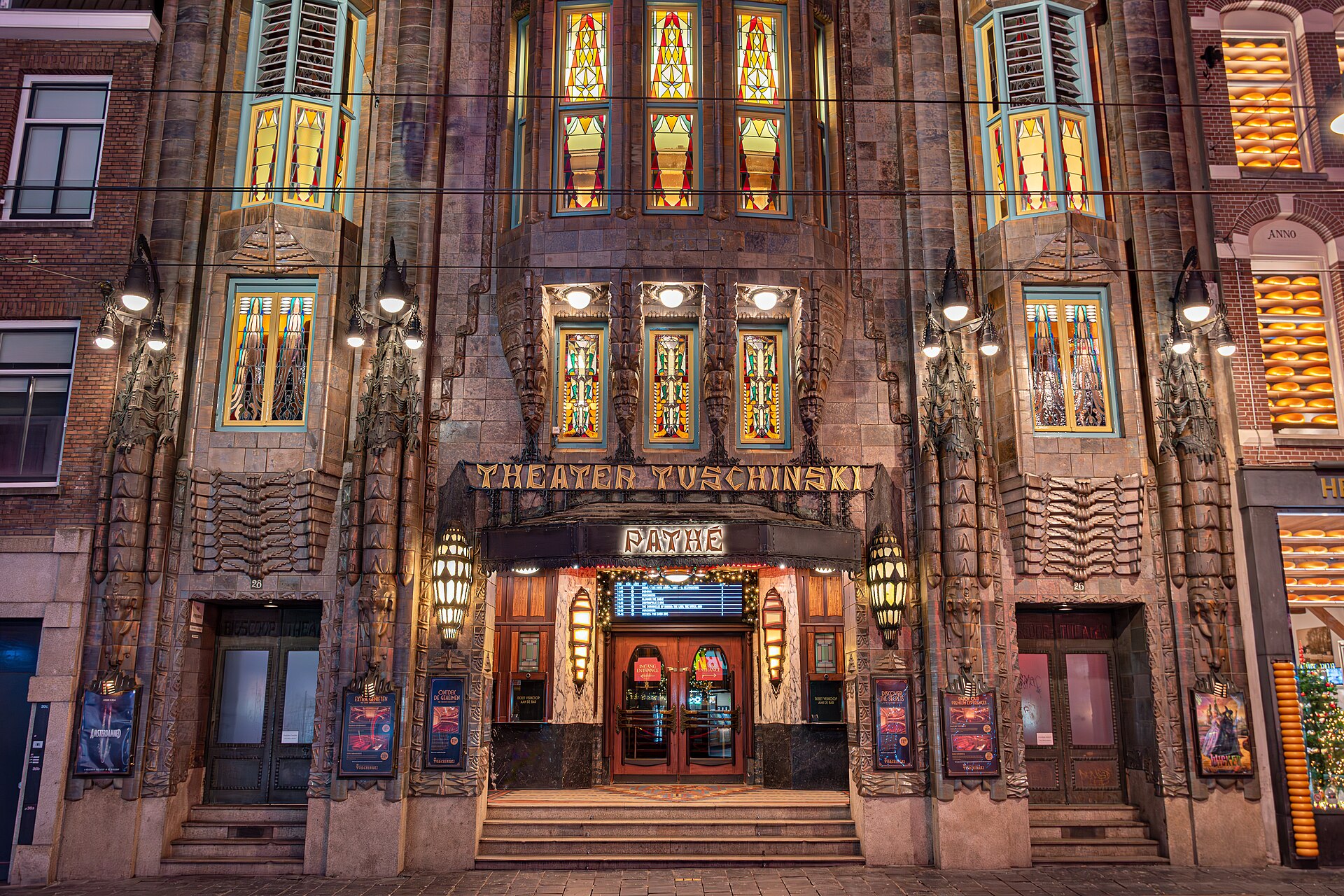
On the evening of 28 October 1921, a man in evening dress stood at the entrance of his own cinema on the Reguliersbreestraat in Amsterdam, watching the city stream in to see what he had built. There was nothing like it anywhere in the Netherlands: no cinema with so much gilding, so much stained glass, so many peacocks and lotus flowers and figures from the Thousand and One Nights above visitors' heads. The man's name was Abraham Tuschinski. Eighteen years earlier he had stepped off a train in Rotterdam, on his way to a ship to America he would never board. Twenty-one years later he would be deported, from this same country he had chosen as a refuge, to Auschwitz, where he was murdered. The theatre that bore his name remained standing, was taken from him, was given another name, and after the war had his name restored above the door. It is still running today.
A Pole on his way to America
Abraham Icek Tuschinski was born on 14 May 1886 in Brzeziny, a small town near Łódź in the part of Poland then occupied by Russia, into a Jewish family. Little is documented about his youth, but in 1903, as a seventeen-year-old, he set out for the United States, as hundreds of thousands of Eastern European Jews did in those years, in search of a future free of pogroms and restrictions. His route passed through Rotterdam, then an important transit port for European emigrants heading to America.
Tuschinski never boarded the ship. Why he stayed in Rotterdam is not established with certainty — some sources mention a lack of money, others speak of a deliberate choice to settle in the Netherlands. What is certain is that he made his first money running a kosher restaurant in Rotterdam, aimed at Jewish travellers waiting there for a ship onward to America. The restaurant was an immediate success, giving Tuschinski the capital and the confidence to move into an entirely different line of business: the still-young cinema trade. In 1911 he opened his first cinema in Rotterdam, the Thalia, soon followed by Cinema Royal, Scala and Olympia. In 1928 came the Grand Theatre, his most luxurious venue in that city. A Dutch writer of the time described him as a man with 'dream-dark eyes in which burned a fierce will' — a characterisation that, judging by what he went on to build, was hardly an exaggeration.
The largest cinema in the Netherlands
In 1917 Tuschinski moved to Amsterdam with a plan that would eclipse his earlier venues: the largest and most lavish cinema in the Netherlands, on the Reguliersbreestraat, a stone's throw from Rembrandtplein. Construction began on 18 June 1919 and cost an estimated four million guilders, an enormous sum for the time. The façade was designed by architect Hijman Louis de Jong, who had worked as a draughtsman for Berlage before becoming an independent architect — he, too, was Jewish, and he, too, would not survive the war.
De Jong combined elements of the Amsterdam School with Art Nouveau and Art Deco in the façade: a tall, narrow front of ornate brickwork, stained-glass windows, lanterns and balustrades, flanked by two towers. Tuschinski reportedly clashed with his architect over the interior, after which he had it finished by another team: among others, Pieter den Besten, Jaap Gidding and Willem Kromhout worked on an interior that combined Art Deco with a strong dose of Central European Jugendstil and Oriental motifs — butterflies and peacocks on the walls, lamps shaped like Chinese lanterns, gold leaf inspired by Japanese kimonos, and fragments of text from the Thousand and One Nights. The winding corridors between the halls were designed to make visitors feel they were stepping into another world — and, more practically, so they would not immediately run into one another.
For its time, the building had advanced technology: electrical systems and a heating and ventilation system meant to keep the auditorium's temperature constant. The main hall, with two balconies, seated an estimated 1,200 to 1,600 visitors — some sources even mention 2,000; the exact figures from those years vary in the historical record. The organ, needed to accompany silent films, did not come from the preferred supplier Wurlitzer, who could not deliver in time, but was ordered from Brussels instead.
When the theatre opened its doors on 28 October 1921, it was the largest cinema in the Netherlands and soon came to be regarded as one of the most beautiful in Europe. Tuschinski himself is said to have described his creation as 'grand as a temple and beautiful as a palace'. Stories still circulate about the construction that sit somewhere between fact and legend — that Tuschinski travelled to Germany himself to fetch timber held up by the post-war British occupation, and had it floated down the Rhine under cover of a Dutch flag to get it past customs; that he personally walked the building site to retrieve damaged bricks. There is no hard documentation for these anecdotes, but they do capture how the city already talked about its builder at the time: as a man who did not accept no for an answer.
Expansion, and a city that came to look
The success of the Tuschinski theatre continued in the years that followed. Tuschinski expanded his Amsterdam empire: in 1928 he opened the Roxy Theatre in the city, alongside his Rotterdam venues. Over the course of the 1920s and 1930s, extra halls were added to the complex on the Reguliersbreestraat, housed in the former cabaret club La Gaîté, a Japanese tea room and a Moorish suite — spaces that extended the lavish, Thousand-and-One-Nights atmosphere of the main building.
For Amsterdammers, Tuschinski became not just a place to watch films, but an attraction in its own right: a building people came to see for its hall, its corridors and its ceiling, regardless of what was showing on screen. That status as a sight to behold never left the theatre, not even through the horrors that followed.
Tuschinski's personal grip on his empire, however, proved less solid than the walls of his theatre. Financial setbacks cost him control of his own cinema chain, including the theatre that bore his name, in 1936. In 1939, before the German invasion, he leased the Amsterdam theatre to a German film distribution company — a business decision that, with hindsight, had already smoothed the way for what the occupying forces would complete a year later.
Occupation, theft, and the name Tivoli
On 14 May 1940, the day of the bombing of Rotterdam, Tuschinski lost all his cinemas in that city in a single blow. Amsterdam remained his for the time being, but not for long. After the German invasion, Jewish owners were systematically forced out of their own businesses — a process known in the literature on the occupation as 'Aryanisation'. In May 1940, Tuschinski and his business partners Ehrlich and Gerschtanowitz were pushed out of their own company. The business and the theatre passed into the hands of the German film concern Tobis.
On 1 November 1940, the name Tuschinski disappeared from the façade. The theatre continued as Tivoli, from then on screening the German and antisemitic propaganda films the occupying authorities wanted shown to the Amsterdam public. According to a story that recurs in several sources, Amsterdammers hung a Dutch and a British flag from a window of the building on Queen Wilhelmina's birthday as a silent protest — an anecdote whose exact circumstances and date cannot be confirmed with hard documentation.
Abraham Tuschinski himself, like so many other Jewish Amsterdammers, fell victim to the deportations that gathered pace from 1942 onward. According to the Jewish Currents article, he went into hiding together with his wife, Miriam Estera Tuschinski, until an informant betrayed them and they were arrested. Sources differ on the exact date of his death: the Dutch Jewish memorial book (In Memoriam, page 746) gives 17 July 1942 as the day on which 'Abram Icek Tuschinki' and Miriam Estera Tuschinski were murdered in Auschwitz, while other sources cite 17 September 1942. What is certain is that both husband and wife were killed in Auschwitz. His business partner Gerschtanowitz was likewise deported to and murdered in Auschwitz; Ehrlich died in Sobibor. The year that had opened with the theft of the company closed with the deaths of the men who had built it, and of the woman who had shared Tuschinski's life.
Tuschinski and his wife were two of an estimated 102,000 Jewish residents of Amsterdam who did not survive the war — around 73 percent of the city's pre-war Jewish population. Among the other victims of persecution in the film world of those years was Bernard Natan, head of the French Pathé group in the 1930s — the very company that, decades later, would take over Tuschinski's theatre. Natan was convicted of fraud after an antisemitic smear campaign, released in September 1942, and murdered in Auschwitz a few months after Tuschinski.
The name returns
After liberation, on 29 July 1945, the name Tuschinski was restored above the entrance — a gesture that could undo nothing, but did mark that the city knew who had built the building and from whom it had been taken. In 1949 a memorial plaque for Tuschinski and his murdered business partners was unveiled inside the cinema. After the war the theatre itself passed into the hands of Max Gerschtanowitz, an heir of one of the murdered owners, and remained a cinema.
In 1967 the complex was designated a national heritage monument. In the decades that followed it changed hands regularly: in 1983 the neighbouring Nöggerath cinema was added as 'Tuschinski 3', in 1985 the complex was sold to Cannon, and in 1991 to MGM Cinemas. During a 1984 restoration, the carpet for the foyer was even flown in from Morocco on a special KLM flight, to restore the original atmosphere as precisely as possible.
From Pathé to royal title
In 1995 the French cinema chain Pathé took over the MGM venues, including Tuschinski. Between 1998 and 2002 Pathé had the building thoroughly restored in its original style, and a connection was made to Tuschinski 3, bringing the complex to six halls. Wall paintings by Pieter den Besten, lost in a fire in 1941, were later reinstated in one of the smaller halls during a subsequent renovation.
Today the complex has one large hall with 735 seats and five smaller halls, together totalling 1,431 seats, fitted with Dolby Digital 7.1 sound. The main hall, as in its early days, is still used for film premieres and live performances. Next to the building now stands Pathé Munt, a twelve-screen multiplex that serves today's audiences — Tuschinski's original theatre is too special to scale up, and is deliberately kept intact.
To mark its centenary in 2021, the complex was renovated once again, and Bar Abraham, named after the founder, opened in the foyer of the former Nöggerath halls. That same year, Time Out named Tuschinski the most beautiful cinema in the world. And on 28 October 2021, exactly a hundred years after it opened, King Willem-Alexander granted the theatre the title 'royal'. Since then it has officially been known as Koninklijk Theater Tuschinski.
A Polish boy who happened to get stuck in Rotterdam in 1903 built a building that outlived its own murdered creator by a century, had his name restored once he was no longer there to see it, and now carries a royal title. Anyone who walks today through Tuschinski's winding corridors on the way to a screening is walking through a building that tells as much about Amsterdam's history as about the film on the programme.
Sources
This story is based on the English-language Wikipedia pages on Abraham Icek Tuschinski and on the Tuschinski Theatre (accessed November 2026), on the article 'The Uncivil Servant: Abraham Tuschinski and His Theater' by Mitchell Abidor in Jewish Currents (31 May 2016), on the article 'Cinema of the Month: Pathé Tuschinski – Amsterdam, Holland' from Celluloid Junkie, and on the page about architect Hijman Louis de Jong from the Jewish Monument (Joods Monument). On a few details — the exact date and circumstances of Tuschinski's arrest and death (17 July versus 17 September 1942), the precise seating capacity at the 1921 opening, the construction anecdotes about the timber and the bricks, and the anecdote about the flags during the occupation — the consulted sources diverge or lack firm documentation; this is noted explicitly in the text. For further verification of the theatre's wartime history and that of its owners, we refer to the archives of the Joods Monument and the Amsterdam City Archives (Stadsarchief Amsterdam).
Nieuwsbrief
Krijg een unieke kijk van en over Amsterdam in je mailbox
De laatste verhalen, en af en toe een verrassing uit het archief.
Comments (0)
Log in to leave a comment.
More stories about Amsterdam
All stories →
The Dam shooting of 7 May 1945: the massacre on the day Amsterdam already felt liberated
Redactie Amsterdammers.love · 11 min read
Wynand Fockink: the tiny Amsterdam liqueur house that has poured jenever for over three centuries
Redactie Amsterdammers.love · 10 min read
Otter with pup filmed in Diemerpark: the first otter birth in Amsterdam since 1963
Redactie Amsterdammers.love · 6 min read
The 1928 Olympic Games: how Amsterdam invented the eternal flame
Redactie Amsterdammers.love · 11 min read
21 November 1981: the day Amsterdam saw its largest-ever peace demonstration
Redactie Amsterdammers.love · 7 min read
Spinoza: the boy from the Houtgracht excommunicated by his own community
Redactie Amsterdammers.love · 13 min read