Place · week 46
De Burcht: the castle diamond workers built for themselves
How a diamond workers' union had the Netherlands' most famous architect build them a fortress in the Plantage in 1900
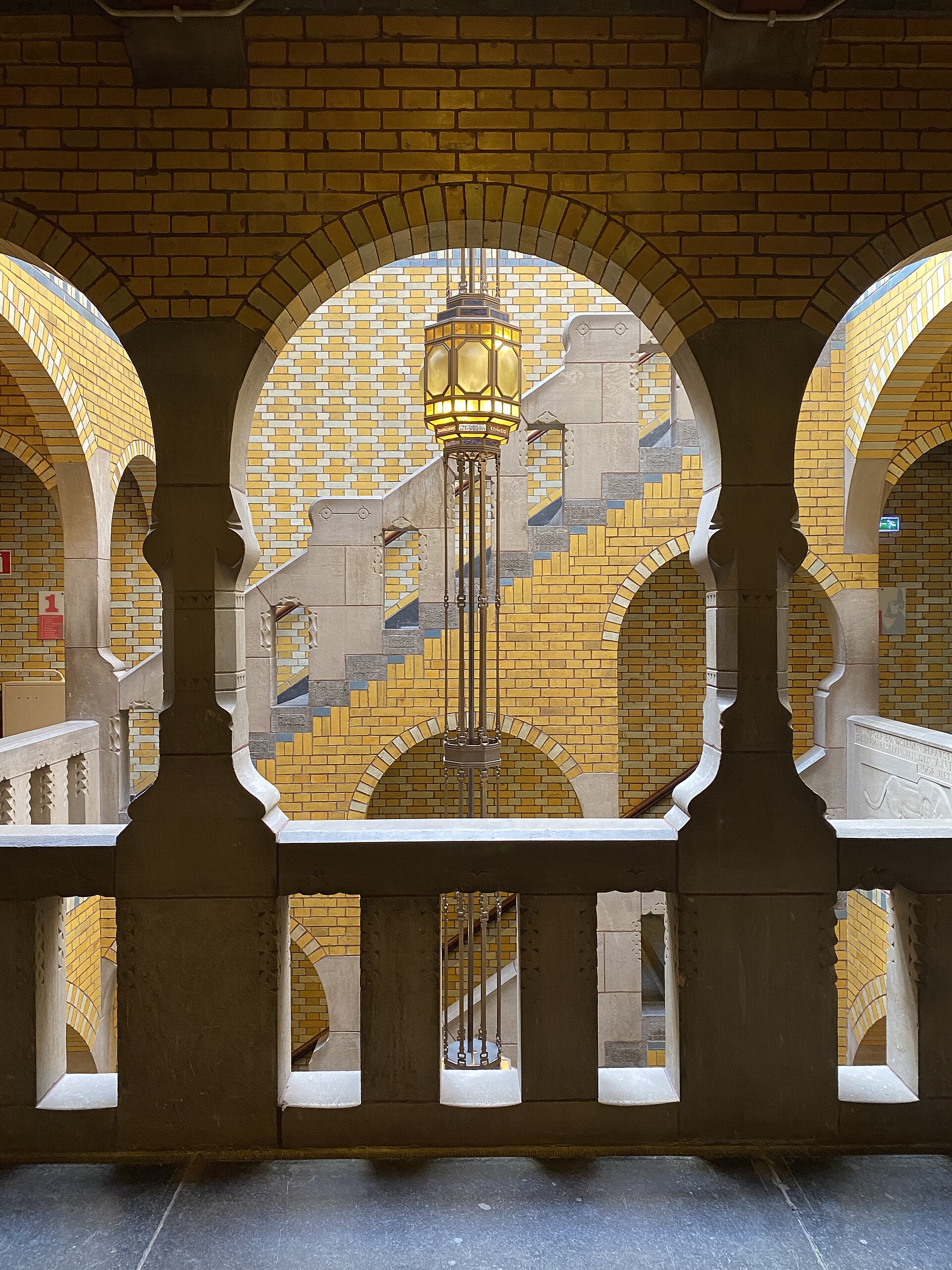
On Henri Polaklaan in Amsterdam's Plantage neighbourhood stands a building that looks nothing like its neighbours. Where the surrounding houses are modest brick townhouses, here a structure rises that looks more like an Italian city palace than a Dutch office: a square tower, natural-stone battlements, a rotating lantern shaped like a diamond. Amsterdammers nicknamed it 'the Castle' (de Burcht) from the moment it opened, and the name has stuck ever since. The building was the headquarters of a diamond workers' union, designed by the most famous architect in the Netherlands, and it tells the story of workers who refused to accept their lot — and built themselves a castle to prove it.
A castle in the middle of the Plantage
De Burcht stands at Henri Polaklaan 9, then called Plantage Franschelaan, in a nineteenth-century district originally laid out for the well-to-do, complete with parks, a zoo and stately villas. That a workers' union headquarters rose precisely here, among the parks and canal houses, was a statement in itself. According to several sources, including the architectural overview on Architectuur.org and the website of current owner Hendrick de Keyser, the building was constructed between 1899 and 1900, designed by Hendrik Petrus Berlage (1856–1934), the architect who would later build the Beurs van Berlage on the Damrak and who is considered the founder of modern Dutch architecture.
The client was the Algemeene Nederlandsche Diamantbewerkersbond (ANDB), a union founded in 1894 after a large and fierce strike in Amsterdam's diamond industry. Diamond processing was at the time one of the city's most important trades, employing thousands, many of them Jewish Amsterdammers from the old Jewish quarter and the Plantage itself. The ANDB grew into one of the most powerful and best-organised unions in the country, with its own strike fund, compulsory dues and paid officials — at a time when that was anything but standard for a workers' union.
The ANDB stood out not only for its strike fund but also for tangible results for its members: the union negotiated shorter working days, sick pay and its own pension scheme, at a time when such provisions were still entirely absent in most other trades. That combination of hard-won working conditions and social provisions made the ANDB a model other Dutch unions looked to in the early twentieth century, and it reinforced the self-confidence with which the union eventually dared to put up such an imposing building of its own.
Henri Polak and a union that refused to be dismissed
The driving force behind the ANDB was Henri Polak (1868–1943), co-founder in 1894 and chairman of the union from 1894 to 1940. Besides being a union leader, Polak was also a city councillor, a senator, and one of Amsterdam's first social-democratic politicians. His idea of what a union should be went beyond wages and working conditions: he wanted diamond workers to have access to art, education and culture, things until then largely reserved for the well-off. The union set up its own library, organised courses and excursions, and had members sing in its own choir.
According to the Dutch Wikipedia page on Polak, construction of the union's own building could only begin in 1899, about five years after its founding, once the ANDB's finances were strong enough: by then the union had built up a healthy strike fund and a stable membership contribution. A union that could afford to build its own palace was, at the time, an unprecedented statement of power and self-confidence — and that was exactly the point.
Berlage designs a fortress for workers
That Polak turned to Berlage for the design was no coincidence. Berlage was already known as an architect with social ideals, someone who believed architecture could elevate society. According to the overview on Architectuur.org, the design process was not entirely smooth: an initial plan with one large hall was rejected on fire-safety grounds, after which Berlage adapted the design into a version with two smaller halls, which did receive a building permit.
The result was a building Berlage deliberately designed as a Gesamtkunstwerk — a total work of art in which architecture, visual art and symbolism come together. The brick façade is built up of four strips of three windows each, with the windows varying in height per floor. The entrance is marked by a square tower, crowned with natural-stone battlements that give the building its castle-like, almost medieval appearance — hence the nickname 'de Burcht'. The tower holds a striking detail: a lantern shaped like a diamond, a nod to the members' trade, which Berlage designed so that it can rotate.
Experts describe the style as inspired by Italian Renaissance palaces, which reinforces the association with a fortress or castle: massive, almost fortress-like brick surfaces rather than the ornate decoration common in other nineteenth-century buildings. With this, Berlage deliberately broke with the exuberant decorative styles of his time in favour of a sober, almost monumental restraint — an architectural language he would later develop further in the Beurs van Berlage.
Around 1912 the ANDB made plans to expand the building and bought four adjoining properties for that purpose. As far as the available sources indicate, that expansion was never fully carried out; passageways to the neighbouring houses were added, but no large-scale new construction followed.
That De Burcht gained such a striking silhouette but was never expanded to the scale once envisioned says something about the building's later history: at its core, it has always remained the compact union building of 1900, even as the ANDB's own ambitions kept growing.
Art, education and union life within the walls
Inside De Burcht it was not just about meeting rooms and offices. The union council chamber was decorated with murals by the artist Richard Roland Holst (1868–1938), one of the most important Dutch monumental painters of his generation and, not coincidentally, brother-in-law of the poet Henriëtte Roland Holst, who herself was closely involved in the early socialist movement. The murals fit the ambition of Polak and the ANDB to emancipate workers not only economically but also culturally: De Burcht was not meant to feel like a bare office building, but like a place the diamond workers could be proud of.
That ambition must be seen against the backdrop of the precarious position of the diamond industry itself. The sector depended heavily on the supply of rough diamonds from, among other places, South Africa, and was subject to sharp economic swings, with periods of severe unemployment. A strong union with a strike fund and social provisions gave members a safety net that was still entirely absent in many other trades.
War, occupation and the end of the ANDB
The history of De Burcht is inseparable from the persecution of Amsterdam's Jewish residents during the Second World War. A large share of the diamond workers and ANDB members were Jewish, as were many residents of the Plantage neighbourhood around the building. According to information on dutchjewry.org, the German occupier dissolved the ANDB in 1941; in its place came the Bedrijfsgroep Fijne Metalen en Diamant, an organisation controlled by the occupying authorities. Many diamond workers were deported and never returned.
After the war, attempts were made to revive the ANDB's union tradition, but the diamond industry itself had been decimated by the war and the Holocaust: much of the craftsmanship and trade knowledge had disappeared along with the murdered and displaced workers. According to the analysis on Heriland.eu, too few diamond workers returned after the war for the old union to be revived in its former shape, and the organisation gradually shrank. Eventually the diamond workers' union merged into broader metalworkers' unions, and through a series of mergers the ANDB's legacy ended up with what would eventually become the FNV — though the precise merger history remains only briefly described in the consulted sources and could not be verified in detail.
From union office to museum
The building itself remained in the hands of the labour movement after the war. According to the overview on Architectuur.org, it has housed a scientific bureau for the labour movement, and De Burcht was also used for conferences. In 1991, according to the analysis on Heriland.eu, part of the building was turned into a trade union museum intended to give the public insight into the history of the Dutch labour movement and the ANDB in particular. For years, visitors could walk through the union council chamber, view the Roland Holst murals, and learn more about Henri Polak and the diamond workers.
In 2000 and the years after, new restorations followed, during which the Roland Holst murals were made visible again after earlier renovations had hidden them from view. A larger restoration followed between 2008 and 2010, after Hendrick de Keyser Monumenten became the owner of the building in 2007. During that restoration, according to Hendrick de Keyser's website, five painted medallions were discovered in the stairwell that had previously been unknown or not visible.
A national monument with limited access
According to Architectuur.org, De Burcht holds the status of rijksmonument (national heritage monument). Yet despite that status and the thorough restoration, the building is today not freely accessible to the public. Since the takeover by Hendrick de Keyser, the property has mainly been rented out as a meeting and events venue, and according to the owner's own website, tours or special open days are only offered occasionally; current dates for these are, according to the same source, announced on a case-by-case basis.
That development has also drawn criticism. An analysis on the heritage-policy platform Heriland points to a tension between the building's original identity — a social-democratic union building, built for and by the workers' community — and its current function as a commercial, largely closed meeting venue. According to that analysis, the owner defends the choice by arguing that the fragile, expensively restored interior cannot withstand intensive public use, and that rental income is needed to fund its upkeep. The author of the piece counters that this runs against a broader trend in heritage conservation, which increasingly emphasises public accessibility and community involvement with monuments. As far as could be verified, both positions trace back solely to that one source and could not be independently confirmed by a second party.
In this, De Burcht is not alone: in Amsterdam and the rest of the Netherlands, other early twentieth-century monuments face the same tension between preservation and use. For a building that was once so emphatically built for and by a community, however, that tension stands out all the more. De Burcht is therefore not only a monument to the history of Amsterdam's diamond industry and the early labour movement, but also, unintentionally, a case study in the ongoing debate over who gets access to restored heritage.
Anyone walking along Henri Polaklaan today sees a building that, at first glance, gives few of its secrets away: the crenellated façade, the diamond-shaped tower lantern, the closed shutters. But anyone who knows what they are looking at sees one of the clearest traces the Amsterdam labour movement left in stone — a castle that diamond workers gave themselves, designed by the country's leading architect, at the moment they first felt they truly mattered.
Sources
This story draws on, among others, the architectural overview on Architectuur.org about the Vakbondsgebouw De Burcht, the page by owner Hendrick de Keyser Monumenten (hendrickdekeyser.nl) on De Burcht, the Dutch Wikipedia page on Henri Polak, the project page on dutchjewry.org about the Algemeene Nederlandsche Diamantbewerkersbond, and the analysis 'The Burcht van Berlage: contradictions in hidden heritage' on Heriland.eu. Facts about the construction year, architect and client are consistent across several of these sources. The precise post-war merger history of the ANDB and the exact number of annual tours are less well documented and could not be confirmed by a second independent source; this is explicitly noted in the text. No freely usable, licence-verifiable photograph of De Burcht on Wikimedia Commons could be consulted for this story, so, as an exception, an Amsterdammers.love illustration was used instead of a Commons photo.
Nieuwsbrief
Krijg een unieke kijk van en over Amsterdam in je mailbox
De laatste verhalen, en af en toe een verrassing uit het archief.
Comments (0)
Log in to leave a comment.
More stories about Amsterdam
All stories →
The February Strike of 1941: the day all of Amsterdam went on strike against the persecution of Jews
Redactie Amsterdammers.love · 12 min read
Jacob Hooy & Co: the Amsterdam drugstore that has kept the same address for three centuries
Redactie Amsterdammers.love · 12 min read
Samuel Sarphati (1813–1866): the doctor who wanted to rebuild Amsterdam
Redactie Amsterdammers.love · 12 min read
The 1928 Olympic Games: how Amsterdam invented the eternal flame
Redactie Amsterdammers.love · 11 min read
Theater Tuschinski: the cinema a Polish immigrant built, and that outlived him
Redactie Amsterdammers.love · 12 min read
The Dam shooting of 7 May 1945: the massacre on the day Amsterdam already felt liberated
Redactie Amsterdammers.love · 11 min read