Event · week 46
The February Strike of 1941: the day all of Amsterdam went on strike against the persecution of Jews
On 25 and 26 February 1941, just nine months after the German invasion, tens of thousands of Amsterdammers stopped work. Trams halted, the docks fell silent, and shops and offices closed. Not over wages, but out of anger at the raid in which the German occupier had seized and deported about four hundred Jewish men days earlier. It became the only mass, open strike against the persecution of Jews to take place anywhere in Nazi-occupied Europe. The occupier struck back hard, and for some of those involved, the consequences were fatal.
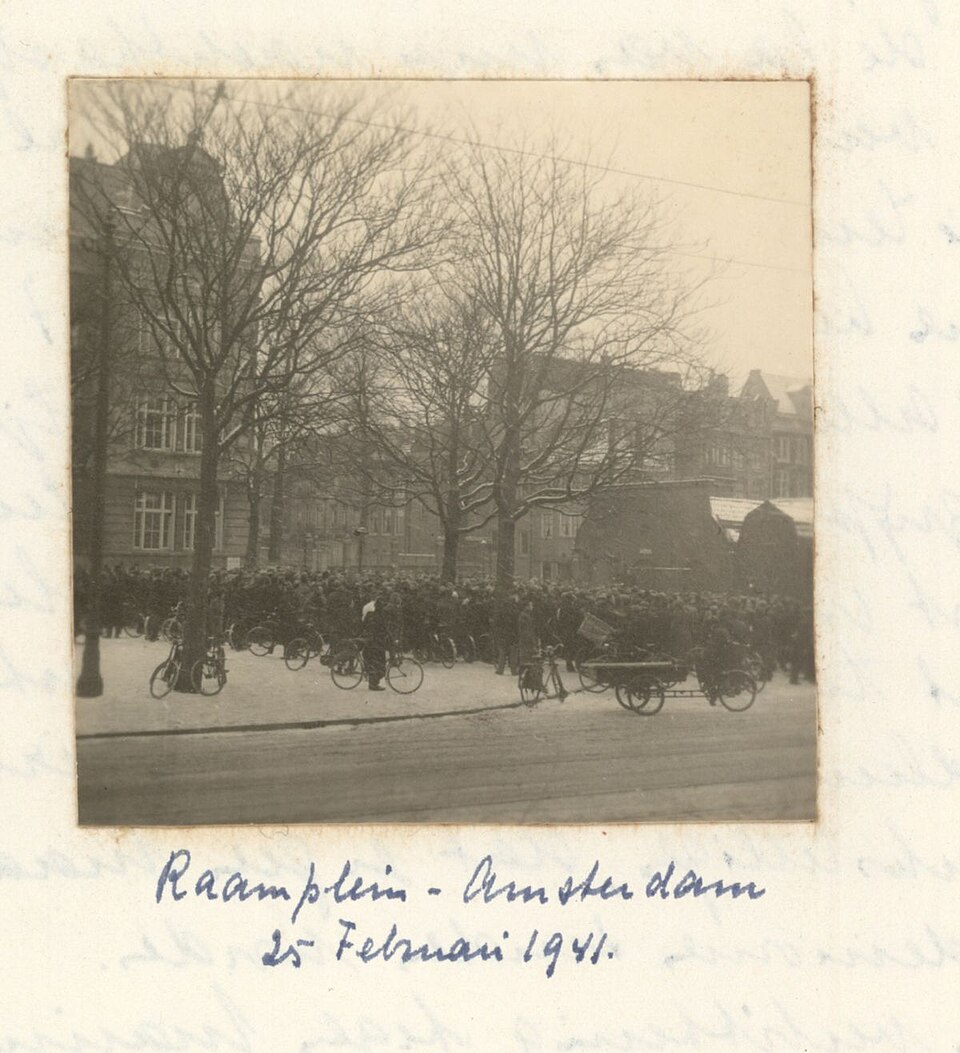
A city under occupation
It is February 1941. The Netherlands has by then been occupied by Germany for only nine months. Since the capitulation of May 1940, measures against Jewish Dutch citizens have steadily escalated. In October 1940, all civil servants are required to fill in a form declaring whether they are of 'pure Aryan' blood. In November 1940, Jewish professors and civil servants are removed from office, which in Leiden leads to a famous protest speech by law professor Rudolph Cleveringa and a student strike.
Amsterdam, home to the largest Jewish population in the Netherlands, feels the pressure most acutely. In the working-class neighbourhood around the Waterlooplein and the Jodenbreestraat, known to Amsterdammers as the Jodenbuurt (Jewish quarter), tens of thousands of Jewish Amsterdammers live at this time, alongside and among non-Jewish neighbours. It is a poor, densely populated area with its own character: market stalls, small workshops, and a long tradition of solidarity among residents, whatever their background.
The WA looks for a fight
In the winter of 1940–41, members of the Weerbaarheidsafdeling (WA), the paramilitary wing of the Dutch Nazi party NSB, regularly move through the Jodenbuurt. They humiliate residents, pick fights and steal belongings. For many Jewish Amsterdammers, this is not the first provocation, but the harassment grows grimmer and more violent. Fighting squads (knokploegen) form in the neighbourhood: groups of Jewish and non-Jewish Amsterdammers, including some from the Jordaan and the Oostelijke Eilanden, who forcibly drive off WA men whenever they enter the area.
On 9 February 1941, things get out of hand for the first time. NSB members and German soldiers attack the café-cabaret Alcazar on the Thorbeckeplein, where Jewish performers are on stage. Twenty-three people are injured. Two days later, on 11 February, a group of WA men marches toward the Waterlooplein to attack Jewish residents there. A fighting squad intervenes. In the brawl that follows, WA member Hendrik Koot is seriously injured. He dies on 14 February in the Binnengasthuis hospital.
A death used as propaganda
The NSB immediately turns Koot's death into a political weapon. Its own press suggests he was murdered by a furious Jewish mob, a version of events that does not match what the police established at the time. On 17 February, Koot is buried at Zorgvlied cemetery, a funeral the NSB uses as a propagandistic show of force.
The German occupier seizes on the unrest to tighten its grip further. On 12 February, Hans Böhmcker, the representative of Reich Commissioner Arthur Seyss-Inquart in Amsterdam, seals off the Jodenbuurt. He orders the creation of a Jewish Council (Joodse Raad), intended to act as an intermediary between the occupier and the Jewish population — a body the Germans will use in the years that follow to tighten their grip on the Jewish community.
Ice-cream parlour Koco and the ammonia
On 19 February 1941, another incident takes place, this time on the Van Woustraat in Amsterdam-Zuid. There stands the Koco ice-cream parlour, named after its owners Ernst Cahn and Alfred Kohn, both Jewish refugees from Germany. A patrol of the German Grüne Polizei tries to force its way in. A fighting squad present resists and sprays the officers with an ammonia installation set up for exactly this kind of situation.
Several German officers are injured. Six people are arrested and mistreated. The next day, Hanns Albin Rauter, the highest-ranking SS and police chief in the Netherlands, reports the 'Koco affair' to Heinrich Himmler in Berlin. For the German authorities, this becomes the pretext for a harsh crackdown in Amsterdam — with consequences that will shock the city within the same week.
The raid of 22 and 23 February
On 22 and 23 February 1941, the occupier, under the command of Friedrich Knolle, carries out a large raid in the Jodenbuurt. An estimated four hundred Jewish men between the ages of 20 and 35 are seized in the street and taken from their homes, officially as reprisal for the Koco affair. Exact figures vary by source: some publications put the number at 389, others at 400, and others at more than 420. They are taken to Kamp Schoorl and subsequently deported to the Buchenwald and Mauthausen concentration camps.
According to several sources, only two men from this group survived the war: Gerrit Blom and Max Nebig. On Sunday 23 February, the raid draws many onlookers. Amsterdammers who happen to be at the Sunday market see with their own eyes how their Jewish neighbours are led away. The Dutch police had not been informed of the operation beforehand and were not involved in it either.
The gathering at the Noordermarkt
The scenes of the raid leave a deep impression, including on non-Jewish Amsterdammers. Among them is paviour Willem Kraan, who witnesses the arrests on 23 February. Together with his friend Piet Nak, both active in the banned Communist Party of the Netherlands (CPN), he decides something must be done. The party agrees to the proposal to call a strike.
On 24 February, around four hundred resistance figures gather in the open air at the Noordermarkt. There, the decision to strike is formally announced. The CPN has the pamphlet 'Staakt!!! Staakt!!! Staakt!!!' ('Strike!!! Strike!!! Strike!!!') printed and distributed, an illegal call that appears across the city in the days that follow — at a time when distributing such a text is extremely dangerous.
25 February: the city grinds to a halt
On Tuesday 25 February 1941, the strike breaks out, earlier and more broadly than the organisers themselves had expected. Tram drivers are the first to stop work, followed by other municipal services. Staff at the De Bijenkorf department store and various schools soon join in. By midday the strike is general in Amsterdam: the docks lie idle, shops and offices close, and civil servants leave their desks.
The strike does not stay confined to Amsterdam. On the very first day it spreads to Zaandam, Haarlem, Velsen, Hilversum, Bussum, Weesp, Muiden and Utrecht. In Hilversum, Henk Meerbeek calls on the roughly four thousand workers at Philips to down tools. According to various historical accounts, tens of thousands take part at the peak of the action in the Amsterdam region, and possibly as many as around three hundred thousand if the wider region is included — there is no exact, independently verified total.
The occupier strikes back hard
On 26 February, the actions spread further still. In Hilversum, a march of an estimated several thousand to ten thousand participants — this figure, too, cannot be established with certainty — heads toward the new town hall, where soldiers block the march. By now the German authorities are responding with violence. A curfew is declared, and additional police units and two regiments of the SS Totenkopf are sent to Amsterdam.
The occupier crushes the strike within two days, using heavy force. Nine people are killed and 24 others are seriously wounded, alongside countless arrests. By 27 February, most strikers are back at work, partly out of fear of further reprisals, and partly because the CPN itself had called for an action lasting no more than two days.
Fines, and a mayor forced out
The aftermath of the strike is severe. Amsterdam is handed a collective fine of 15 million guilders, Zaandam half a million, and Hilversum 2.5 million — sums that would be many times higher in today's money. Mayor Willem de Vlugt is forced by the occupier to step down. Civil servants who had taken part in the strike are dismissed on a large scale.
For the German authorities, the strike is an unwelcome signal: for the first time in occupied Europe, ordinary citizens dare to rise up, en masse and openly, against the persecution of Jews. For this reason, historians often call the February Strike the only large-scale, open strike action against the persecution of Jews to take place anywhere in occupied Europe.
Ernst Cahn before the firing squad
The consequences of the Koco affair that preceded the strike continue to haunt those involved for weeks afterward. Ernst Cahn, one of the two owners of the Koco ice-cream parlour, is executed by a German firing squad on 3 March 1941 at the Waalsdorpervlakte near Scheveningen. According to several sources, this makes him the first civilian executed by firing squad in the Netherlands during the Second World War. His business partner Alfred Kohn later dies in a concentration camp.
A second strike that never happens
In the weeks after the strike, the occupier focuses above all on the CPN, in an effort to prevent a second action planned for 6 March 1941. On 5 March, 23-year-old Leendert Schijveschuurder is arrested while putting up posters calling for this new strike. He is shot the following day. Because of the swift arrests, the planned follow-up strike never gets off the ground.
On 13 March 1941, more Dutch citizens are executed at the Waalsdorpervlakte: Hermanus Coenradi, Joseph Eijl and Eduard Hellendoorn, along with fifteen members of the resistance group De Geuzen. Twenty-two communists are sentenced to ten years' hard labour in Germany. Two of them, Adrianus van Waert and Joseph Jacques van Weezel, do not survive their sentence: Van Waert dies on 9 June 1942 in Rheinbach, Van Weezel on 23 April 1945 in Dachau, only days before that camp's liberation.
The fate of the men who started it
Willem Kraan, the paviour who, together with Piet Nak, set the strike in motion, is arrested on 16 November 1941 for his role in it. In the summer of 1942 he is sentenced to death. On 19 November 1942, he is shot at Soesterberg airfield, aged 33. In a farewell letter to his wife Bets and daughter Catrientje, he writes that he is no traitor. After his death, his wife and daughter live for years in deep poverty.
After his arrest, Piet Nak is severely beaten, but the Germans never discover that he had been one of the strike's leaders, and he is released. He survives the war. In 1966, both Kraan (posthumously) and Nak receive the Yad Vashem honour Righteous Among the Nations, for their efforts on behalf of the Jewish population.
A poem for the eighteen dead
The executions at the Waalsdorpervlakte in March 1941 inspire writer and journalist Jan Campert to write the poem 'Het Lied der Achttien Dooden' ('The Song of the Eighteen Dead'). The poem, which imagines the final thoughts of a resistance fighter before his execution, becomes after the war one of the best-known Dutch poems about the resistance. Campert himself dies in 1943 in the Neuengamme concentration camp, after being arrested for helping people in hiding.
De Dokwerker
After the war, the February Strike is given a permanent memorial. The city of Amsterdam commissions sculptor Mari Andriessen to create a statue: a muscular, resolute man with a clenched fist. In December 1952 the statue, De Dokwerker (The Dockworker), is unveiled by Queen Juliana. At the time it stands on the Waterlooplein, on the spot where the first clashes between the WA and the fighting squads took place in February 1941.
In 1970 the statue is moved to the Jonas Daniël Meijerplein, at the edge of the former Jodenbuurt and close to the Portuguese Synagogue. Since then, that square, with De Dokwerker at its centre, has been the fixed site of the annual commemoration on 25 February.
A commemoration that stayed divided for a long time
That commemoration has its own layered history. The strike has been commemorated every year since 1946, but the communist organisers were for a long time excluded from, or kept at a distance from, the official Amsterdam commemoration — a reflection of the Cold War, during which many official bodies preferred not to acknowledge the CPN's role in the resistance. As a result, the communists held their own, separate ceremony for years.
It was not until 1968 that the two commemorations were merged, on the initiative of, among others, Harry Verheij and the future mayor Ed van Thijn. Since then, former strikers, their families, trade unions, political parties and Jewish organisations have stood together at De Dokwerker. In Zaandam too, at the monument 'Staakt, staakt, staakt' near the Wilhelminabrug, a commemoration has taken place every 26 February since 1946. In Hilversum, the first post-war commemoration did not take place until 2014, at the old town hall.
What remained
The February Strike did not achieve its immediate goal: the deportations and persecution of Jewish Dutch citizens continued unabated, and would only escalate further in the years that followed. Even so, historians regard the strike as a significant moment. It was the first large, open act of resistance against the Nazi occupier in Europe, and to this day the only time an entire city stopped work en masse specifically in protest against the persecution of Jews.
Today, De Dokwerker still stands on the Jonas Daniël Meijerplein, fist raised. Around the square lie the Portuguese Synagogue, the Jewish Historical Museum, and the outlines of what was once the Jodenbuurt. Anyone walking past on an ordinary day sees cyclists, tourists and residents. But every year on 25 February, as it has for almost eight decades, a city gathers there to remember that ordinary people — tram drivers, dock workers, shop staff, schoolchildren — chose in 1941 not to look away.
Sources
Dutch Wikipedia (Februaristaking), the International Institute of Social History / IISG (80 jaar Februaristaking), accounts drawn via the National WWII Museum (The Amsterdam General Strike of February 1941), the Jewish Monument (February Strike), DutchNews.nl (75 years ago Amsterdammers went on strike to support the Jews; I die for my ideals), NOS (Staken uit protest tegen Duitse bezetter kostte Willem Kraan zijn leven), TracesOfWar (Monument De Dokwerker; biography of Piet Nak), and the Yad Vashem Righteous Among the Nations database. Exact figures — participants in the strike, Jewish men arrested in the raid of 22–23 February — vary by source; this story uses the most widely supported estimates and notes where sources diverge.
Nieuwsbrief
Krijg een unieke kijk van en over Amsterdam in je mailbox
De laatste verhalen, en af en toe een verrassing uit het archief.
Comments (0)
Log in to leave a comment.
More stories about Amsterdam
All stories →
Jacob Hooy & Co: the Amsterdam drugstore that has kept the same address for three centuries
Redactie Amsterdammers.love · 12 min read
Samuel Sarphati (1813–1866): the doctor who wanted to rebuild Amsterdam
Redactie Amsterdammers.love · 12 min read
Theater Tuschinski: the cinema a Polish immigrant built, and that outlived him
Redactie Amsterdammers.love · 12 min read
The 1928 Olympic Games: how Amsterdam invented the eternal flame
Redactie Amsterdammers.love · 11 min read
The Dam shooting of 7 May 1945: the massacre on the day Amsterdam already felt liberated
Redactie Amsterdammers.love · 11 min read
Wynand Fockink: the tiny Amsterdam liqueur house that has poured jenever for over three centuries
Redactie Amsterdammers.love · 10 min read